MY SON’S DNA TEST SAID I WASN’T HIS FATHER—THEN THE COUNSELOR TOLD ME TO TEST MY WIFE
The envelope was still open when my wife walked into the kitchen.
“What is that?” Rachel asked.
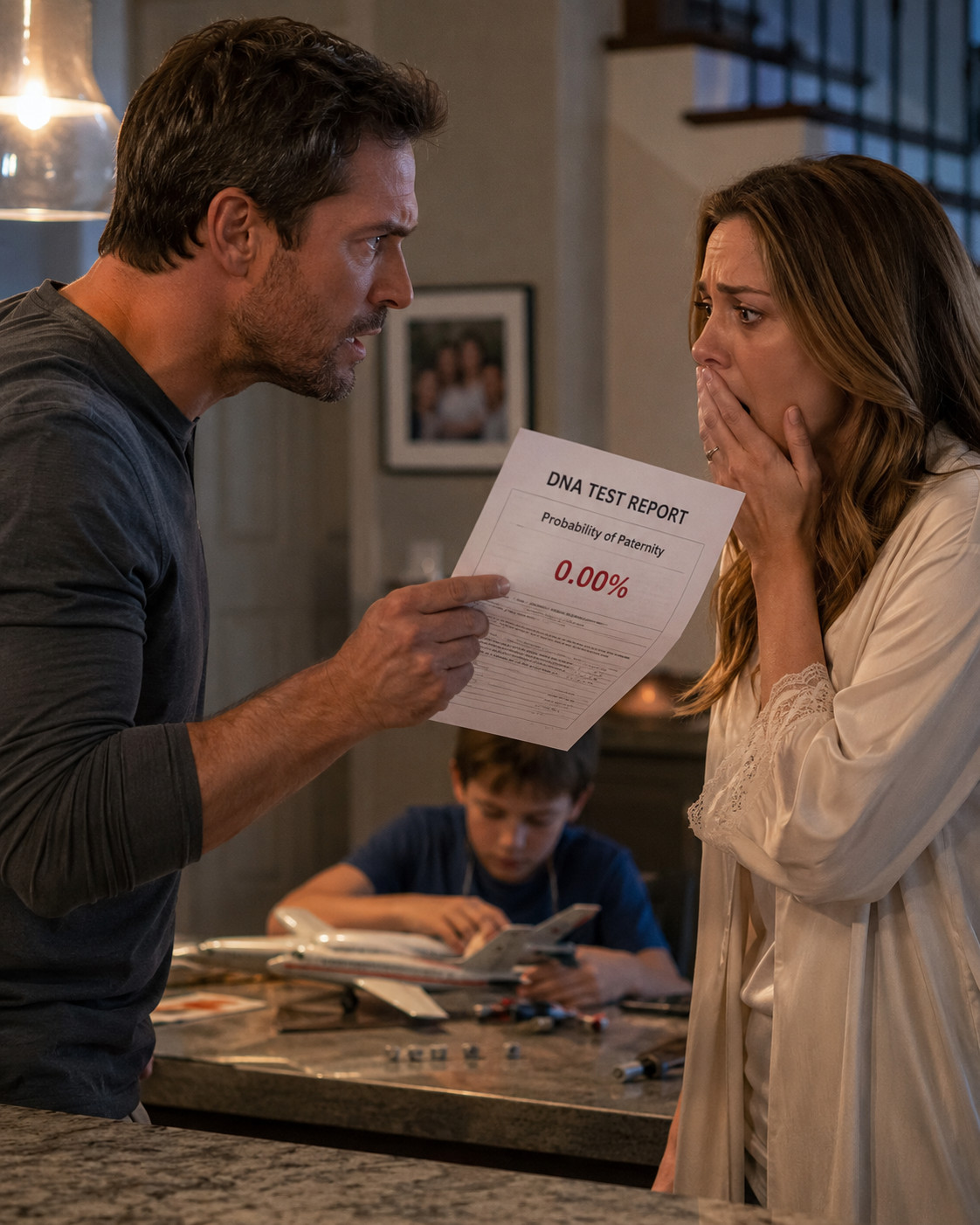
I pushed the paper toward her.
“A DNA test. Noah isn’t my son.”
Her face went pale.
Our ten-year-old boy was upstairs building a model airplane. The child I had taught to ride a bike. The child who called me whenever he had a nightmare.
The report said the probability of paternity was 0.00%.
Rachel stared at me.
“I never betrayed you,” she whispered.
“Then explain this.”
“I can’t.”
Her answer felt worse than a confession.
Noah had been conceived after years of fertility treatments. Rachel always said he was our miracle. Now I wondered whether she had known the truth from the beginning.
I packed a bag and drove to a family counselor named Dr. Elaine Parker.
She listened without interrupting as I described the test, Rachel’s denial, and the anger I felt every time Noah called me Dad.
When I finished, she studied the report.
“Do you still have records from the fertility clinic?” she asked.
“Yes.”
She leaned forward.
Then she said four words that changed everything.
“Test your wife too.”
I almost laughed.
“What would that prove?”
Dr. Parker’s expression remained serious.
“Perhaps the betrayal didn’t happen inside your marriage.”
Two days later, Rachel and I submitted new samples.
When the results arrived, we opened them together.
I wasn’t Noah’s biological father.
But Rachel wasn’t his biological mother either.
👇👇 Part 2 in the comments 👇👇
PART 2
For several minutes, neither of us spoke.
Rachel read the report again and again.
“That’s impossible,” she whispered. “I carried him. I gave birth to him.”
I looked toward the staircase.
Noah was still upstairs. He had no idea that two pieces of paper had just turned our family upside down.
Rachel grabbed her phone.
“I’m calling the clinic.”
The fertility center had changed ownership years earlier, but some of the original records were still stored in an archive.
The receptionist promised to contact the records department.
Three days passed.
Rachel barely slept. I stopped going to work. We moved through the house like strangers, speaking quietly so Noah would not hear us.
He noticed anyway.
“Are you and Mom getting divorced?” he asked me one evening.
I sat beside him on the couch.
“No.”
It was the first answer I had given with complete certainty.
Whatever had happened, Rachel had not lied to me. Noah had not deceived anyone. We were all trapped inside someone else’s mistake.
The clinic finally called.
A legal representative asked us to come in immediately.
We sat in a conference room across from a woman named Ms. Dalton. Beside her were two attorneys and a large cardboard file box.
She opened Noah’s original treatment records.
“Your embryo transfer occurred on March 14,” she said. “Three patients had procedures that morning.”
Rachel gripped my hand.
Ms. Dalton continued.
“One patient’s file contains a handwritten correction. The identification number on an embryo container was changed after a technician noticed that two labels had been printed incorrectly.”
“What are you saying?” I asked.
She took a breath.
“We believe the wrong embryo may have been transferred to your wife.”
Rachel began crying.
I felt as if the room had tilted.
“Where is our embryo?” she asked.
“We don’t know yet.”
The clinic contacted the other two families.
One refused to participate.
The second family agreed to testing.
They lived only two hours away.
Their names were Marcus and Dana Reed, and they had a ten-year-old daughter named Lily.
A week later, the results confirmed the truth.
Noah was biologically related to Marcus and Dana.
Lily was biologically related to Rachel and me.
Rachel collapsed against my shoulder when we heard.
Somewhere nearby, our biological daughter had been growing up with another family.
And another family’s biological son had been sleeping down the hall from us for ten years.
The Reeds agreed to meet.
We chose a quiet community center with a counselor present.
Marcus looked exhausted. Dana held a photograph of Lily but kept turning it facedown on the table.
“I don’t know what we’re supposed to do,” she said. “I love my daughter.”
“So do we,” Rachel replied. “And we love Noah.”
No one suggested exchanging the children.
The very idea felt cruel.
DNA could explain where they came from, but it could not erase ten birthdays, bedtime stories, scraped knees, school plays, and Christmas mornings.
We decided to introduce the children slowly.
At first, we told them the clinic had made a mistake before they were born and that our families had an unusual connection.
Noah stared at us.
“Are you still my parents?”
Rachel pulled him into her arms.
“Always.”
He looked at me.
“Even you?”
I remembered the first test. I remembered packing my bag because I thought biology had canceled everything we had shared.
I knelt in front of him.
“I became your dad the day I held you. No laboratory can change that.”
When we met Lily, I recognized Rachel’s smile immediately.
That hurt more than I expected.
But Lily ran back to Marcus when she felt nervous. He placed a protective hand on her shoulder, and I understood.
He was her father.
I was the man whose DNA she carried, but Marcus had raised her.
Over the next year, our families became part of each other’s lives.
The children learned the full truth with help from counselors. There were tears, confusion, and difficult questions.
There was also relief.
Neither child had to lose a family.
Instead, both gained one.
The clinic eventually admitted responsibility. An investigation found that an employee had noticed the labeling error but altered the paperwork to hide it. She feared losing her job and convinced herself that no one would ever discover the truth.
That single decision affected four parents and two children for a decade.
We reached a legal settlement, but the money never felt important.
What mattered was protecting Noah and Lily.
One evening, Noah and I finished the model airplane he had started on the day I confronted Rachel.
As we placed it on his shelf, he asked, “Do you wish the clinic had given you Lily instead?”
I chose my words carefully.
“I wish the mistake had never happened. But I could never wish for a life without you.”
He hugged me.
That was when I finally understood what Dr. Parker had been trying to show me.
The first DNA test told me who Noah was not.
It did not tell me who I was.
I was the man who stayed beside his hospital bed when he had pneumonia.
I was the man who taught him how to swim.
I was the voice he called for in the dark.
Biology revealed the mistake.
Love decided what happened next.