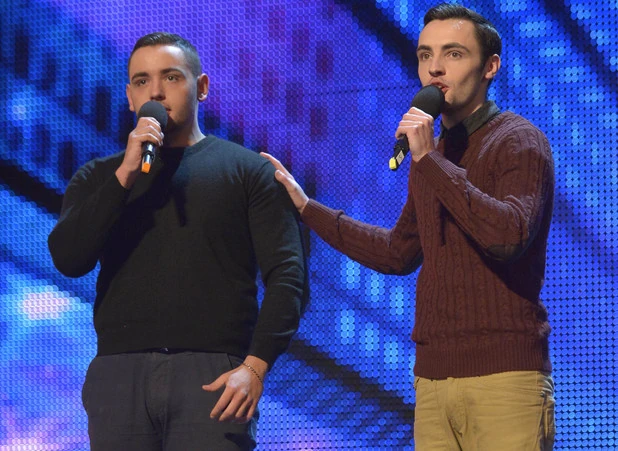
Richard and Adam, two brothers from a small town in North Wales, walked onto the Britain’s Got Talent stage with a comfortable camaraderie that immediately disarmed the room. At 22 and 19, they didn’t present themselves as polished showbiz types; instead they came across as ordinary lads with an extraordinary gift, the sort of humility that makes talent feel all the more genuine. In their brief chat with the hosts they talked about singing around the house and performing for their grandmother, who they described as their biggest fan. That image — of two boys harmonizing in the kitchen while their Nan sat nearby with a cuppa — landed with the audience, turning what might have been a standard audition into something intimate and familial.
They also shared, with a grin, that they worked in a sandwich shop — a detail that made them instantly relatable. The brothers joked about how they split the mundane tasks, one buttering the bread and the other adding the fillings, as if their days were a far cry from the grand theatrical life they were about to taste. Those offhand comments did more than amuse; they painted a picture of young men who knew the value of hard work and who had chosen to practice their craft alongside ordinary routines. The contrast between their day jobs and the soaring voices they were about to unveil made the moment feel like the start of a fairytale: behind the counter one moment, filling an arena the next.
When they began their classical rendition of “The Impossible Dream,” it quickly became clear why they had been quietly practicing together for years. Their harmonies were not simply two voices singing in unison, but a blending of timbres that created something larger than its parts. One brother would take a phrase with a clear, ringing tenor, and the other would counter with a resonant lower line, and together they produced an effect that filled the arena with an almost orchestral warmth. The arrangement they chose showcased both individual strength and a rare sense of unity: timing was immaculate, dynamics shifted naturally, and the emotional build of the song was handled with a maturity beyond their years.
Small, human details enriched the performance. As they sang, you could see them exchange subtle looks — not competitive, but supportive, the kind of unspoken communication that only siblings who have spent countless hours practicing together can achieve. Their Nan, waiting in the wings with Ant and Dec, beamed with pride; for her, the moment must have felt like the realization of countless afternoons listening to her grandsons harmonize around the kitchen table. In the crowd, audience members who moments earlier had been chatting fell silent, drawn in by the sheer beauty of the vocal blend. The judges leaned forward, eyes bright, as the brothers negotiated difficult intervals with surprising ease and a sense of phrasing that suggested careful attention to musical detail.
Alesha Dixon was quick to praise their “incredible” voices and the beautifully synchronized harmonies. Her compliment felt particularly resonant because it acknowledged not just technical ability but the aesthetic pleasure their sound produced. Simon Cowell, ever the pragmatist, added measured praise as well. He suggested they might benefit from some technical refinement — a nod to breath control here, diction there — but hastened to emphasize that such tweaks were secondary to what really mattered: their passion and authenticity. Simon compared their dedication to the “Olympic spirit,” a metaphor that captured both the discipline required to reach that level and the emotional uplift their performance provided. It was clear from his reaction that he recognized their potential not only as competitors but as artists with genuine appeal.
The unanimous four “yes” votes that followed felt inevitable. For the brothers, the decision was more than a step forward in a competition; it was a validation of years spent harmonizing in modest spaces, of evenings patched between shifts at the sandwich shop and practice sessions at home. Backstage, the relief and joy were palpable. Friends and family hugged, tears were discreetly wiped away, and their Nan’s grin seemed to stretch from ear to ear. What had started as a charming, low-key introduction had blossomed into a life-changing opportunity.
Their audition was a reminder of how classical crossover music can resonate when performed with sincerity. It showcased not only robust vocal talent but also the power of storytelling through performance: two brothers, rooted in everyday life, capturing a moment of beauty that transcended their humble origins. In an era when television talent shows often prioritize spectacle, Richard and Adam offered something refreshingly simple — the human voice, harmonized with love and practiced devotion. That authenticity is what transformed a standard audition into a memorable highlight, one that sent these sandwich shop workers onward toward a promising future and left the audience convinced they had witnessed the start of something special.