
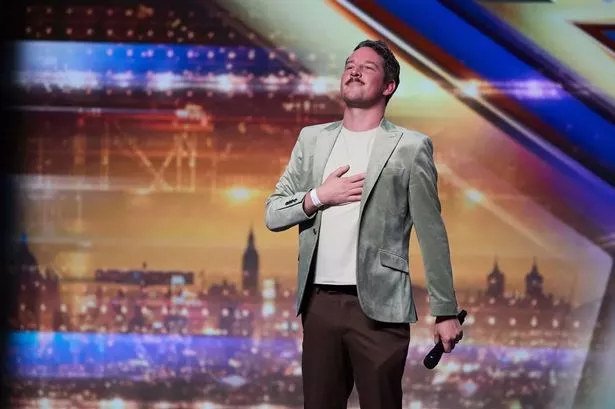
For 19 years, Max Fox had nursed the same quiet hope: to one day step onto a talent-show stage and finally be heard. He had rehearsed in front of bathroom mirrors, at family gatherings, and on Sunday afternoons in empty church halls. None of those practice runs, however, compared to the pulse-quickening moment he found himself in that night. Seated in the audience, just ten feet from the judges’ table, Max couldn’t bear the feeling of being so close and yet so unseen. He rose, breath steady but hands slightly shaking, and walked down the aisle toward the spotlight. When he reached the front row he turned to the judges and, in a voice that mixed nerves with stubborn resolve, asked if he could sing. For him, this wasn’t a gimmick or a staged stunt; it was the culmination of nearly two decades of trying.
At first, the room reacted the way rooms do when rules are bent: confusion, suspicion, the quick, reflexive assumption that someone was pulling a prank. The judges exchanged glances; crew members murmured into headsets. A producer squinted at Max as though calculating whether the moment could be accommodated. Some of the people nearby laughed nervously, convinced it was all part of the show’s choreography. But Max insisted, with a quiet, almost pleading honesty, that he was serious. He had no script, no rehearsed punchline—just a phone in his pocket with a backing track and a voice that wanted its chance.
Once the crew located the track on his phone—a small, unassuming file among countless apps—the atmosphere shifted from skepticism to curiosity. The lights were redirected, a mic was hurriedly handed over, and the stage crew found a place for him amid the sudden flurry of activity. What had started as a disruption slowly became a spontaneous experiment: could a single, determined singer turn a chaotic moment into something meaningful? As Max took his place under the lights, the audience quieted, perhaps out of courtesy, perhaps out of wonder. There was a hush that felt a lot like anticipation.
When the gentle intro of “My Way” began, it was impossible not to feel the weight of the moment. The song is an old standard for a reason—its melody carries decades of public memory—so to take it on is to invite comparison. But Max didn’t try to mimic anyone. He sang as if telling his own story, leaning into the phrasing as though each line were a chapter he had lived. His voice filled the auditorium with a steady, resonant clarity; where some singers push for effect, Max allowed the song to breathe. He accentuated a lyric here, softened a line there, and by the time he reached the chorus the crowd had gone still, caught up not just in the melody but in the narrative of a man who had waited a long time to be recognized.
There was a cinematic quality to the performance—an observation one judge later voiced—that made the room feel less like a studio and more like a scene from a film. Viewers described the way the camera lingered on his face, on the small, hopeful tremor in his hands, on the rows of faces leaning forward in rapt attention. People in the audience wiped their eyes; a couple of younger viewers covered their mouths in disbelief. The judges’ expressions moved from wary interest to visible emotion, the lines around their eyes softening as they absorbed what was unfolding.
When Max hit the song’s climactic passages, he did so with a blend of technical skill and hard-earned feeling. A held note near the end didn’t merely showcase what his voice could do—it felt like the sound of an old promise kept. Applause erupted when the final chord settled, but it was more than applause; it was recognition. From the judges’ table to the back rows of the auditorium, people rose to their feet, some with tears in their eyes. Max stood in the center of it all, mouth slightly open, taking in the noise as if trying to make sure it was real.
The moment that followed was one for the record books. One judge, who had already used the show’s coveted golden buzzer earlier in the season—a tool traditionally allowed only once per judge—rose from his chair, eyes wet and face alight with an emotion that overrode protocol. In a decision that shocked the producers and delighted viewers, he reached for the golden buzzer again and pressed it for Max. The room erupted into cheers; crew members exchanged stunned smiles; other judges hugged each other and laughed through their tears. The gesture sent Max straight to the semifinals, condensing nineteen years of trying into a single, life-changing instant.
For Max, the press of the golden buzzer wasn’t merely symbolic. It was validation—public, unapologetic proof that persistence matters and that a moment of bravery can break through skepticism and scripted television alike. For the audience and viewers at home, the episode served as a reminder that the most powerful performances often arrive unannounced, and that sometimes the person who appears least likely to take center stage is the one who will own it. Max’s story—his nearly two decades of quiet practice, his willingness to stand up and ask, and his reward—felt less like a carefully manufactured TV moment and more like an affirmation of what happens when courage meets opportunity.