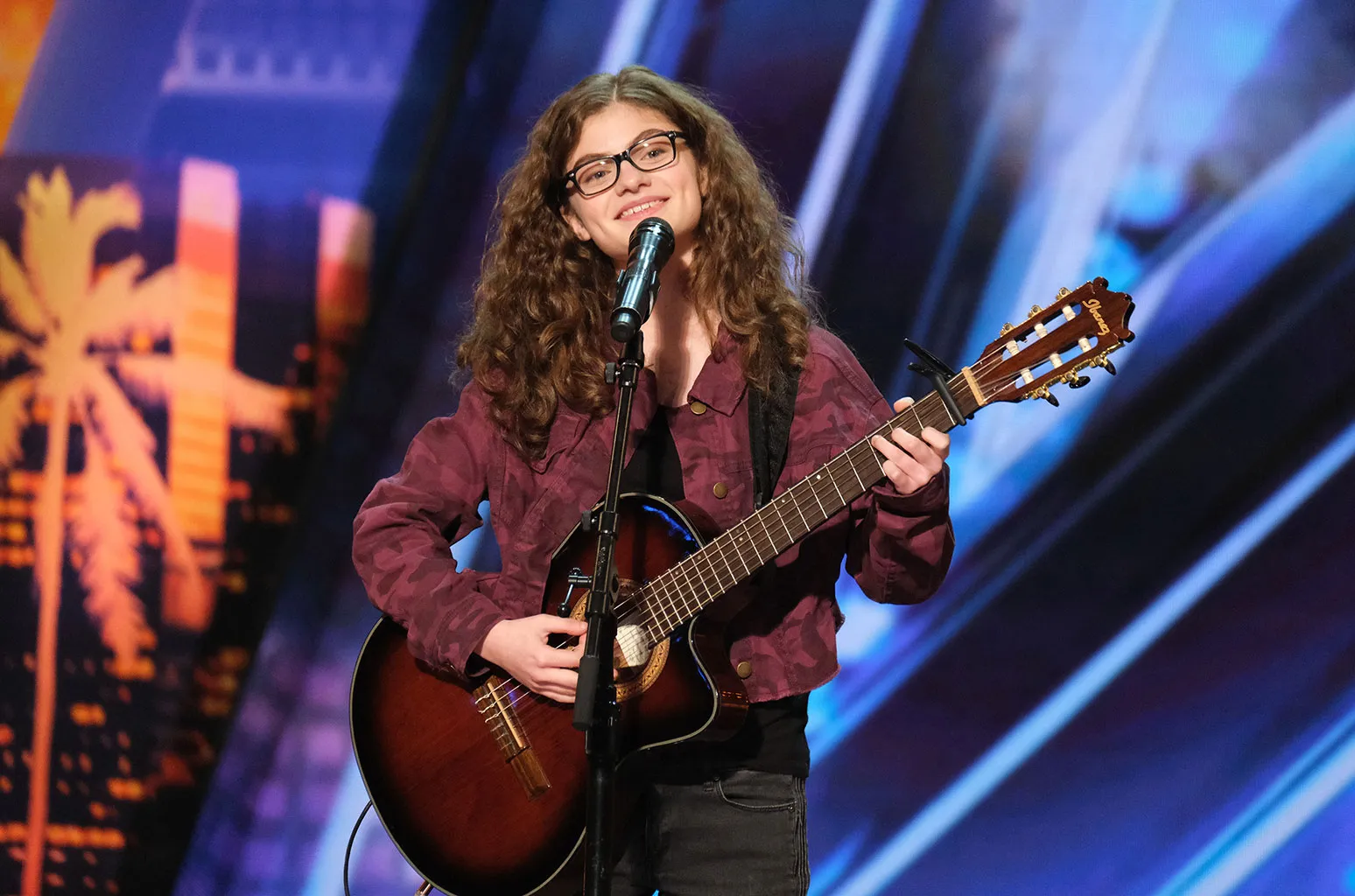
Sophie Pecora, a 15-year-old singer-songwriter, walked onto the America’s Got Talent stage carrying more than just a guitar — she carried a story that had shaped her adolescence. She told the audience plainly that she had been bullied in seventh grade, and the way she spoke about it made the room hush; this wasn’t a rehearsed anecdote for sympathy, but a memory that still lingered. There was a steadiness in her voice as she introduced the song she had written about those months: not bravado, but a quiet resolve to turn pain into something honest and find a way to reach others who might be carrying similar wounds.
As Sophie tuned her guitar, small gestures revealed the weight of what she was about to do. She glanced at the judges with a half-smile that suggested both nerves and determination, fingers hesitating briefly before settling into the first chord. You could see she had thought carefully about the song’s arrangement — it started simply, just her voice and guitar, which allowed the lyrics to sit front and center. That choice felt deliberate; by stripping back the instrumentation, she invited listeners into her inner world without distractions, as if whispering a secret that needed to be heard.
From the opening verse, it was clear this was not a generic pop piece but something drawn from lived experience. Sophie sang about days spent hiding feelings behind a practiced smile, about the loneliness that can follow you even into crowded hallways. She sang of retreating to the bathroom, a detail so specific it landed with a visceral punch: the fluorescent tiles, the muffled noise of the school outside, the brief sanctuary of privacy. Those concrete images made the lyrics relatable — anyone who has felt small or unseen could picture themselves in that cramped space, counting breaths until the bell rang.
What made the performance particularly affecting was the way Sophie navigated shifts between restraint and release. Many songwriters who tackle painful subjects default to either melodrama or numbed detachment; Sophie found a middle path. In verses she was intimate and understated, letting vulnerability breathe in quiet phrasing. Then in the chorus she allowed herself to open up — fuller tones, more sustained notes — as if finally stepping into the sunlight after hiding in a doorway. That dynamic mirrored the emotional arc of survival: the slow accumulation of hurt and the eventual decision to make it visible, to claim it as part of one’s story rather than let it define them in silence.
Her lyrics carried lines that felt autobiographical without being self-indulgent. She spoke of the ways bullying can rewrite your inner script — the creeping doubt, the second-guessing of every action — and how music became a countering voice. There were small, human moments woven into the song: the awkwardness of sitting alone at lunch, the double-take when a classmate passed by without recognition, the ache that follows a whispered insult. Those details grounded the song in reality and allowed empathy to grow naturally in the room.
Sophie’s delivery was honest rather than polished, which only added to its power. You could hear the vulnerability in slight breaks in her voice, the inhalations that punctuated certain lines, and the careful way she formed each phrase as if choosing words that mattered. When she reached the bridge — a moment where the lyrics turned from recounting pain to offering a message of resilience — there was a palpable shift. Her strumming grew more insistent, and her voice carried both the memory of hurt and the possibility of healing. It was a reminder that songwriting can be an act of alchemy: transforming the raw into something that can comfort others.
The judges and audience responded the way you hope they would in moments like this: with attention and then with emotion. You could see heads tilt, eyes narrow in concentration, and after the final chord rang out there was a hush that felt reverent. When applause arrived, it was spontaneous and warm, not the polite clapping reserved for competent performances but the kind granted to someone who had bared themselves in public and come through intact. Judges commented on her bravery, on how rare it is to see a young artist use original material in such a vulnerable way, and on the maturity in her songwriting.
Beyond the immediate impact, Sophie’s story resonated because it suggested a larger truth: personal struggles, while isolating, can also become a source of connection. By sharing specific details of her experience, she gave others language for their own pain and a model for how to use creative outlets to cope. Her decision to present an original song rather than a cover was significant; it said she didn’t just want to impress with vocal ability — she wanted to be heard as a person who had something to say.
When the judges ultimately gave Sophie four “yes” votes, it felt like recognition of both talent and testimony. The unanimous decision acknowledged her craft, her courage, and the way she had used vulnerability not as a plea but as a bridge. Walking offstage, Sophie carried with her more than advancement in a competition; she had offered a message of solidarity to anyone who had ever felt small in a big room. Her performance was a quiet, powerful reminder that sharing our stories can be a first step toward healing — and that music, for all its notes and rhythms, remains one of the most human ways we have of saying: you are not alone.