
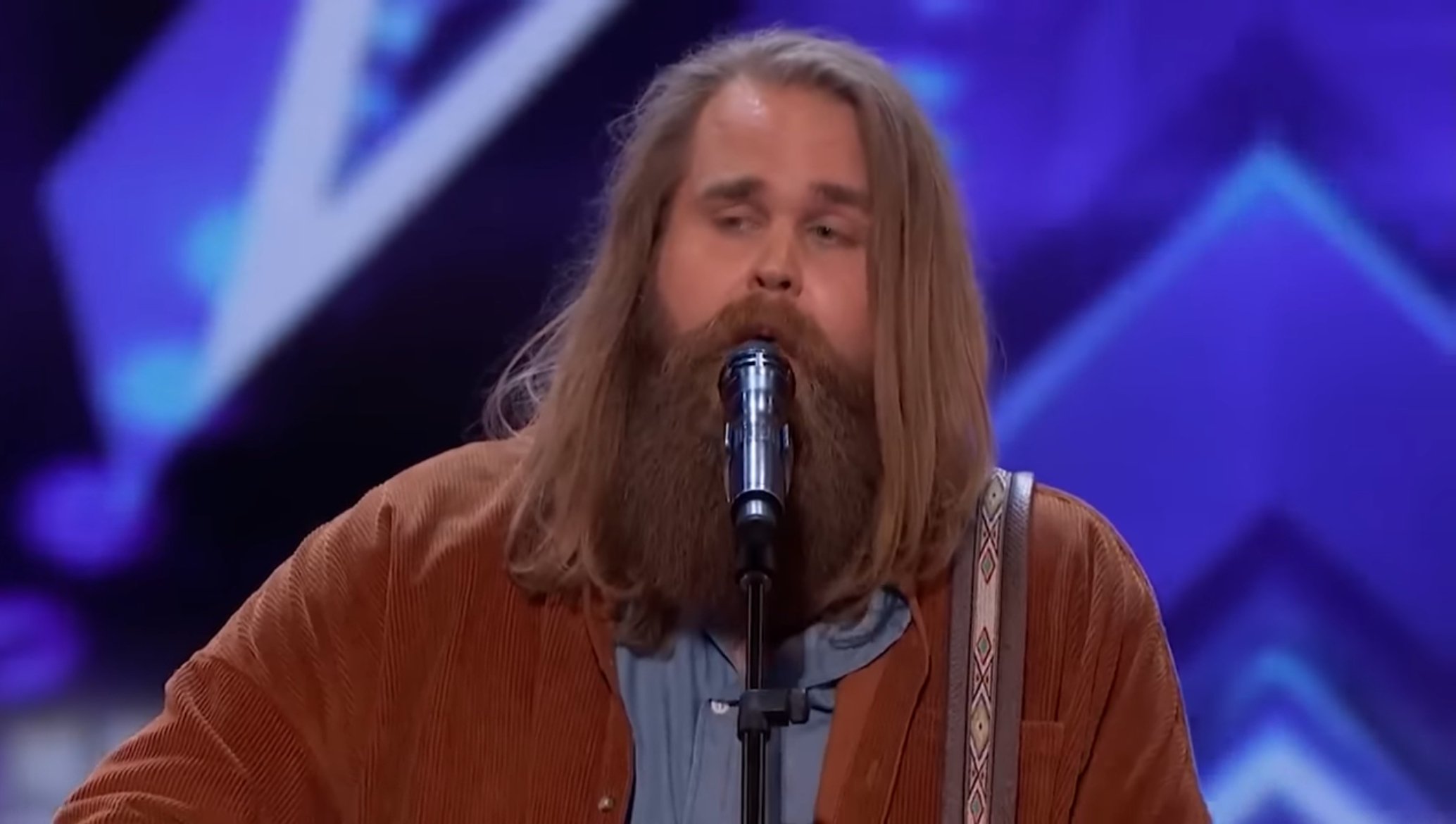
Chris Kläfford, a soft-spoken singer from a tiny village in Sweden, arrived at the America’s Got Talent stage carrying a quiet kind of determination. He spoke briefly about where he came from and how rock bands like Kiss had first lit a fire in him for music. There was an understated humility to his introduction — the sort of modesty that comes from growing up somewhere small, where ambitions can feel both precious and fragile. Yet beneath that unassuming exterior was someone who had traveled a long way, literally and figuratively, to stand under those bright lights, and that journey lent an extra weight to everything that followed.
When he took his place at the microphone, there was nothing flashy about his presence. He didn’t pace or work the crowd; instead, he simply breathed in, closed his eyes for a second, and began. The song he chose — John Lennon’s “Imagine” — is so well known that many singers default to familiar renditions. Chris, however, made a deliberate choice: rather than imitate a memory, he would interpret it. From the very first line it was clear this would not be a cover that leaned on nostalgia. He stripped the song back to its emotional bone and rebuilt it in his own image.
His voice carried a texture that felt both raw and weathered, as if life’s small trials had rubbed a character into each note. There was a huskiness there that lent gravity to simple lines, and when he softened his tone you could hear intimacy that drew listeners in like a whisper. He shaped phrases with small, thoughtful inflections — a tiny hold here, a breathy approach there — that transformed familiar lyrics into an immediate conversation. The arrangement he used was spare, letting his voice move freely against minimal accompaniment so every nuance could land.
As he continued, something quiet and profound began to happen in the theater. People who had arrived expecting a pleasant audition instead found themselves drawn into a deeply human moment. Faces in the front rows grew still; you could see people leaning forward, as if to catch a private line meant only for them. Tears appeared on more than a few cheeks, not out of spectacle but from recognition — of longing, of hope, of the aching honesty in Chris’s delivery. The emotional arc he brought to the song made it feel less like a polished performance and more like a personal testament.
Small stage details highlighted how invested he was in the moment. He often looked down at the floor, not out of shyness but as if consulting an internal compass; at key lines he would lift his eyes to make a fleeting connection with the audience, a reminder that the sentiment was shared. His hands were restrained, expressive in their smallness — a subtle reach at a climactic phrase, a reassuring thumb against the mic stand during softer moments. Those gestures were uncontrived, and they underlined the sincerity of his interpretation.
What made Chris’s rendition especially striking was how he bent the familiar melody without breaking it. He respected Lennon’s message but approached it through his own emotional lens. Where the original might feel idealistic in its pacifist optimism, Chris’s version felt tempered by realism — the hope in the lyrics existed alongside an awareness of pain, loss, and difficulty. That tension — hope held within hardship — resonated powerfully in a global audition room, making the song feel urgent and necessary rather than merely nostalgic.
The judges’ reactions told the story of the room’s shift. Simon Cowell, who watches a steady stream of talent, called the performance “touching,” his voice softening in a way reserved for genuinely moving moments. Howie Mandel praised the reinterpretation, noting how risky it can be to reshape a song so beloved and how successfully Chris had made it his own. The audience rose to their feet at the end of the final note, and the standing ovation felt less like a scripted response and more like a communal release — a shared acknowledgment of having witnessed something honest and rare.
Chris himself was visibly affected, his composure cracking into a smile and then a damp-eyed turn toward the crowd. He had come a long way, and in that instant the miles, the nerves, and the quiet sacrifices were all validated. The unanimous “yes” from the four judges was less a surprise than a confirmation: they had seen an artist who could move people without resorting to theatricality, a singer who could translate a classic into a new emotional language.
When he left the stage, applause still echoed behind him, and you could imagine the ripple effect of his performance — viewers at home moved, contestants backstage inspired, and perhaps a few young musicians from small towns thinking, for the first time, that distance and obscurity aren’t always barriers to being heard. Chris’s audition was a testament to the power of interpretation and the idea that music can cross borders, not just in language but in feeling, connecting strangers through a shared, human pulse.