
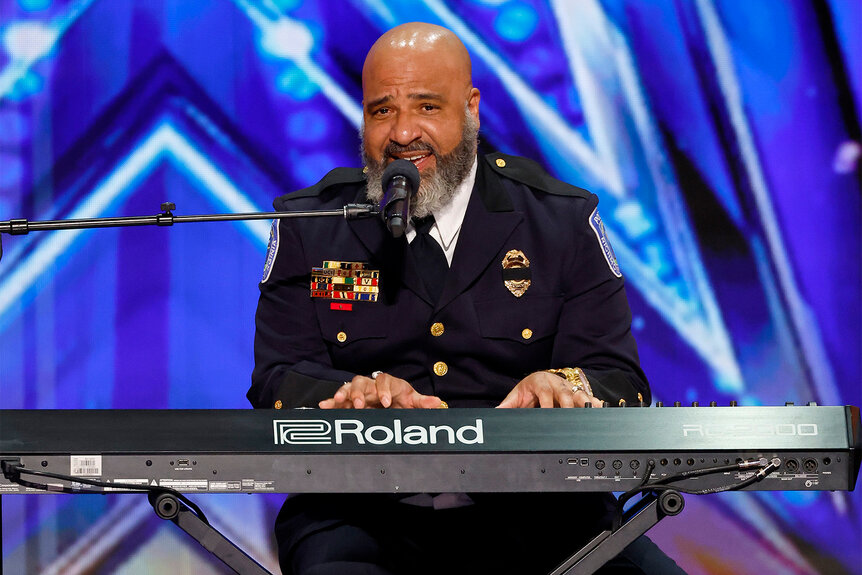
When Officer Mervin Mayo walked onto the America’s Got Talent stage, you could feel the room shift—a mix of curiosity and quiet respect. He carried himself with the easy, down-to-earth air of someone used to showing up for others, not commanding a spotlight. Dressed simply in his clothes rather than a showy outfit, he introduced himself matter-of-factly as a Richmond police officer with 19 years on the force, a husband, and someone who’d grown up in a housing project. Those few details framed the audition in a way that made what followed feel less like entertainment and more like an honest, lived-in confession.
Mervin’s backstory didn’t read like a safe, manufactured narrative. He spoke plainly about growing up in a neighborhood where mischief and danger were part of the landscape, and about choosing law enforcement as a path to break that cycle—not just for himself but for the kids around him. For him, policing wasn’t only about enforcement; it was mentorship, presence, and the belief that steady attention could reroute young lives toward better choices. That commitment to community gave his presence onstage a depth that resonated even before he sang: here was someone who had spent nearly two decades carrying other people’s burdens and who used music as a private way to process them.
Supported visibly by his wife, Michelle—introduced as a school counseling director and the person who encouraged him to audition—Mervin took the microphone with a blend of nerves and determination. He chose Ed Sheeran’s “Thinking Out Loud,” a romantic ballad that, in his case, doubled as a tribute. For years he’d used song as a personal refuge; performing it publicly was a step toward sharing a part of himself he usually kept private. The arrangement he chose stripped the song of any gimmicks and let his voice stand at the center, warm and conversational, shaped by years of speaking to people in crisis and finding the right tone to reach them.
From the first line, the auditorium leaned in. Mervin’s voice carried a texture that felt familiar and human—a slight rasp at the edges that spoke of late nights, age-earned experience, and nights on shift; a mellowness that suggested careful restraint rather than showy display. He didn’t rely on elaborate runs or vibrato; instead, he told the song the way a good mentor tells a difficult truth: plainly, patiently, with feeling. When he sang about growing old together, it wasn’t syrupy or theatrical—it was real, like a promise made in the quiet spaces between jobs, school meetings, and family dinners.
Small gestures made the performance especially moving. At one point his eyes flicked toward Michelle in the audience; her face shone with pride and a few tears, the kind of steady support that had clearly pushed him to this moment. After a particularly tender phrase, Mervin closed his eyes as if committing the sound to memory, a private ritual that invited listeners in. The band behind him held back just enough to let his voice breathe, creating an intimate soundstage that made the moment feel less like television spectacle and more like a living-room serenade shared with thousands of strangers.
The judges’ reactions captured how rare the moment was. They didn’t respond with snappy quips or automatic praise; instead, their faces showed genuine surprise, warmth, and emotion. Comments centered not only on his vocal quality but on the narrative that underpinned the performance. One judge highlighted how his role as a public servant added layers of authenticity to his delivery; another praised the bravery it took to step out of a uniformed identity and expose a softer side. When the judges invited Michelle onto the stage afterward, the applause felt less like a routine acknowledgment and more like a communal embrace—an appreciation of two people who had chosen lives of service and finally allowed themselves to celebrate a private joy in public.
Beyond the immediate reaction, Mervin’s audition felt consequential because it reframed ideas about who gets to be an artist. He proved that talent does not belong exclusively to the young, the trained, or the celebrity-adjacent. It can live in anyone who has accumulated enough life to turn experience into expression. Watching a man who had spent years intervening in community crises sing about long-term love and vulnerability created a tension that was profoundly affecting: authority meeting tenderness, duty meeting desire.
The Golden Buzzer moment that followed—four resounding yeses and a surge of confetti—was as much symbolic as procedural. It fast-tracked Mervin to the live shows, yes, but it also signaled something more: recognition that stories of everyday dedication can move a national audience as powerfully as any dramatic backstory. Clips of his audition circulated widely across social media after the show, often accompanied by comments from people who connected with his story of mentorship, his honesty about his upbringing, and the idea that music sustained him through difficult nights on patrol.
For Mervin and Michelle, the moment onstage was a celebration of partnership and community. For viewers, it was a reminder that talent often emerges from the spaces where people work hardest and love most deeply. His journey—from mischievous kid in public housing to seasoned officer and now viral singing sensation—underscores the redemptive power of mentorship and the solace music can provide. In a single performance, Mervin Mayo offered both a personal revelation and a public testament: it is never too late to share your voice, and sometimes the people who spend their lives protecting others are the ones who carry the most compelling stories to tell.