
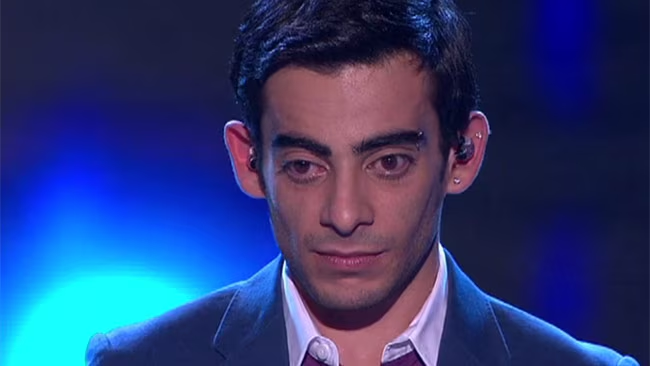
When 22-year-old Carmelo Munzone wandered onto the stage in what looked like an outfit picked for a sunny beach day—polka-dot shorts, a plain tee, and an easy, infectious grin—there was an audible ripple of amusement through the crowd. It wasn’t malice so much as surprise; on shows like this, people are tuned to expect polished wardrobes, rehearsed theatrics, and carefully curated personas. Carmelo gave none of that. He looked like someone who’d stepped off a skateboard and into a spotlight by accident. That low-stakes, carefree energy was his opening line, and for a moment the judges weren’t sure whether to laugh or lean in. What they hadn’t accounted for was how quickly that lightness would transform into something electrifying.
From the first warm syllable of Maroon 5’s “Sunday Morning,” the room shifted. Carmelo’s voice wasn’t just technically sound—it had a looseness that felt joyful and lived-in, a kind of vocal ease that comes from singing because you love the song, not because you’re trying to impress. Where many contestants bring tension or over-polished runs, Carmelo offered a casual virtuosity: perfect pitch threaded through with playful inflections, breathy textures that gave his phrases personality, and a rhythmic sense that made the arrangement sparkle without needing heavy production. It was the kind of performance that made people lean forward in their seats and forget to blink.
What made his audition especially memorable was the way he balanced serious skill with genuine delight. At one point, he laughed—softly, uncontrollably—mid-phrase, not because he was nervous but because he seemed delighted to be there. That laugh punctuated the song like a secret between him and the audience, as if he were thinking, “Can you believe this is happening?” It humanized him instantly. Rather than appearing unprepared, Carmelo’s lightheartedness felt like authenticity: an artist confident enough in his gifts to let joy bubble through, even on a televised stage. That’s a rare quality and one that resonated across the room, from the front row to the judges’ table.
Simon Cowell’s reaction captured the moment perfectly. The usually reserved judge—whose raised eyebrow has ended countless auditions—sat in stunned silence for a beat, then struggled for words. When he finally spoke, it was with a mixture of admiration and disbelief, the kind reserved for genuine surprises that don’t come along very often. The other judges followed suit, switching from smiles of bemusement to expressions of genuine awe. Their shift in demeanor mirrored the audience’s: what started as a lighthearted spectacle became an instant recognition of talent so effortless it felt effortless to the listener too.
There were technical details in Carmelo’s delivery that underlined his readiness for the next level. He has a warm midrange that carries emotional weight during the verses and the ability to glide into brighter tones on the chorus without sounding strained. His timing—those subtle pauses and playful syncopations—created an intimate atmosphere, as if he were singing directly to each person in the room. The arrangement he chose allowed those traits to shine; he didn’t try to out-sing the original but leaned into the mood, making the song feel like his own while respecting its familiar contours.
Beyond the immediate performance, Carmelo’s audition tapped into something larger about why certain moments go viral. In an era where so much content feels manufactured, moments of real, unfiltered humanity cut through. He wasn’t trying to be a star in the classic sense; he was simply being himself—and that authenticity connected. Viewers online noticed the same things the studio audience did: the surprise of his attire, the contrast between his appearance and his vocal prowess, and the unguarded joy that threaded through the performance. Clips of his audition spread quickly, with commentators praising not just the voice but the person who owned it.
The unanimous “yes” from the judges felt less like a formality and more like an acknowledgment: this was someone worth following. It wasn’t solely an endorsement of technical skill, though that was undeniable; it was also recognition of stage presence, of personality, and of a rare capacity to disarm an audience through honesty rather than spectacle. Talent shows have always been about the discovery of potential, but every so often a contestant arrives who doesn’t only signal potential—he delivers a moment that feels complete in itself.
What sticks afterward is the image of Carmelo walking off the stage, polka-dot shorts still catching the lights, a grin wide enough to suggest the whole thing was more fun than frightening. In that grin you can read a lesson: presentation matters, but it isn’t everything. Sometimes the most compelling performances come from people who refuse to be boxed in by expectations, who sing because they have to, and who let their personality do half the work. Carmelo Munzone’s audition was a reminder that the world is full of surprises—and that a pair of spotty shorts and an honest laugh can precede one of the most captivating musical moments of the night.