
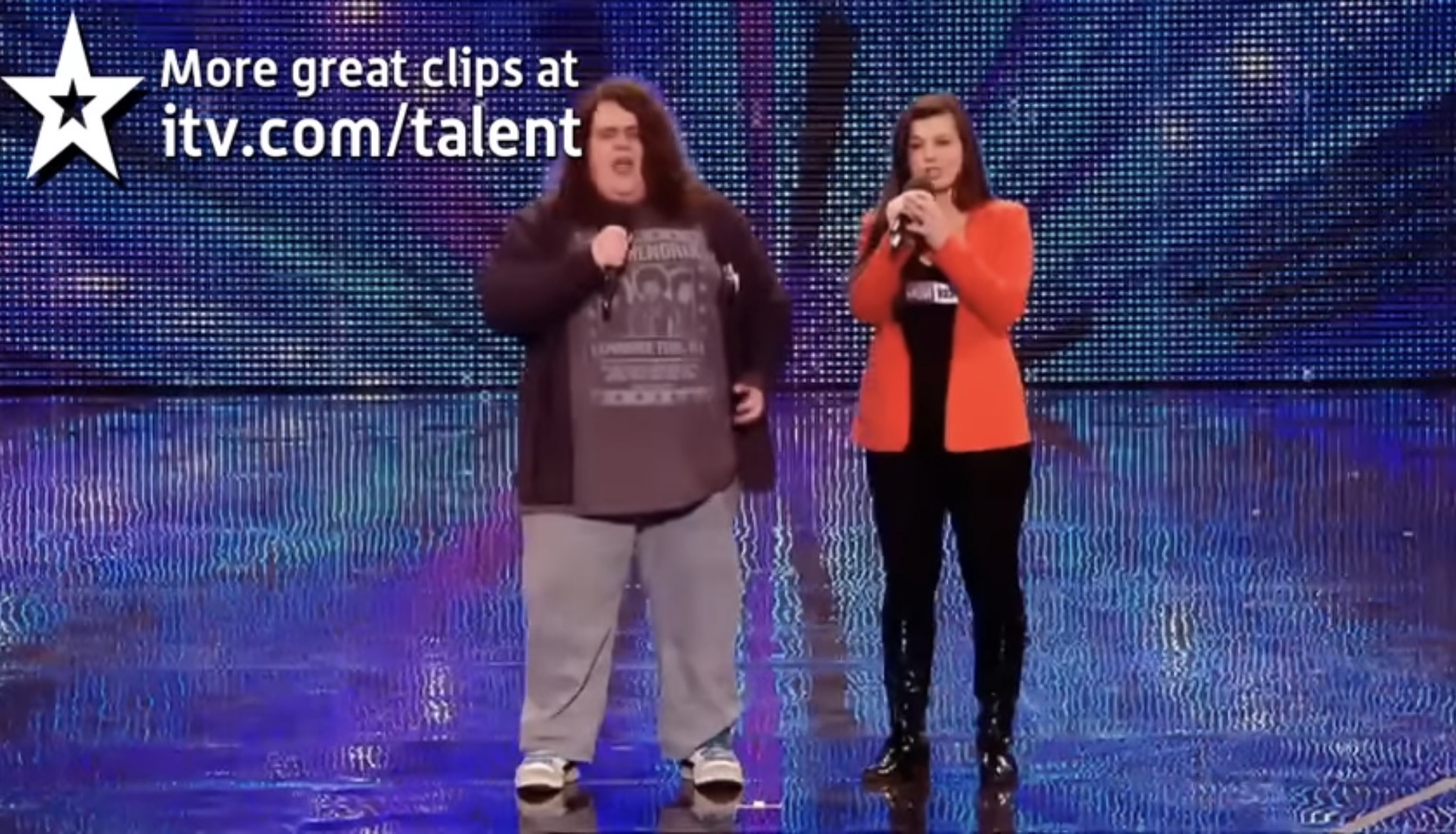
Charlotte and Jonathan’s audition on Britain’s Got Talent remains one of those rare moments that people still talk about years later—not just because of the talent on display, but because of the story behind it. When the two teenagers first walked onto the stage, there was an immediate contrast in their presence. Charlotte appeared relatively relaxed and confident, offering a polite smile to the judges, while Jonathan, at just 17 years old, seemed visibly nervous. He kept his gaze low at times, his body language hinting at the anxiety he later admitted to feeling.
As they introduced themselves, Jonathan spoke honestly about his struggles with self-confidence and the bullying he had endured growing up. It wasn’t said for sympathy—it felt genuine, almost hesitant, like something he wasn’t entirely used to sharing in such a public setting. He explained that Charlotte, his 16-year-old singing partner, had been a constant source of support. She wasn’t just a duet partner; she had been his protector, encouraging him to keep singing when he might have otherwise given up. That dynamic added a quiet emotional weight to the audition before a single note had even been sung.
At first glance, some in the audience—and even on the judging panel—seemed unsure of what to expect. There’s a tendency in shows like this for quick assumptions to form, and this moment was no different. But what followed would completely overturn any early doubts.
They chose to perform “The Prayer,” a song known for its technical demands and emotional depth. It’s not an easy piece for seasoned performers, let alone teenagers stepping onto such a large stage for the first time. As the opening notes played, Charlotte began with a soft, controlled delivery that immediately set a calm tone. Then Jonathan joined in—and the reaction was instantaneous.
His voice was nothing short of astonishing. Rich, powerful, and remarkably mature, it filled the auditorium with a depth that no one seemed prepared for. It wasn’t just loud or technically impressive; it carried a clarity and emotion that made it impossible to ignore. The comparison to a young Luciano Pavarotti didn’t feel exaggerated—it felt earned in that moment. You could see the judges’ expressions shift from mild curiosity to complete disbelief within seconds.
What made the performance even more compelling was the contrast and harmony between their voices. Charlotte brought a lighter, more contemporary tone that complemented Jonathan’s operatic strength. Together, they created a balance that felt both modern and classical, bridging two styles in a way that was unexpectedly seamless. It wasn’t just about one standout voice; it was about how they worked together, supporting each other through every phrase.
As the song progressed, the atmosphere in the room changed entirely. The earlier skepticism disappeared, replaced by a kind of collective awe. Audience members leaned forward in their seats, some exchanging glances as if to confirm that what they were hearing was real. By the time they reached the final notes, there was a palpable sense of anticipation—one of those moments where silence feels just as powerful as sound.
Then came the eruption of applause. The entire arena rose to its feet in a standing ovation that felt both spontaneous and deeply deserved. Jonathan, who had walked on stage with visible nerves, looked almost overwhelmed by the response. Charlotte, standing beside him, smiled with a quiet pride, as if she had always known he was capable of this.
The judges were equally impressed, though their feedback took an unexpected turn. Praise came quickly, especially for Jonathan. He was described as “unbelievable” and a “future star,” with clear recognition of his extraordinary vocal ability. However, Simon Cowell’s comments introduced a moment of tension. While he acknowledged Jonathan’s talent, he suggested that Charlotte might hold him back and controversially advised that Jonathan consider going solo.
The remark hung in the air, shifting the tone of the moment. It wasn’t just a critique—it challenged the very foundation of what the duo represented. For a brief second, it seemed as though the narrative might change from one of partnership to one of division.
But Charlotte and Jonathan handled it with quiet strength. There was no visible frustration or argument, just a calm and firm response. Charlotte made it clear that they were a team and intended to stay that way. Jonathan, too, didn’t waver. Considering everything he had shared about his journey and the role Charlotte played in it, their decision felt deeply rooted in loyalty and mutual respect rather than strategy.
That response resonated just as much as their performance. It reinforced the idea that their connection wasn’t just about music—it was about trust, friendship, and shared growth. In a setting where competition often encourages individual success above all else, their unity stood out.
When the votes were cast, the outcome was clear. Four “yes” votes sent them through to the next round, confirming that whatever disagreements existed among the judges, their talent as a duo couldn’t be denied. The applause that followed felt like a continuation of the support they had already received, a recognition not only of their voices but of the story they carried with them.
In the end, Charlotte and Jonathan’s audition wasn’t just memorable because of the performance itself—though that alone would have been enough. It was the combination of vulnerability, surprise, and unwavering partnership that made it truly unforgettable. They reminded everyone watching that talent doesn’t always arrive in the form people expect, and that sometimes, the strongest voices are the ones that rise together.