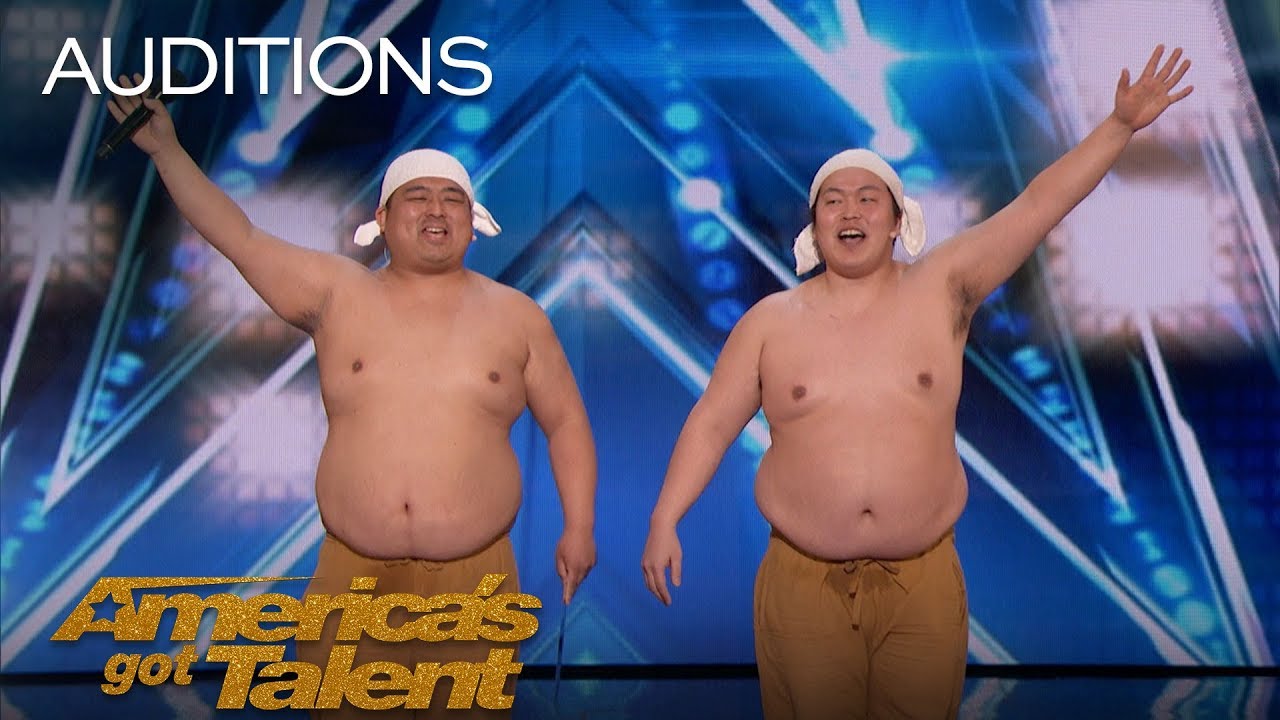
When Yumbo Dump walked onto the America’s Got Talent stage, they didn’t carry instruments or gizmos — just two performers and a shared sense of mischief. The duo, hailing from Japan, quickly made clear they weren’t there to deliver a conventional musical act. Instead, they introduced an entirely new approach: making rhythm, melody, and comic effect using only sounds produced with their bodies. That premise alone teased curiosity; the reality that followed turned polite interest into delighted disbelief.
Their routine opened playfully. The pair exchanged a conspiratorial look, then launched into a series of small, precise noises — clicks, pops, low hums — produced by lips, tongue, throat, and chest. At first, the audience assumed those sounds were novelty; but as the noises layered and patterns emerged, the illusion of simplicity dissolved. What had begun as individual sound effects coalesced into a tight percussive groove. One performer provided a steady beat that sounded like a snare and bass combination, while the other added higher rhythmic embellishments and strange, trumpet-like tones. It felt like watching a miniature band conjured from flesh and breath.
Part of the charm was watching how they drew music from the ordinary. A throat-sounded bass line mimicked an upright bass walking a line; a sharp tongue click stood in for a cymbal crash; a cigarette-lighter puff of air rendered a muted horn blast. The two exploited the human body’s range in unexpected ways, creating timbres and textures you’d expect from a small ensemble rather than a pair of comedians. The cleverness of it wasn’t just the novelty of the sounds, but the care with which they arranged them: there were verses, a chorus-like hook, a restrained bridge, and even a moment that functioned like a drum fill. The structure made the performance feel complete rather than a string of party tricks.
Comedy threaded through everything. Yumbo Dump didn’t present their skill with solemnity; they played it up with timing and facial expressions that punctuated the punches. When one of them produced a ridiculous trombone wobble, his partner reacted with a mock-offended stare. In another section, they mimed a dramatic argument synchronized to a percussive rhythm, and the audience laughed at the uncanny coordination and the way their physicality sold the gag. The humor made the sound work more accessible: if you were skeptical about “body music” as an art form, the laughs softened you up, and by the time their technical prowess revealed itself, you were already on their side.
The staging and production supported their concept without overshadowing it. Lighting colors shifted to match musical moods — warm amber for narrative bits, stark white for rhythmic showcases — and camera cuts occasionally offered tight close-ups on mouths and throats so viewers could appreciate the mechanics of the sounds. Those close-ups were revealing and a little uncanny: the tiny movements of tongue and jaw that produced a trumpet-like blare suddenly looked like serious instrumental technique. The judges’ reactions went through the predictable arc: bemused tolerance, then widening smiles, then open-mouthed astonishment as the pair pulled off increasingly complex arrangements.
There were moments that made the studio audibly gasp. In one impressive passage, they built a call-and-response section where one performer imitated a sax line with smooth, breathy tones while the other held a steady, pulsing bass. The effect was so convincing that some viewers and judges reached for the wrong conclusion: was there a hidden instrument offstage? The answer was always the same and always more impressive — no, it was just two bodies and a lot of practice. That revelation — the idea that such a wide palette of sound could be produced without gear — is what makes clips of Yumbo Dump so shareable online. People post the videos asking, “How is that real?” because the performance upends assumptions about what is possible with the human voice.
Beyond the immediate spectacle, the act prompted a broader appreciation for experimentation in live entertainment. In a season full of polished singers, emotional acts, and elaborate novelty performances, Yumbo Dump carved a niche by blending comedy with genuine musicianship. They weren’t simply trying to shock; they were demonstrating a technique that requires listening, timing, breath control, and precise muscular coordination. Their success onstage suggested that novelty acts can still be artful when the craft underpinning the gimmick is rigorous.
The crowd’s energy built as the routine progressed. What began as tentative clapping evolved into rhythmic participation, with audience members tapping their knees and copying a few of the easier sounds during a playful interlude. The judges rose to their feet by the final bar, clapping and whooping in appreciation. Backstage, after the lights dimmed, social media lit up with clips of the act, each caption a variation on the same astonished question. The shareability factor on a piece like this is huge: it’s short, visually engaging, and invites immediate disbelief and conversation.
When the duo left the stage, they did so grinning, arms slung around each other in the way people do after pulling off something risky but exhilarating. Whether they advanced deep into the competition or simply created a viral moment, Yumbo Dump achieved something more lasting: they reminded viewers that creativity often lies in reimagining the familiar. Two performers, a handful of strange noises, and an audience willing to be surprised — that was enough to turn a novelty into a performance people wanted to talk about, rewind, and share.