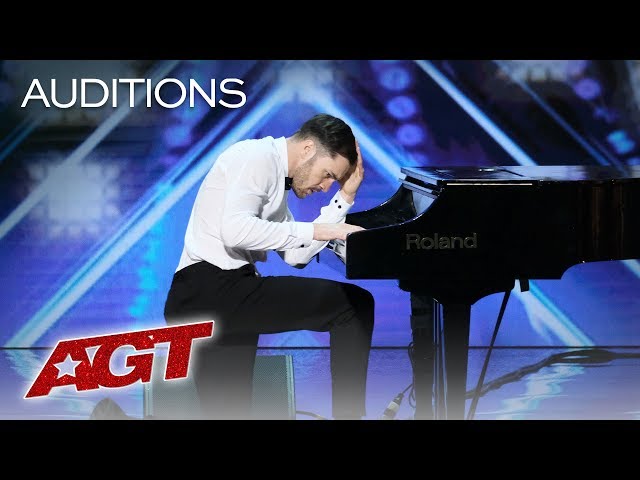
When Patrizio Ratto walked onstage, most people assumed they were about to watch a standard piano performance: tidy posture, focused fingers, maybe an emotional ballad or a virtuosic display. He sat at the grand with a small smile, gave the piano a quick nod, and then began to play. The opening bars were perfectly ordinary in a way that made the eventual twist all the more delightful — lyrical phrasing, clean articulation, a melody that felt familiar but fresh. The audience relaxed into listening, settling in for what sounded like a purely musical moment.
Then, unexpectedly, the music shifted and so did Patrizio. Mid-phrase, he rose from the bench and launched into a series of athletic, tightly choreographed moves that somehow stayed perfectly in time with the piano line. It was a fluid transformation: one second a classical pianist, the next a dancer entirely in command of his body. The surprise landed not as a cheap trick but as a seamless expansion of the performance’s vocabulary. Instead of separating music from movement, he fused the two so that each informed the other — the rhythms of the left hand became the beat for a stomp or slide, the lyrical right-hand lines suggested sweeping arm gestures, and the dynamic swells shaped the crescendos of his choreography.
What makes that kind of hybrid performance work is the technical skill on both sides, and Patrizio has it in spades. His piano playing remained unflappable while he moved: chords were clean, phrasing intact, and tempo stayed rock-solid even as he shifted weight, turned, and leapt. That level of coordination takes years of practice. Close-ups during the performance revealed how his footwork and torso brace supported the subtle changes in pedal and pressure — little details ordinary viewers rarely notice when hands are the focus. The dancing itself borrowed from a range of vocabularies: ballet-like extensions, street-dance isolations, and a sprinkling of theatrical flair that made the whole thing feel cinematic rather than simply athletic.
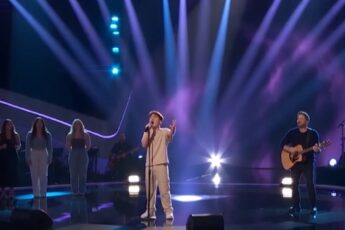
The staging helped sell the surprise. Lighting transitioned in pace with the music, narrowing to a cool spotlight during intimate piano passages, then opening into broader washes as the choreography expanded across the stage. Costume choices were practical but expressive: a tailored shirt and slim trousers that allowed both elegant seated playing and full-bodied movement, paired with shoes that looked equal parts sensible and stage-ready. Camera work, if this was filmed, picked up the action with quick cuts that emphasized the illusion of continuity — a spin, a hand on the keyboard, a slide across the floor — so viewers barely had time to separate one discipline from the other.
There were moments that truly stopped the room. At one point, Patrizio executed a sequence where his left hand maintained a repeating ostinato while his right hand stretched into a cascading arpeggio; simultaneously he used that ostinato as a rhythmic base for a syncopated foot-tap routine that sounded like percussion. The effect was startling: the audience could hear the beat and see the beat produced simultaneously, an almost synesthetic experience that turned sight into sound and vice versa. Another highlight was a lift-and-return phrase where he carried the melody standing, then slid back onto the bench with the perfect rubato to let the final note linger.
Comedy and charm threaded through, too. Patrizio didn’t present his stunt with a poker face; he winked at the audience at a few well-placed moments, letting them in on the joke and building rapport. Those little gestures — a playful eyebrow raise after a particularly flashy move, a dramatic bow that began on one knee and finished at the keyboard — made the performance feel human rather than merely showy. You could tell he was enjoying the risk, and that enjoyment made viewers more willing to accept the unusual format.
Audience reaction moved through predictable stages: initial polite applause for a solid piano intro, rising laughter and vocal appreciation at the first major movement shift, and finally a roaring ovation as the set reached its theatrical peak. People stood on cue not because they’d been instructed but because the thrill of witnessing something unexpected and excellently executed compelled them to. If judges were present, their faces likely mirrored the crowd — surprised delight, curiosity about technique, and then full-throated approval.
Beyond the immediate spectacle, Patrizio’s act does something more interesting: it challenges assumptions about what a piano performance can be. Concerts and talent shows often pigeonhole acts into narrow categories — singer, instrumentalist, dancer — but hybrid pieces like this suggest richer possibilities. Music can be physical. Dance can be melodic. When an artist merges the two authentically, they expand the language of performance and create moments that are impossible to categorize and irresistibly shareable.
No wonder clips of the routine would take off online. The shock factor alone makes people hit replay, but the craft keeps them watching. Patrizio’s combination of pianistic control and fierce, well-timed movement gives viewers both the satisfaction of musical integrity and the thrill of spectacle. It’s the kind of performance that makes you grin, clap, and immediately want to send the video to friends with a single caption: “You have to see this.”