
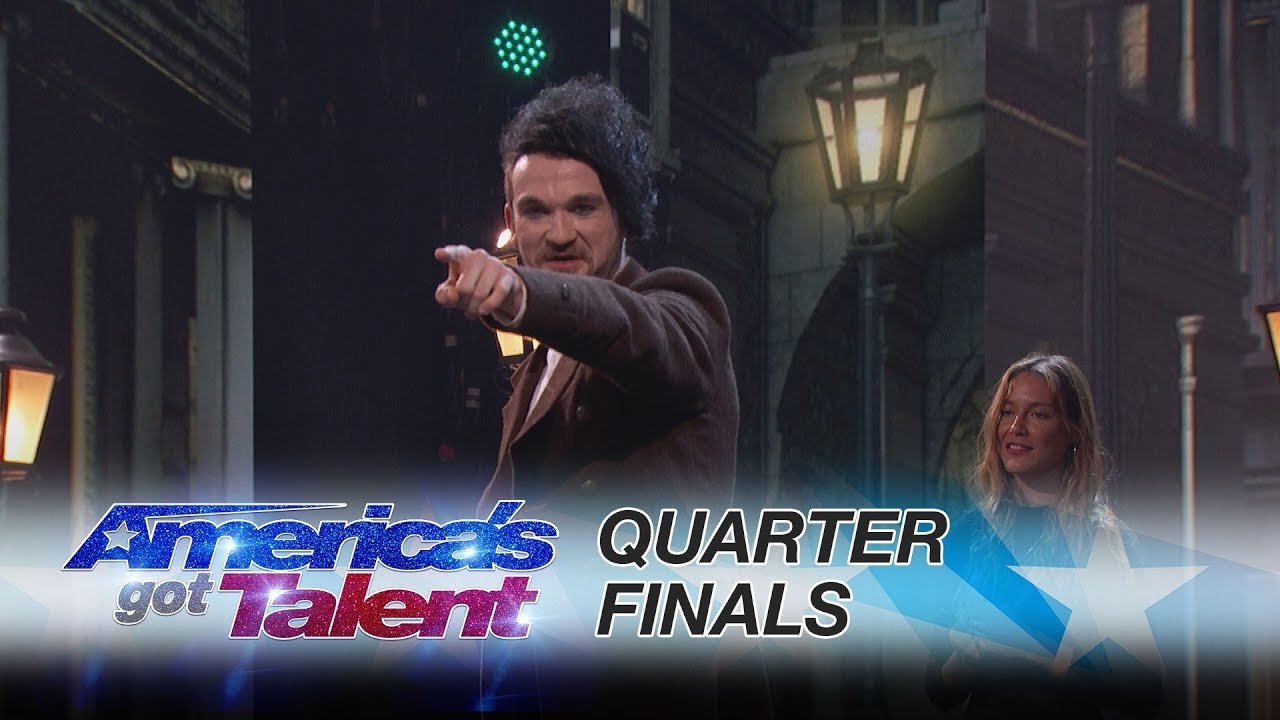
When Colin Cloud walked onto the stage, he carried himself like someone used to moving in the margins of what people think is possible. There was no flashy setup, no smoke and mirrors — just a quietly confident presence and an air of old-school showmanship that hinted at something cerebral rather than theatrical. He’s billed as a “real-life Sherlock Holmes,” and from the first moment he spoke, you could feel the room shifting into a different register: curiosity sharpening into a kind of delicious unease. People leaned forward because they wanted to see what would happen next, not just because they were entertained but because they were about to have the ordinary rules of perception tested.
Colin’s act is built on misdirection, acute observation, and psychological theatre — the kind of mentalism that makes you question where your own thoughts end and someone else’s influence begins. That tension reached its apex in the segment where he convinced Mel B to “stab” Simon Cowell. The description already sounds sensational, and the performance managed to be every bit as intense as it first appears on paper, but it’s the setup and the human detail that make the trick so chilling.
He began gently, establishing rapport with the judges and the audience, using casual conversation and small, seemingly innocent demonstrations of reading micro-expressions. Those early moments were crucial; they lulled people into thinking they were watching clever observation rather than a deeper psychological orchestration. Colin’s voice was measured and calm, his questions conversational, and he let the room fill in the gaps with its own assumptions. By the time the dramatic beat arrived, the audience had already been primed to accept some degree of mental influence.
The stabbing sequence itself unfolded with the kind of slow-build tension that any good thriller would envy. Colin set the scene: a prop knife, a dramatic context, and the willing participation of Mel B, who came across as intrigued if a little nervous. He wasn’t asking her to do something reckless or violent; he framed the moment as a test of trust and of the limits of suggestion. Even so, it was impossible not to feel a tingle of apprehension. Cameras cut to Simon’s face — amused confidence at first, then a flicker of wariness as the trick progressed. The audience, too, registered the shift, moving from curiosity to a quiet collective intake of breath.
What made the moment truly unnerving was the way Colin blended control with ambiguity. He gave Mel B choices that felt voluntary, yet guided the outcome with a subtle choreography of language, timing, and attention. He used suggestion as a sculptor uses a chisel: small, deliberate touches to shape a larger result. To viewers, it looked like a mind literally nudging another mind across the stage. Mel B’s actions felt authentic — she wasn’t acting in a heavy-handed way, and that realism made the illusion all the more powerful. When the blade came forward, even though it was harmless and staged, the emotional spike in the theatre was real.
Judges and audience members reacted in ways that revealed how deeply such an act penetrates everyday assumptions. Laughter broke nervous tension at times, but more telling were the quiet moments afterward: faces trying to reconcile what they’d seen with what they believed about free will and influence. Simon, ever the showman, played the part and recovered with theatrical flair, but you could see the afterimage of surprise. Mel B’s mixture of amusement and awe — the kind of expression one has after watching a magician reveal the last, impossible card — helped humanize the spectacle. She had been both subject and co-conspirator, and that duality created an emotional complexity that lingered long after the applause.
Beyond the immediate shock value, Colin’s performance works because it taps into deeper cultural fascinations. We love mysteries, and we love the idea that some people can see through the fog of daily life to a hidden pattern. Mentalism borrows from cold reading, suggestion, and showmanship, but at its best it also asks an ethical question: how much influence can one person have over another without overt coercion? The trick onstage didn’t attempt to answer that, but by dramatizing it, it invited the audience to think about persuasion, consent, and the fragile boundaries of autonomy.
There’s also a theatrical elegance to the way Colin delivers his craft. He doesn’t rely on loud proclamations or cheap shocks; his performance is texture-driven, using silence and small gestures as effectively as any explosive reveal. The “stab” moment was the climax of a carefully constructed narrative arc — it didn’t exist for its own sake but as the inevitable peak after a sequence of smaller demonstrations that built trust and tension. That restraint is what separates a gimmick from a memorable act.
After the performance, conversations buzzed: people replayed the moment, debated whether it was staged, and marveled at Mel B’s willingness to participate. Clips circulated, and for good reason — there’s a contagious quality to something that genuinely unsettles and fascinates at the same time. Colin Cloud’s ability to choreograph psychological moments makes you feel like you’ve watched a short psychological thriller unfold live, complete with misdirection, complicit actors, and a punchline that lands like a cold gust.
In the end, the trick wasn’t just about a knife or a gasp; it was about the power of suggestion and the theatrical thrill of seeing human behavior bent, momentarily, to someone else’s will. It left audiences talking because it touched on something elemental: our curiosity about the mind’s hidden levers and our delight — and discomfort — when someone demonstrates how easily those levers can be pulled.