
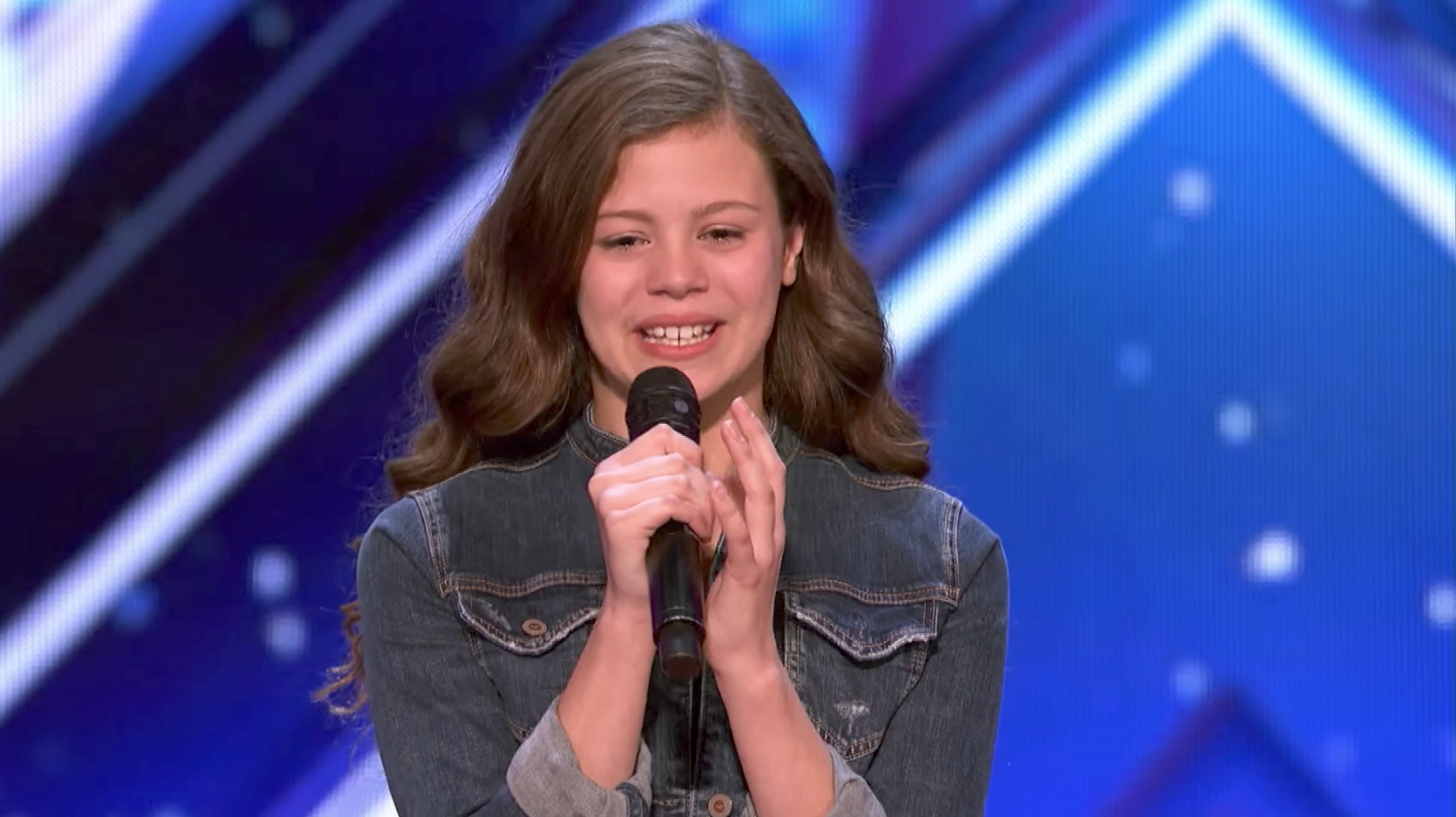
When thirteen-year-old Angelina Greene walked onto the stage, she carried with her not just a song but a quiet testimony to how music had become her refuge. She spoke plainly about the wrenching changes that came with her parents’ divorce and how, amid the upheaval, singing had steadied her. That admission — simple, honest, and delivered without any attempt to dramatize — framed the performance that followed. Angelina described her mother as her closest confidante and best friend, a detail that made the story feel intimate rather than rhetorical. It wasn’t a publicity line; it was a lifeline: a young girl leaning on the person who had helped her find her voice again.
As she stood in the vast auditorium, Angelina’s hands trembled slightly and her shoulders curled inward with nervousness. You could see the kind of jitters you might expect from any teenager in such a bright spotlight, but there was something else beneath the surface — a determined calm, as if she had rehearsed not just the notes but the act of offering herself honestly to a room full of strangers. That combination of vulnerability and purpose set the tone immediately. She wasn’t there to perform for fame; she was there to share a piece of her healing process, and that intent shaped every phrase she sang.
Choosing “I’ll Stand By You” by The Pretenders was a telling decision. The song’s message of unwavering support and solace mirrored Angelina’s own experience with music and with her mother. From the first note she released, it was clear that she understood the song beyond its melody; she inhabited its sentiment. Her voice, pure and unforced, carried a surprising maturity. Instead of leaning on vocal gymnastics or theatrics, she let the lyrics breathe. She paused on certain lines, allowing the meaning to sink in, and at other moments she drew out a syllable with a tenderness that revealed how deeply she felt the words. Those small choices — a held breath here, a gentle vibrato there — made the performance feel like a conversation rather than a recital.
Concrete details in her delivery made the moment feel lived-in. When she sang the line about walking through fire for someone, her eyes briefly softened as if picturing the person she meant. She clutched the microphone with a thoughtful steadiness, sometimes closing her eyes as memories passed through her. Through those gestures, the audience could sense that the song wasn’t abstract for her; it was personal. People in the crowd shifted forward, drawn in by the combination of sincerity and technique. The orchestra of reactions — the silent intake of breath, a hand pressed to a chest, an exhale at the end of a phrase — created a communal experience that deepened the emotional impact.
By the time the final chorus swelled, Angelina had transformed the theatre into a place of shared feeling. Her tone remained controlled but full, and the final notes hung in the air as if reluctant to dissipate. For a young performer to command that kind of aftermath is rare; for her to do it while staying true to a simple expression of love and resilience felt extraordinary. It’s one thing to sing well; it’s another to make dozens of strangers feel as though they, too, have been witness to a small but meaningful act of courage.
The judges’ responses reflected that sentiment. Mel B, moved and maternal, spoke to the depth she sensed in Angelina, saying there was an “old soul” inside the young body. That phrase captured the paradox of seeing maturity in someone so young — a maturity forged by experience and softened by compassion. Simon Cowell, often the most critical voice in the room, called it one of his favorite auditions and confessed that she had given him goosebumps — an admission that underlined how rare and genuine the moment was. Even judges who prize technical skill recognized that Angelina’s gift included something less tangible: emotional intelligence, the ability to translate pain into beauty.
Mel B’s reaction went beyond praise. When she reached forward and pressed the Golden Buzzer, the action felt like more than a dramatic television moment; it felt like an affirmation of a young life reclaiming itself. The buzzer propelled Angelina straight to the live shows, but it also symbolized a larger truth: that art can be a form of therapy and that the courage to be vulnerable on a public stage can invite others to hold space for that healing. Backstage afterward, you could imagine the relief and joy mingling on Angelina’s face as her mother rushed to embrace her — not just the triumph of competition, but the relief of being seen and understood.
Angelina’s story resonates because it’s rooted in everyday realities. Divorce is a painful process for many families, and the idea that a thirteen-year-old could find a steadfast companion in music is both heartbreaking and hopeful. Her audition reminded viewers that young people often carry sophisticated emotional lives and that creativity can be the vessel through which they process and grow. In one performance, she demonstrated that pain need not be hidden away; it can be acknowledged, shaped, and shared in ways that bring people together.
Ultimately, Angelina’s Golden Buzzer moment wasn’t just about winning a place in a competition. It was about a young girl reclaiming her voice and inviting the world to listen. Her performance was a reminder that sometimes the most powerful performances aren’t the loudest or most elaborate, but the ones that come from a quiet, honest place — the songs we sing to steady ourselves when the ground shifts beneath our feet.