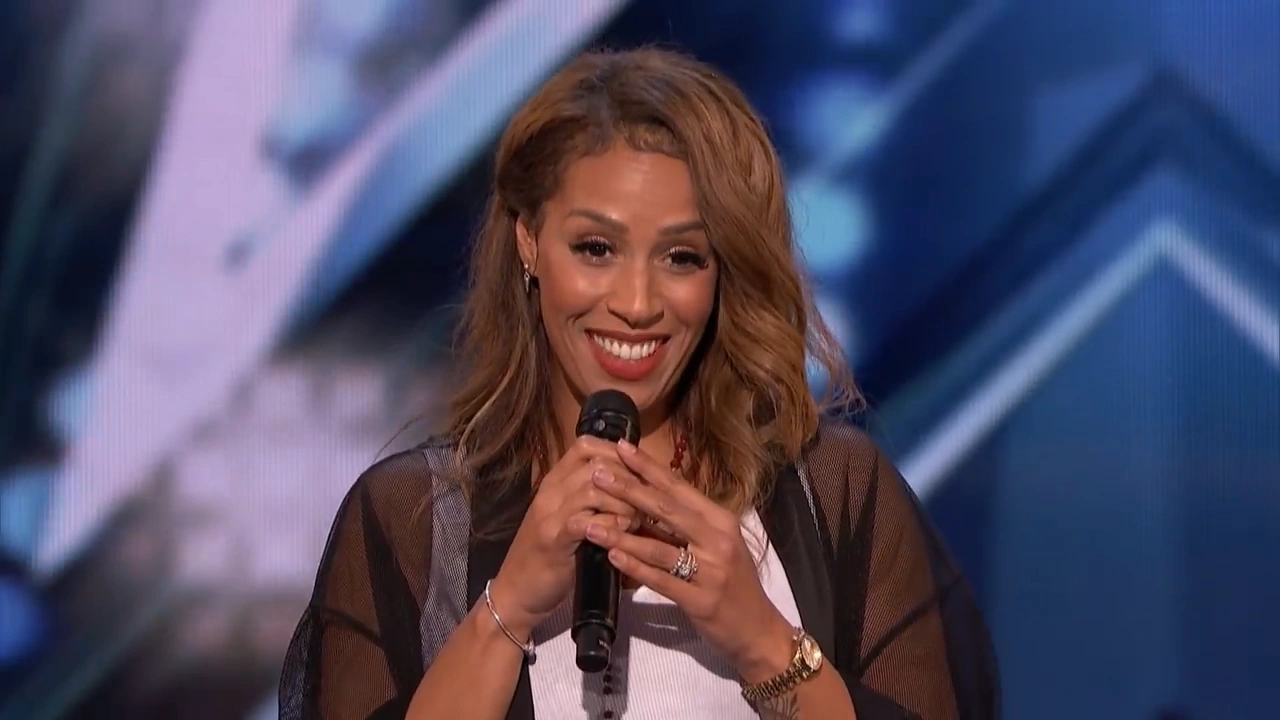
When thirty-nine-year-old Glennis Grace stepped onto the America’s Got Talent stage, there was a quiet confidence about her that suggested she’d been here before—if not on this stage, then certainly in front of audiences who knew her name. She introduced herself simply, explaining that she had been singing for years but that her dream had never changed: she wanted to share her voice with more people. That ambition, she said, wasn’t abstract. It was personal and immediate, fueled in large part by the encouragement of her eleven-year-old son, Anthony, who had been urging her to take this exact leap onto a massive American platform. The tenderness of that motivation—mother and son, dreaming together—set a warm, human tone before a single note was sung.
The judges listened with interest. Glennis was not a typical unknown hopeful; she arrived carrying the weight of experience and the vulnerability of someone willing to risk it all for the chance to be heard by millions. The panel leaned in, curious about what a seasoned performer might reveal when stripped down to a single, defining moment. There was an unspoken challenge in the air: this wasn’t just about technical ability, it was about whether she could translate her years of work into a universally unforgettable performance.
She chose a formidable vehicle for that test: “Run to You” by Whitney Houston, a song that demands both technical mastery and emotional authenticity. From the first breath, the audience understood why she’d picked it. Glennis’s opening note landed with immediacy—crystal clear, yet carrying the kind of grain and texture that made it feel lived-in. There was an uncanny resemblance in tonal color and power to the late icon, but more than mimicry, there was true ownership. She didn’t simply imitate Whitney; she channeled the emotional landscape of the song, making each lyric feel current and personally earned.
As the performance progressed, Glennis demonstrated a rare combination of control and abandon. Her runs were precise, never gratuitous, and her dynamic control allowed softer, intimate moments to sit alongside explosive climaxes without losing cohesion. The auditorium was quiet in those tender passages; you could feel the collective inhalation of hundreds of people hanging on a single phrase. Then, when she pushed into the song’s soaring moments, the room erupted. It wasn’t just applause—it was a standing ovation that built like a wave, judges rising not out of obligation but in stunned recognition.
For the judges, the response was immediate and visceral. Simon Cowell, who has built a reputation for cutting honesty, seemed genuinely taken aback. He admitted, plainly, “I feel like I’m looking at a star already, I’m going to be honest with you.” That kind of endorsement from Simon is not casual; it’s a declaration that the performance had crossed an invisible threshold into something commercially and artistically viable. Mel B’s reaction captured another layer of the moment: she leaned forward and said, “You do sound so much actually like Whitney, it’s unbelievable.” Her comment acknowledged the technical similarity while also hinting at the emotional authenticity that made the likeness meaningful rather than merely imitative.
Howie Mandel offered perhaps the most heartfelt assessment of all, distilling Glennis’s journey into a single, resonant truth: “The only reason why you’re not a star yet is because we haven’t seen you and we haven’t heard you.” That line underscored the entire point of talent shows—sometimes remarkable talent simply needs the right stage and the right timing. For Glennis, who had clearly toured and performed for years, AGT represented more than another audition; it was a doorway to a broader audience who might finally recognize what those close to her had long known.
Beyond the judges’ words, there were small moments that lingered. You could see Anthony in the crowd, pride radiating from his face as his mother owned every bar of the song. There were gestures—Glennis’s hands rising with the crescendos, the brief closing of her eyes during the most intimate lines—that signaled a performer completely present in the moment. Those details made her performance feel less like a technical showcase and more like an offering: a seasoned artist giving everything she had for the possibility of a wider stage.
When the votes came in, Glennis received four resounding yeses. The simple tally was the formal confirmation of what the room already knew: she had delivered an audition that transcended expectation. For an artist who had spent years refining her craft, that validation was both professional and deeply personal. It was proof, for her and for Anthony, that the dream they shared was within reach.
In the aftermath, the applause and praise felt deserved rather than excessive. Glennis had not only honored Whitney Houston’s legacy—she had revitalized it through a performance that showcased her own artistry. More importantly, she’d given herself the shot she’d been seeking: a chance to be seen and heard on a scale that could change everything. As she left the stage, there was a sense of closure mixed with the electric possibility of what might come next—a reminder that talent, when coupled with courage, can finally find its audience.