
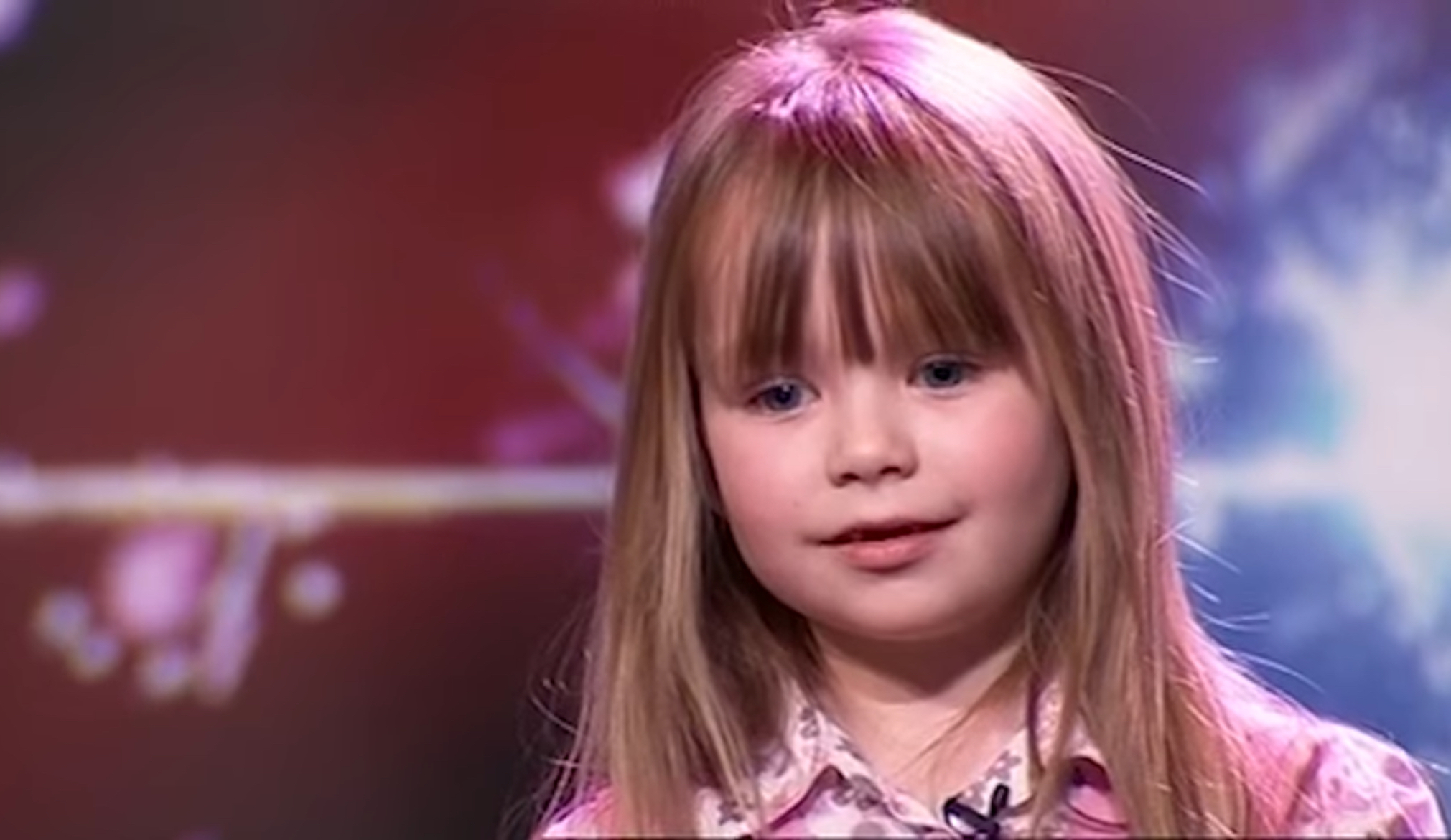
Six‑year‑old Connie Talbot stepped onto the Britain’s Got Talent stage practically as a pocket‑sized bundle of nerves and hope. She looked like any nervous child about to perform for the first time — hair neatly tied back, small hands clasped around the microphone, eyes wide with a mixture of wonder and concentration. When the hosts asked if she wanted to be a famous singer, her immediate, earnest “yes” drew a ripple of laughter and a warm smile from the audience. She told the judges she’d been singing since she was two, and in the kind of off‑hand way only a child can manage, confessed she didn’t quite know what singing in front of the Queen might feel like when asked whether she wanted to perform for royalty. “I don’t know,” she answered, and the hush that followed was partly affection and partly anticipation: this was a little girl who wasn’t trying to be anything other than herself.
That simplicity and innocence set the tone for a moment that felt, right from the opening bars, like something rare. Connie chose “Somewhere Over the Rainbow,” the song made immortal by Judy Garland, a piece of music that carries both nostalgia and emotional weight. There’s a temptation in auditions to over‑arrange or belt to prove maturity, but Connie’s approach was the opposite: she let the melody speak. As the piano began and her small voice rose into the familiar lines, the auditorium that seconds earlier had buzzed with pre‑show chatter seemed to exhale. You could feel the sound move like a gentle wave through the crowd — it softened the room rather than filling it, and that contrast made the performance all the more powerful.
Listening to a child sing with that kind of clarity is disarming. Connie’s tone was pure and unadorned, each note landing with a precision that made even casual listeners lean in. There were no dramatic flourishes, no deliberate attempts to mimic adult phrasing — instead she delivered the song with a tenderness and straightforwardness that let the lyrics breathe. Her pitch was flawless, and the emotional restraint in her delivery made the heartbreak of the song feel poignant rather than theatrical. You could see the judges’ faces change as the performance progressed: interest sharpened into surprise, surprise softened into admiration.
Amanda Holden’s reaction was immediate and raw. As Connie moved through the bridge and the upper lines, Amanda’s composure unraveled in the kind of way only a truly moved person can show — a single hand rising to her mouth, eyes glistening, then letting tears fall. Piers Morgan, famously quick with a jab or a cutting remark, watched instead with a kind of stunned quiet, noting later how affected the room had become. When the last note lingered and finally faded, the silence was broken by a spontaneous eruption of applause; people who had come in for a TV moment found themselves unexpectedly touched by something sincere.
Simon Cowell’s response was the one everyone anticipated. He is known for bluntness and skepticism, especially with child performers, but on that day his manner shifted into something more measured. He spoke to Connie “like an adult,” a phrase he used to underline the seriousness and authenticity of his praise. He called her “fantastic,” a word that, coming from Simon, carries a particular weight. Then he leaned in with the obvious question on everyone’s mind: “Was that really you singing?” It was a question that expressed both disbelief and the need for confirmation; Connie’s pure, unprocessed sound had been so astonishing that it prompted suspicion as well as admiration.
Connie answered simply and matter‑of‑factly, and the judges’ unanimous “yes” felt less like a predictable TV outcome and more like an acknowledgement of something genuinely impressive. That resounding approval sent her through to the next round, but the moment did more than advance a contestant in a competition. It turned Connie, for a little while at least, into a symbol of unvarnished talent in a world that often prizes spectacle over substance. Her tiny stature and unassuming presence made the performance feel less like a display and more like a gift: a reminder that raw, honest musicality can still cut straight to the heart.
Beyond the immediate reactions, there was a tenderness in how the audience and judges treated Connie afterward. People reached out with encouragement, smiles, and small consolations — the type of human warmth that seems especially important when a child steps into the glare of national television. The image of a six‑year‑old standing under bright lights, singing a song about yearning and hope, struck a chord. It wasn’t simply technical skill that moved people; it was the way her voice carried an emotional truth that felt rare at any age. In a room that often rewards showmanship and polish, Connie’s performance stood out for its simplicity: a clear voice, a sincere heart, and a song that, for a few minutes, connected everyone in the auditorium to a shared, gentle feeling of wonder.