
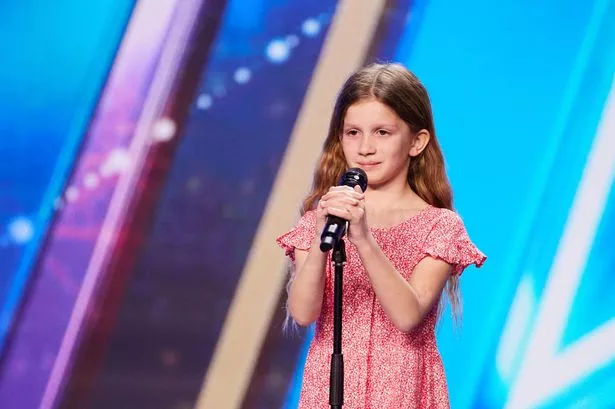
Eleven-year-old Olivia Lynes’s road to the Britain’s Got Talent stage began with a surprise that felt both carefully orchestrated and genuinely tender. She thought she was going to see Matilda on the West End — a bright, ordinary treat that would make any child’s day — but behind the scenes Amanda Holden had quietly been pulling strings. Olivia’s mum and nan had sent in a video about her extraordinary singing, and Amanda arranged for a covert invitation to audition. The moment of reveal was immediate and warm: Olivia’s eyes widened, her mouth formed a delighted gasp, and the small, private shock of the surprise read like sunlight across her face. For a girl who had expected nothing more than an evening at the theatre, the sudden possibility of performing on that very stage changed everything in an instant.
That initial joy was laced with nerves. It’s one thing to sing at home, in assemblies, or for family; it is quite another to face a professional stage, cameras, and judges who can make or break a child’s confidence. Amanda sensed Olivia’s anxiety and did something disarmingly simple — she danced a little, made a silly face, and encouraged the youngster to laugh. The move may have seemed inconsequential, but it did exactly what it needed to: it broke the tension, coaxed out a giggle, and reminded Olivia that this moment could be playful as well as serious. With her mum and nan beaming in the audience and judges watching expectantly, Olivia took a breath and steadied herself, the quiet kind of steadiness you see in a child who’s decided to be brave.
Olivia chose “Defying Gravity” from Wicked, a song with soaring climaxes, emotional complexity, and technical demands that can flatten even experienced performers. From the very first notes she sang, though, whatever remaining nerves seemed to evaporate. Her voice arrived with clarity and purpose. She didn’t simply hit pitches; she shaped phrases with an understanding of the music’s arc. There was a maturity to her interpretation — a sense of when to hold back and when to let the sound swell — that made listeners forget her years for a moment. It’s the sort of thing you expect to see from someone who’s not only practiced but has spent time thinking about what the words mean.
Concrete moments from the audition lingered. At the opening lines, the audience inhaled as one, a hush that signaled attention rather than polite silence. When she softened a vowel to let an emotion hang in the air, you could see rows of people leaning forward. The way she took a slight step forward on a climactic phrase, then relaxed her shoulders on the resolution, hinted at stagecraft beyond her age. Her diction was crisp — each lyric felt clean and purposeful — and her dynamics were surprisingly nuanced: she could be delicate in one bar and unfurl into power in the next without the transitions feeling forced. Small details mattered, like the way her fingers curled around an imagined edge of the world at the song’s peak, or how she briefly closed her eyes as if to summon a courage that was both the character’s and her own.
The judges’ reactions were immediate and visceral. Bruno Tonioli, with his flair for the dramatic, seemed genuinely awed and called Olivia a “singing miracle,” a phrase that captured the stunned admiration in the room. Amanda’s own delight was layered: there was the professional satisfaction of a well-played surprise and something like maternal pride. Her decision to press the Golden Buzzer felt less like a television stunt and more like a moment of recognition — a public, glittering affirmation that Olivia’s performance deserved to be celebrated. As gold confetti rained down, the stage took on a warm glow, and for a few heartbeats the noise of the studio felt celebratory rather than performative.
The Golden Buzzer didn’t just send Olivia straight to the live semi-finals; it validated the faith her family had in her and offered an unmistakable boost to a young performer’s confidence. Watching her leave the stage, clutching her mother’s hand, you could see the swirl of emotions — disbelief, joy, and a kind of stunned gratitude. Her mum and nan exchanged looks that said more than words: pride, relief, and the wonder of seeing a child’s talent acknowledged on such a scale. For Olivia herself, the night was a turning point. What began as a simple trip to the theatre ended as a revelation of possibility: practice and courage had met opportunity, and the result was more than applause.
Beyond the spectacle, the audition felt like a small lesson about encouragement. It showed how a bit of belief from family and a gentle, playful nudge from someone who matters can open doors a child may not even know exist. Olivia’s performance was not just technically impressive; it was honest. She carried the emotional weight of the song in a way that made the audience care, and Amanda’s Golden Buzzer sealed a moment of collective belief in a young voice. For viewers at home and those in the studio, Olivia’s audition was a reminder that talent can appear when you least expect it, and when it does, the right kind of support can help it take flight.