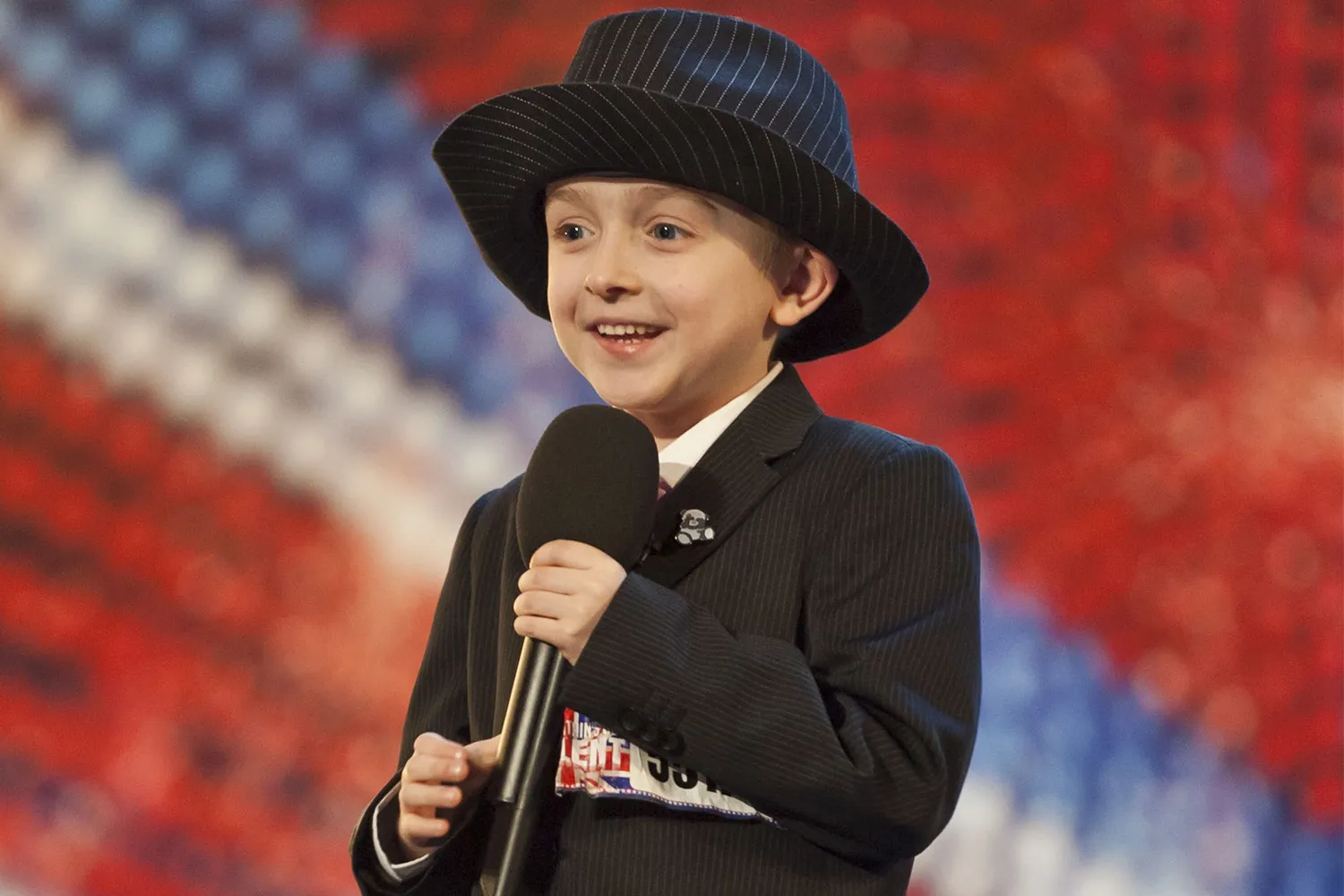
Seven-year-old Robbie Firmin walked onto the Britain’s Got Talent stage with a confidence that made the room smile before he even opened his mouth. There was the slightly unpredictable energy of a child who still believes anything might happen — the quick grin, the bright eyes, the way he shifted his weight on tiny, well‑polished shoes — but he moved with an ease that suggested a performer already comfortable in the spotlight. Flanked by a cluster of proud relatives whose faces glowed under the studio lights, Robbie explained his motivation in the simplest, most affecting terms: he wanted to give his mum the “best birthday present ever.” That line landed with the audience as if it were a key to the whole moment. Suddenly his audition was not merely a performance but a gift wrapped in song, and the room leaned in as if helping him untie the bow.
Before he sang, Robbie charmed the judges with an impish aside: he introduced his aunt and, with guttering comic earnestness, tried to set her up with one of the panel. The attempt at matchmaking — part bold, part adorable — dissolved any lingering formality and brought a ripple of laughter across the stage. It showcased the kind of charisma you can’t teach: a mixture of cheek, warmth and total unselfconsciousness that makes people lean forward and want to back you. In those small moments of banter you could see who he was offstage, too — not a kid mimicking adult showmanship, but a natural entertainer who instinctively understood the little theatrics that make a live audience tick.
Then came the choice that made lungs collectively draw in: Frank Sinatra’s “My Way.” Nobody expects a youngster to pick a song steeped in years of lived experience, swagger, and wistful reflection. It is a number most adults approach with caution; its lyric asks for world‑weary conviction, and its melody demands a singer who can own every line. For a seven‑year‑old to choose it felt audacious, borderline reckless. Yet when the orchestra’s opening chords unfurled, any doubt evaporated. Robbie didn’t try to imitate Sinatra’s baritone or borrow his decades of baggage; instead he approached the song on childlike terms — with curiosity, a wink, and an unexpected seriousness. From the first line, he treated the lyrics as if they were his own observations, not borrowed sentiments. That ownership transformed the piece from an adult declaration into something playfully philosophical: a child’s reflection on doing things his way, which somehow made the words feel fresh.
His interpretation was full of surprising musical savvy. Robbie toyed with tempo — stretching a phrase for dramatic effect, then nudging the pace along where the lyric demanded a sly smile — and he used pauses like a storyteller choosing where to let the room react. Technically, his voice carried a clarity and pitch control that belied his age; he struck notes with steadiness and rarely let the vibrato wobble into uncertainty. At moments when the orchestra softened, he leaned into the intimacy, bending a syllable just so to coax a laugh or a sympathetic murmur. But more than technique, it was his stagecraft that dazzled: the boy launched into a line, then glanced at the crowd as if gauging their reaction, adjusting emphasis based on the gasp or chuckle he’d earned. Every cheeky grin, theatrical lean, and tiny bow felt calibrated yet spontaneous — like a child playing at being larger than life and discovering he genuinely fits the clothes.
There were delightful, human details that made the performance feel vivid rather than staged. He clasped the microphone with the solemnity of someone rehearsing an important speech; he tipped an imaginary hat to a judge in mock maturity. At one point, mid‑verse, his foot tapped an almost imperceptible rhythm that revealed his internal metronome. His family, visible in the wings and among the audience, were a study in emotion: aunts with hands over their mouths, grandparents wiping at the corners of their eyes, his mum leaning forward with a smile so wide it looked like relief. You felt the room pull for him — not as a spectacle to be consumed but as a small person taking a brave leap. That communal rooting made every note carry more weight than it might on paper.
The judges’ responses were as delighted as they were astonished. Louis Walsh singled out Robbie’s theatrical instincts, noting that the boy “toyed with the audience” and demonstrated a natural leadership on stage — the kind of instinct seasoned performers cultivate over years. Michael McIntyre’s reaction captured the sense of wonder the performance created: he admitted he’d never seen anyone so young tackle a song like that and yet come away with something authentic. Their praise didn’t feel patronizing; it felt earned. They weren’t applauding a cute novelty — they were recognizing a performer with a singular voice and a fearless approach.
When the votes were tallied, Robbie earned a unanimous set of “yes”es — a tidy, three‑way endorsement that propelled him to the next round. For his mum, the resulting hug and glittering‑eyed smile must have felt like the birthday present she’d been promised. For Robbie, the moment would likely stitch itself into memory: a night when a small child chose a giant song and, through charm, timing, and unexpected musical sense, made it feel entirely natural. Walking offstage, he left not only an applauding crowd but the clear impression that age is sometimes just a number when personality, confidence, and heart carry the tune.