## Part One: The Black Gate
**By the time I learned I had once begged to be stolen, my wedding dress was hanging from a stranger’s doorway like a pale body in a bag.**
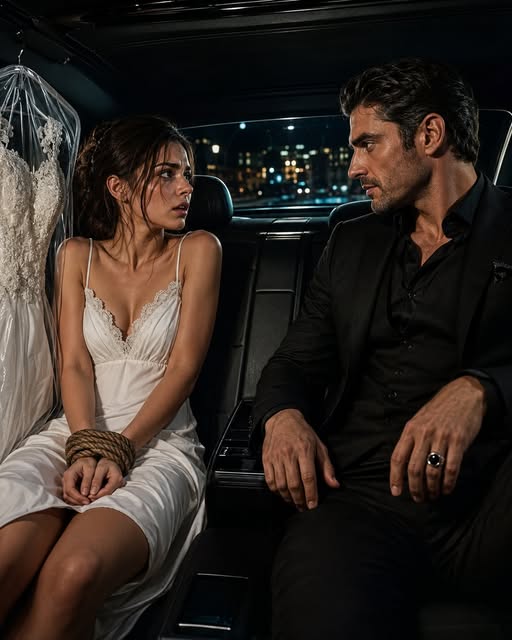
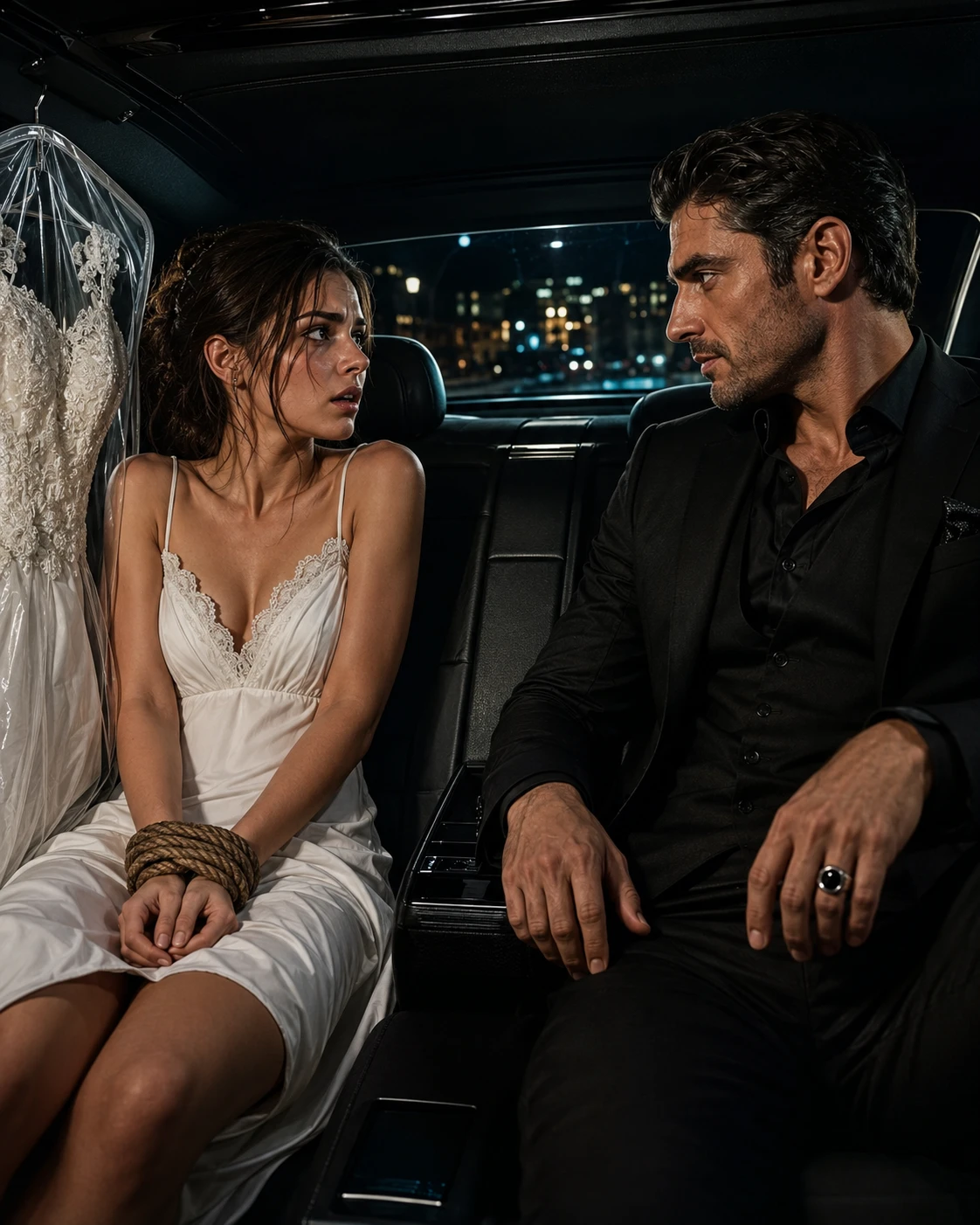
Three days before I was supposed to become Mrs. Victor Hale, I woke in the back of a black car with my wrists tied, my throat raw, and Massimo Moretti sitting across from me as if eight years had not passed since he disappeared from my life.
The city lights smeared across the windows. My dress swayed beside me in its white garment bag, brushing the floor with every turn. It looked less like silk and lace than a ghost trying to stand.
“You kidnapped me,” I whispered.
Massimo did not deny it. He only watched me with those dark Sicilian eyes I had once trusted more than Scripture.
“I corrected a mistake,” he said.
The words should have sounded ridiculous. Instead, they sank into me with a terrible weight.
I had spent eight years believing he had left me because leaving was easy. I had carried that belief like a stone in my chest, polishing it with pride until I could call it wisdom. Now here he was, older, colder, dressed in a black suit that made him look like a man who had outlived mercy.
“I’m getting married,” I said.
His jaw tightened.
“To a man who bought you.”
The air left my lungs.
Victor Hale was admired in every room he entered. He smiled for cameras, donated to hospitals, kissed old women on the cheek, and told my father I was “the finest woman in Boston.” In private, his compliments felt like measurements. His kindness had edges. His hand on my back always guided, never asked.
Still, I said, “You don’t know anything.”
“I know about the contract.” Massimo’s voice was low. “I know about the transfer to your father’s account. I know Victor calls you an asset.”
**The word asset opened a locked door inside me.** I heard Victor’s voice again, smooth as polished wood: *Once you’re my wife, Angela, all this uncertainty ends. You’ll thank me for taking responsibility.*
The car stopped before a black iron gate, where two men stepped from the shadows and bowed their heads. Massimo opened my door himself. He cut the rope from my wrists with a silver blade, slow enough to show me he could have done it earlier and had chosen not to.
“Run,” he said, nodding toward the road behind us. “I won’t stop you.”
I looked into the darkness. Bare winter trees leaned over the long drive. Beyond them, the city was gone, swallowed by hills and old money and secrets.
“Why would you let me run after dragging me here?”
“Because I am many things,” Massimo said. “But I am not Victor Hale.”
Then he reached into his jacket and took out a sealed envelope.
My name was written across the front.
Angela Caruso.
The handwriting made my knees weaken.
Not because it was his.
Because it was mine.
Beneath the seal sat a blue hospital stamp from St. Agnes Medical Center, dated **the morning Massimo vanished eight years ago**.
I stared at it until the letters blurred.
“What is this?” I asked.
Massimo’s expression changed. The mask cracked. Under the danger, under the control, I saw something raw and exhausted.
“The first truth,” he said.
Inside the villa, the halls smelled of lemon oil, old stone, and rain. He led me into a library where a fire burned low. Shelves climbed to the ceiling. On the table lay photographs, bank records, and a folded copy of my wedding invitation.
I wanted to hate him. I wanted hatred to be clean.
But when he placed the envelope in front of me, his hand trembled.
“Open it,” he said.
The paper inside was brittle from age. The first page was not a letter. It was an emergency intake report. Massimo Moretti, male, twenty-eight at the time, admitted to St. Agnes with a skull fracture, two broken ribs, and internal bleeding.
Found at 4:12 a.m. beside the chapel road.
The same road where he had promised me, “Angela, I’ll come back for you.”
I looked up slowly.
“You were hurt.”
“I was nearly killed.”
“By whom?”
His mouth hardened.
“Victor’s men.”
The room tilted. I gripped the table.
“No.”
“Yes.”
“You’re lying.”
“I wish I were.”
For eight years, I had imagined him walking away while dawn broke over the chapel. I had imagined him free, careless, alive in some woman’s arms, while I stood behind a locked bedroom door with shame burning in my face.
But the report did not care about my pride. The ink was indifferent. The truth sat there, cold and stamped and official.
“I came back,” Massimo said. “I crawled half a mile before I collapsed. When I woke, eighteen days had passed. Your father told me you wanted nothing to do with me.”
“My father?”
“He said you were engaged to Victor Hale.”
“I wasn’t.”
“I know that now.”
The fire snapped. Somewhere in the villa, a clock struck midnight.
I pressed my hand to my mouth, but the sob came anyway. Not soft. Not graceful. It tore out of me like an animal.
Massimo moved as if to touch me, then stopped.
“I hated you,” I said.
“I know.”
“I built a whole life around hating you.”
“I know.”
I laughed bitterly through my tears. “Do you? Do you know what that costs a woman? To teach herself not to love the one person she never stopped loving?”
His eyes closed for a moment.
When he opened them, they were wet.
“Yes,” he said. “I know.”
That was when I understood that Massimo had not come back from the grave to ruin me.
**He had come back carrying a coffin full of truths.**
And one of them had my name on it.
## Part Two: The Price of a Daughter
I did not sleep that night.
Massimo gave me a room with a locked door, then placed the key on the dresser inside.
“There,” he said. “So you can decide whether you are my prisoner.”
I picked up the key and threw it at his chest.
He caught it.
“Don’t make a performance of decency after tying my hands,” I snapped.
His face did not soften, but his voice did. “Fair.”
That irritated me more than cruelty would have.
The room overlooked a garden of cypress trees and stone angels. My wedding dress hung from the wardrobe door, delivered from the car by one of Massimo’s men. It seemed to watch me all night.
By morning, my wrists were bruised purple. I rubbed them while standing before the mirror.
Fifty-five thousand dollars’ worth of lace. Custom sleeves. Pearl buttons. A veil long enough to make a cathedral aisle look like a river.
Victor had chosen it.
He had said, “A woman should look untouched on her wedding day.”
At the time, I had smiled because my father’s nurse was in the room, and smiling had become my second language.
Now the memory made my skin crawl.
Downstairs, an older woman named Rosa served coffee, eggs, and bread still warm from the oven. She had silver hair pinned in a knot and the calm, unreadable face of a woman who had seen men bleed on expensive carpets.
“You should eat,” she said.
“I should be home.”
“That may be true also.”
I looked at her. “Do you work for him?”
“I work in his house. That is not always the same thing.”
Before I could answer, Massimo entered.
In daylight, he looked less like a phantom and more like a man who had not slept properly in years. There were faint lines beside his mouth. A scar disappeared beneath his collar. His hands were elegant, but there was violence in the stillness of them.
He placed a folder beside my plate.
“What now?” I asked. “More evidence?”
“Yes.”
“I haven’t finished hating you for the first batch.”
“You may hate me while reading the second.”
Rosa made the sign of the cross and left us.
Inside the folder was the contract.
It was not called a sale. Men like Victor Hale never used ugly words when clean ones could do the same work. It was a “marital consolidation agreement,” drafted by attorneys, witnessed by men who probably played golf with judges.
My father’s signature appeared on page eight.
Victor’s on page nine.
Mine was missing.
“That’s why the wedding has to happen,” Massimo said. “Once you marry him, he controls the trust your mother left you. Your father’s debts disappear. Victor gains the Caruso properties and the St. Agnes foundation board seat.”
“My mother left me no trust.”
“She did.”
“My father said she died with nothing.”
“Your father says many things.”
The coffee turned sour in my mouth.
My mother, Elena Caruso, had died when I was twenty-three. At least, that was the story. A stroke. A closed coffin. My father weeping in public and drinking in private. Afterward, he began making decisions for me with the solemn sorrow of a man who believed grief excused tyranny.
“Why would Victor want me?” I asked.
“Because St. Agnes sits on land worth more than half the buildings in his portfolio. Because your mother’s foundation still owns the final vote. Because your signature, as her heir, unlocks everything.”
“Then why not just tell me?”
Massimo leaned forward. “Would you have signed?”
“No.”
“There is your answer.”
I thought of Victor’s hand on mine at charity dinners. My father praising him. The wedding planner calling me lucky.
**All those months, I had not been walking toward marriage. I had been escorted toward a vault.**
“My father wouldn’t do this,” I said, but my voice lacked conviction.
Massimo slid a phone across the table.
“Call him.”
I stared at it. “Is this another trap?”
“No. It is a door.”
I dialed my father’s number from memory.
He answered on the second ring. “Angela?”
His voice broke on my name, and for one foolish second I was twelve years old again, running to him after a nightmare.
“Papa.”
“Thank God. Where are you? Victor has the police searching. Massimo Moretti is dangerous.”
“So is Victor.”
Silence.
My hand tightened around the phone.
“I saw the contract,” I said.
My father exhaled. It sounded like a man stepping off a ledge.
“Come home,” he whispered.
“Tell me it isn’t true.”
“Come home, and we will discuss everything.”
“No. Tell me now.”
Another silence. Then, softly, “You don’t understand what he can do.”
“Victor?”
“Yes.”
“What can he do, Papa? Ruin us? Shame us? Take money? Or was selling me just simpler than telling me the truth?”
He began to cry.
I had heard my father cry only twice in my life. Once when my mother died, and once when his brother was buried. Both times, his grief had made him seem noble. Now it sounded small.
“I was trying to save you,” he said.
“By handing me to him?”
“I made a mistake.”
“No,” I said. “A mistake is forgetting an appointment. This had lawyers.”
“Angela—”
“Did you know Massimo was beaten?”
His crying stopped.
That was answer enough.
I hung up.
For a while, I sat very still. The breakfast cooled. Outside, a gardener clipped hedges as if the world had not ended over coffee.
Massimo said nothing.
At last I whispered, “I don’t want to belong to Victor.”
“You won’t.”
I looked at him. “And I don’t want to belong to you.”
Pain moved across his face, quick and gone.
“Good,” he said.
The answer startled me.
He stood and walked to the window. “For eight years, I dreamed of taking you away from every man who hurt you. Your father. Victor. Myself, even. In my dreams, you came willingly. You forgave me before I explained. You loved me before I deserved it.”
“And now?”
“Now I am awake.”
The morning light silvered his profile.
“I didn’t bring you here to make you mine, Angela. I brought you here because no one else would get you out before the wedding.”
I wanted to believe him.
That frightened me most of all.
## Part Three: What the Chapel Remembered
That afternoon, the rain came.
It moved across the hills in gray sheets, softening the villa windows until the world looked painted and uncertain. Massimo found me in the chapel at the edge of the property. It was small, older than the house, with cracked plaster saints and candles burning before a statue of the Virgin.
“I thought you didn’t pray anymore,” he said from the doorway.
“I don’t.” I lit another candle. “But I like to give God the opportunity to apologize.”
A sound escaped him. Almost a laugh.
We stood in the quiet together.
Eight years earlier, behind a different chapel, Massimo had kissed me with rain in his hair and wild hope in his voice. I had been old enough to know better and lonely enough not to care. He was the son of a disgraced Sicilian family. I was the dutiful daughter of a Boston patriarch who believed love was something women outgrew.
Massimo had held my face and said, “Come with me tonight.”
I had said, “Come back at dawn.”
He had smiled. “Always bargaining.”
“I needed time.”
“You needed courage.”
I turned on him now. “And you needed a skull fracture, apparently.”
His expression darkened.
“I am sorry,” I said, because the cruelty had come from pain.
“So am I,” he answered. “For not dying, for not staying, for believing your father, for all of it.”
I folded my arms. “Do not apologize for surviving.”
“I didn’t survive cleanly.”
“What does that mean?”
He looked at the candles. “After I woke, I became what my family needed. My father was dead. My uncle wanted the Moretti name turned into a weapon. I let him. I told myself power would bring me back to you. Then power became the thing I knew how to hold when I could not hold you.”
“You could have written.”
“I did.”
“I never received anything.”
“I know.”
“What did you write?”
He smiled sadly. “Bad poetry. Worse promises. One apology that took six pages.”
Against my will, I pictured those letters sitting in some locked drawer of my father’s, aging in the dark.
Massimo reached into his coat and took out the hospital envelope again.
“There is more.”
My pulse quickened. “You kept something from me.”
“Yes.”
“Why?”
“Because the letter told me to.”
I frowned. “What letter?”
He handed me a second page, folded into quarters. My handwriting crawled across it, uneven and slanted, as if written by a shaking hand.
I read the first line.
**If I forget, do not let them call forgetting peace.**
The chapel seemed to recede around me.
I sat on the nearest pew.
Massimo knelt in front of me, not touching.
“Angela?”
“I don’t remember writing this.”
“I know.”
The page smelled faintly of dust and old antiseptic. The hospital stamp marked the bottom. St. Agnes Neurology Ward. Three days after Massimo had been admitted.
Three days after my world had shattered.
The letter was brief.
*Massimo, if this reaches you, they have already begun. Victor is not a suitor. He is a patient man with a ledger for a heart. Papa is afraid of him. I am afraid of what they are giving me. I hear things through doors. I lose hours. If they convince me you left, do not believe the woman I become too quickly. Somewhere inside her, I will still know.*
I stopped reading.
“What did they give me?”
Massimo’s voice was rough. “Sedatives. Memory suppressants, according to a doctor I found years later. Not enough to erase a life. Enough to blur weeks. Enough to make grief easier to shape.”
I shook my head.
“No. I would know.”
“Would you?”
The question was not cruel. That made it worse.
I remembered the months after Massimo vanished as a series of dim rooms. My father’s doctor visiting. Bitter pills. Victor bringing flowers before we were even courting. People telling me I was fragile. People praising me for becoming calm.
Calm.
**A beautiful word for a woman who had been drugged into silence.**
I forced myself to finish the page.
*If he comes back, I may hate him. Let me. But do not let me marry Victor Hale. Not unless I stand before him with my whole mind and choose it freely.*
My eyes filled.
Below that line was another.
*And if I am too afraid to run, Massimo, steal me.*
The candle flames trembled.
I looked at him.
“You didn’t kidnap me because you wanted me.”
His face changed.
“I wanted you,” he said. “God forgive me, I wanted you every day. But no. I came because you asked me to.”
The world I had known did not collapse all at once. It folded, like paper in careful hands.
“My father sent you this?”
“Yes.”
“When?”
“Six days ago.”
“Why would he do that now?”
“Because Victor moved the wedding up. Because your father found out what Victor planned after the ceremony.”
“What?”
Massimo hesitated.
I stood too quickly. “Tell me.”
“Victor had papers prepared to declare you medically incompetent if you resisted signing over the foundation vote. He would become your husband first. Then your guardian.”
The words entered me slowly.
A husband.
A guardian.
A locked room with better wallpaper.
I walked to the statue of the Virgin and pressed my palm to the cold stone base.
For most of my life, I had mistaken obedience for goodness. I had confused endurance with virtue. I had believed that a woman could lose herself gracefully if she did it for family.
But the letter in my hand had been written by a younger, terrified version of me who still possessed one fierce instinct.
**She had tried to save me before anyone else did.**
When I turned back, Massimo was watching me as if waiting for a sentence.
“Take me to Victor,” I said.
“No.”
“Yes.”
“Angela—”
“I am not hiding in your villa while men argue over my signature.”
“He will hurt you.”
“He already has.”
Massimo’s hands closed into fists. “I can end him without you near him.”
“I know.” I stepped closer. “But then the story becomes yours. The criminal lover. The stolen bride. The powerful groom. Poor Angela, confused again.”
His silence told me he understood.
“I need to walk into that church,” I said. “I need every person who smiled at me while I was being sold to hear my voice.”
“And if your voice shakes?”
“Then it shakes.”
Rain struck the chapel roof harder.
Massimo looked at me for a long time.
Then he bowed his head.
“What do you need?”
The question was so simple, so unlike Victor, so unlike my father, that it nearly undid me.
I answered carefully.
“Proof. A way in. A way out. And your promise that when this is over, you will not ask me to trade one cage for another.”
He lifted his eyes.
“You have it.”
“Say it.”
“I promise.”
“No vows?”
A faint, sorrowful smile touched his mouth.
“Only this one,” he said. “When you walk away, I will let you.”
The strange thing was, only then did I want to stay.
## Part Four: The Bride Walks Back
I returned to the city the next morning wearing the same clothes in which I had been taken.
Massimo’s driver left me two blocks from my father’s townhouse. No guards. No instructions. Only a small recorder sewn into the lining of my coat and a folded copy of the contract beneath my blouse.
The house looked unchanged: black shutters, brass knocker, winter urns by the steps. Inside, however, fear had rearranged the air.
My father sat in the parlor with Victor Hale.
Victor rose when I entered.
He was handsome in the reliable way of expensive men—silver at the temples, steady blue eyes, a smile designed for donors and juries. He crossed the room and took my shoulders.
“My God, Angela. Are you hurt?”
His concern was perfect.
Too perfect.
I looked at his hands on me and thought: **These are not hands. These are signatures waiting to happen.**
“I’m tired,” I said.
“Of course.” He kissed my forehead. “Massimo Moretti will pay for this.”
I stepped back. “Will he?”
Victor’s smile remained, but his eyes sharpened.
My father looked ten years older than he had on the phone. His skin hung loose beneath his jaw. A glass of untouched brandy sat beside him.
“Angela,” he said. “Please sit.”
“No.”
Victor gave a soft laugh. “She’s had a shock.”
“I have had several.”
He lowered his voice. “Darling, this is not the time.”
Darling. The word felt like a collar.
I turned to my father. “Tell him what you told me on the phone.”
My father stared at the rug.
Victor did not look at him. “Your father is unwell.”
“He signed the contract.”
“For your security.”
“My security has a purchase price?”
His smile vanished for half a second. Then returned colder.
“You are emotional. Understandably. But tomorrow, you and I will stand before God, our families, and half the city. After that, there will be time for explanations.”
“After that, there will be paperwork.”
He leaned closer. His cologne was clean and expensive. “Careful.”
There it was.
Not a threat shaped like anger.
A threat shaped like advice.
I let my voice soften. “Victor, I am frightened.”
His face relaxed. He preferred me frightened. It made him generous.
“I know.” He touched my cheek. “But you must trust me now.”
“What if Massimo tells the police you arranged the attack eight years ago?”
Victor’s hand stilled.
My father made a sound like a wounded animal.
For the first time, Victor Hale looked at me without polish.
“If that criminal has filled your head with fantasies—”
“You didn’t answer.”
His eyes flicked to my coat, my sleeves, my face. Searching.
Then he smiled again.
“Angela, grief can make memory unreliable. Your doctor explained that years ago. You lost time. You became confused. It would break my heart to see that happen again.”
He was telling me the plan in a velvet voice.
I could almost admire the discipline of his cruelty.
“I need to rest,” I said.
“Yes,” Victor said. “You do.”
That evening, my father came to my room.
He knocked like a stranger.
When I opened the door, he stood there holding a small wooden box.
“Your mother’s,” he said.
I did not invite him in. He entered anyway, because fathers like mine had never learned the difference between love and permission.
He set the box on my vanity.
“I did terrible things,” he said.
I laughed once. “That is a crowded sentence.”
He flinched.
“I thought I could manage Victor. I thought if I gave him what he wanted, he would leave you unharmed.”
“Men always think surrender is strategy when it is a woman being surrendered.”
Tears gathered in his eyes.
“I am sorry.”
I wanted to forgive him. That old daughter in me rose immediately, trained by years of wanting peace at any price.
But another voice spoke now. Younger. Shaking. Written on hospital paper.
**Do not let them call forgetting peace.**
“What is in the box?” I asked.
He opened it.
Inside lay my mother’s gold rosary, a deed folded with age, and a cassette tape labeled in her handwriting.
“For Angela, when the men start whispering.”
My breath caught.
“My mother knew?”
“She knew Victor wanted the foundation. She tried to stop him. Then she died.”
“A stroke?”
My father looked away.
My stomach went cold.
“Papa.”
“I signed the order to keep the investigation quiet.”
The room became very still.
“You let me mourn a lie.”
“I was afraid.”
“Of Victor?”
He nodded.
“And of shame. Of ruin. Of what people would say.”
There it was. The family god. Reputation. The altar where women were sacrificed so men could remain respectable.
I took the cassette.
“What is on this?”
“Your mother’s last insurance.”
“Why give it to me now?”
He covered his face.
“Because I sent the envelope to Massimo,” he whispered. “And because if tomorrow fails, I do not deserve to keep breathing with the truth still hidden.”
I did not comfort him.
That may have been the first honest thing I ever did for us both.
The next morning, my wedding day dawned bright and bitterly cold.
Women filled the house before sunrise. Hair. Makeup. Flowers. Perfume. False cheer. My bridesmaids told me I looked radiant. The photographer said my eyes were unforgettable.
He did not know they were the eyes of a woman watching her own execution and memorizing the room for testimony.
When they buttoned me into the dress, the pearls down my spine felt like tiny teeth.
Victor sent a diamond bracelet.
The note read: **No more wandering.**
I put it on.
Then I slipped my mother’s cassette into the small beaded purse beside my lipstick and rosary.
Before leaving, I looked at myself in the mirror.
For months, I had thought the dress made me look pure.
Now I saw something else.
**A white flag can become a battle standard if the woman carrying it refuses to surrender.**
At the cathedral, the pews were full. Politicians. Judges. Old family friends. Women in pearls. Men who kissed Victor’s hand without touching it.
My father walked beside me, trembling.
At the closed doors, he whispered, “Angela, forgive me if you can.”
I looked straight ahead.
“Walk me,” I said. “That is all you get today.”
The organ began.
The doors opened.
And I walked toward Victor Hale with every eye in the city upon me.
## Part Five: The Vow
Victor waited at the altar with the calm expression of a man who believed the world had already agreed with him.
The cathedral glowed with winter light. White roses climbed the pillars. The aisle beneath my feet looked endless, a river of polished stone leading not to marriage but judgment.
I felt my father’s arm shaking under my hand.
Halfway down, I saw Massimo.
He was not hiding.
He stood near the back in a dark suit, between two plainclothes officers who clearly believed they were watching him. Our eyes met for only a second.
He did not smile.
He did not rescue me.
He simply stood there, keeping the promise I had demanded of him.
At the altar, Victor took my hand.
His grip tightened just enough to hurt.
“You look beautiful,” he murmured.
“So do traps,” I said softly.
His eyes flickered.
The priest began.
Dearly beloved.
Sacred union.
Trust.
Faith.
Words passed over me like birds over a battlefield.
When the priest asked whether anyone had reason this marriage should not proceed, the cathedral held its breath in the traditional way—lightly, politely, expecting nothing.
I stepped forward.
“I do.”
A murmur moved through the pews.
Victor’s hand clamped around mine. “Angela.”
I pulled free.
The priest blinked. “My child?”
I turned to face the crowd.
For a moment, I saw them as I had been trained to see them: people whose approval mattered. Mrs. Donnelly from the hospital board. Judge Arlen. My cousin Theresa, crying into a handkerchief. Men who had toasted Victor. Women who had envied me.
Then I saw something else.
Witnesses.
“My name is Angela Caruso,” I said. My voice shook, but it carried. “And I am here because a contract was signed to sell my inheritance, my legal authority, and my body into this marriage.”
Gasps rose.
Victor laughed softly. “Darling, stop.”
I held up the folded agreement.
“My father signed this. Victor Hale signed this. I did not.”
Victor turned to the priest. “She was kidnapped two nights ago by a violent man. She is confused.”
The officers near Massimo moved.
Massimo did not.
Victor faced the room with tragic dignity. “Many of you know Angela suffered a breakdown eight years ago. I have tried to protect her privacy. But she is not well.”
There it was. The second cage, lowered from the ceiling.
I opened my purse.
“My mother was not well either, according to men who needed her quiet.”
Victor’s face changed.
I held up the cassette tape.
“Before she died, Elena Caruso recorded a conversation with Victor Hale regarding the St. Agnes foundation, my inheritance, and the threats made against our family.”
The room erupted.
Victor stepped toward me. “Give me that.”
I stepped back.
My father moved between us.
It was the bravest and smallest thing I had ever seen him do.
“No,” my father said.
Victor stared at him with disbelief. “You pathetic old man.”
The words struck the cathedral harder than any confession.
My father turned to the guests.
“I signed because I was afraid,” he said, voice breaking. “I lied because I was ashamed. I let my daughter believe the man she loved abandoned her because Victor had him beaten and left for dead.”
The officers stopped moving.
Massimo remained still, his face pale.
Victor’s mask finally fell.
“You think this saves you?” he hissed. “All of you? That tape is thirty years old. That contract is a civil matter. And she is unstable. I have medical witnesses.”
A woman rose from the third pew.
She was small, gray-haired, and wore a navy suit. I recognized her from nowhere and everywhere—the kind of older woman people dismiss until she speaks.
“My name is Dr. Miriam Vale,” she said. “Former attending neurologist at St. Agnes.”
Victor went white.
Massimo’s eyes shifted to me.
Dr. Vale walked into the aisle holding a folder.
“Eight years ago, Angela Caruso was admitted under sedation without proper consent. Her chart was altered. Her memory loss was chemically induced and then exploited.”
Victor barked, “That woman lost her license.”
“Yes,” Dr. Vale said. “Because I refused to keep falsifying records for your family.”
Your family.
I stared at her.
Victor’s last name was Hale.
Vale.
A murmur rippled.
Dr. Vale looked at me with sorrow.
“Victor Hale was born Victor Vale. He changed his name after his father’s trial. His family had been attempting to acquire St. Agnes land since before you were born. Your mother stopped them. Then you became the obstacle.”
The cathedral seemed to tilt under the weight of it.
Not romance.
Not family debt.
Not one corrupt agreement.
**A thirty-year hunt had been dressed in flowers and called a wedding.**
Victor lunged.
Massimo moved faster than anyone I had ever seen.
He crossed the space, seized Victor by the arm, and twisted him down before the officers reached them. Victor cried out, but Massimo did not strike him. He only held him there, breathing hard, as if all the violence in him had come to the edge of its leash and chosen, for my sake, not to break free.
Police flooded the aisle.
Victor shouted names, threats, promises. Men who had smiled at him all morning looked at the floor. Women clutched pearls that suddenly seemed heavy.
I thought I would feel triumph.
Instead, I felt grief.
For my mother. For the years stolen from Massimo. For the younger woman inside me who had written a desperate letter and then vanished under medication, shame, and obedience.
Victor was dragged past me.
He leaned close enough to whisper, “You think you won?”
I looked at him clearly.
“No,” I said. “I think I woke up.”
After they took him away, no one knew what to do with the flowers.
That is the strange thing about public ruin. The roses remain. The candles burn. The musicians hold their instruments and wait for grief to find a schedule.
I walked down the aisle alone.
Outside, the winter sun struck the cathedral steps so brightly I had to close my eyes.
Massimo followed at a distance.
My father did not.
When I reached the bottom step, I turned.
“You can come closer,” I said.
Massimo descended slowly, as if approaching a wild creature.
For a while, neither of us spoke.
Then I asked, “Was that all of it?”
“No.”
The answer should have frightened me. Instead, I laughed. I could not help it. It came out cracked and exhausted.
“Of course not.”
Massimo took the hospital envelope from inside his coat.
“There was one page I did not show you.”
“Because the letter told you not to?”
“Yes.”
“Give it to me.”
He did.
The final page was sealed separately. My name crossed the front again in my own handwriting.
I opened it with fingers that no longer trembled.
The letter was longer than the others. Written in a hospital bed, by a woman who knew she was being drugged and feared she might not remember her own courage.
*Angela, if you are reading this, then the worst has come dressed as respectability.*
*You will be tempted to hate the man who took you. Let yourself hate him if you must. But know this: he did not steal you first.*
*They did.*
My throat tightened.
I kept reading.
*I heard Victor say he would wait. He said women like us are easiest to defeat when they believe obedience is love. I do not know what they will make me forget, but I know what I choose now.*
*If I ever stand within days of marrying Victor Hale, I authorize Massimo Moretti to remove me by any means short of harm. I authorize him to place proof in my hands. I order him not to tell me everything at once, because fear may make me run back to the familiar cage.*
I looked up at Massimo.
His eyes were full of tears.
He had obeyed every word.
I read the final lines.
*Do not let him save me like a prince. Make him return me to the dragon with a sword in my own hand.*
*And if I survive, remind me of this: I was never the bride waiting to be chosen.*
**I was the woman who planned her own rescue.**
The world went silent.
The twist was so complete, so intimate, that it seemed to rearrange my bones.
All this time, I had thought Massimo had come back as the author of my fate. I had thought Victor owned the plot, my father edited it, and I was merely the woman in white moving where men placed me.
But beneath years of fog, a younger version of me had hidden a weapon.
Not a gun.
Not a knife.
A choice.
Massimo spoke carefully. “I wanted to tell you.”
“But I told you not to.”
“Yes.”
“And you listened.”
“Yes.”
A tear slipped down my face.
“For once,” I whispered, “someone listened.”
He looked as if the words had struck him harder than any blade.
“What happens now?” he asked.
The old Angela would have searched his face for the answer. The trained daughter would have asked her father. The almost-wife would have waited for permission.
I looked at the torn wedding veil in my hand.
Then I looked at the city beyond the cathedral, loud and cold and mercilessly alive.
“Now,” I said, “I go to the police. Then I bury my mother properly. Then I find every woman Victor frightened into silence and ask what truth they want spoken.”
Massimo nodded.
“And after that?”
I met his eyes.
“After that, you may ask me to dinner.”
His laugh broke like sunlight through a boarded window.
“Dinner?”
“Yes. Something ordinary. No ropes. No contracts. No men with guns.”
“I can try.”
“You will do better than try.”
He bowed his head. “Yes, Angela.”
I started down the sidewalk, then stopped.
“One more thing.”
He waited.
“You said in the car I wasn’t yours yet.”
Regret crossed his face. “I should not have said that.”
“No,” I said. “You shouldn’t have.”
The wind lifted the edge of my veil.
“But I understand now what the answer should have been.”
He looked at me, uncertain.
I stepped out of the veil and let it fall on the cathedral steps behind me, a white ghost finally dismissed.
“I was not Victor’s,” I said. “I was not my father’s. I was not yours.”
Massimo’s eyes shone.
“Whose are you, cara mia?”
I smiled then, not sweetly, not politely, but with every broken piece of myself standing upright inside me.
**“Mine,” I said. “At last, I am mine.”**
And this time, when I walked away, no one stopped me.
“`
“