## Part One: The Baby in the Blue Blanket
**The first time I saw my son, I had broken into his mother’s house with hatred in my heart.**
That is not a sentence a man wants to confess at sixty-two, when he has collected enough years to know better, enough losses to speak more softly, and enough money to pretend he has earned wisdom. But age does not purify a fool. Sometimes it only gives him better shoes, a colder house, and a longer driveway to walk down when he is running from the truth.
On Christmas Eve, I drove through Bellevue in my black Aston Martin, past homes glowing with garlands and porch lights, past families carrying pies and wrapped toys through the snow. I should have been in my penthouse, where the tree my staff had arranged stood twelve feet high beside windows overlooking Seattle. It had gold ribbon, glass ornaments from Milan, and not one single memory hanging from its branches.
Instead, I was parked outside Emily Carter’s small blue house, watching warm light spill across her porch.
My ex-wife’s house looked alive in a way mine never had. There were crooked Christmas lights along the roofline, a wreath on the door, and a ceramic angel in the window that Emily had bought years before at a church bazaar. I used to make fun of that angel. “It looks like it survived a fire,” I once told her.
Emily had only smiled and said, “Then it has character.”
I did not understand character then. I understood acquisitions. I understood market share. I understood how to enter a room and make men twice my size lower their voices. Magazines called me **Gavin Rowan, the ruthless billionaire behind Rowan Technologies**, as if ruthlessness were a virtue and not simply another name for fear dressed in a tailored suit.
Five months earlier, Emily had signed our divorce papers across a conference table while I stood opposite her like a stranger. Her hands shook once, only once, and I pretended not to notice. I told myself she was leaving because she could not bear the demands of my life. I told myself she had grown resentful, sentimental, weak.
The truth was uglier.
**I had taught my wife that there was no room in my world for tenderness. Then I blamed her for disappearing from it.**
That night, sitting outside her house, I imagined another man inside. I imagined him laughing in her kitchen, pouring wine, hanging his coat beside hers. I imagined his hand at the small of her back. The images burned through me with a childish cruelty. I had not wanted Emily when she was mine—not properly, not daily, not with the humility love requires—but the thought of someone else loving her made me feel robbed.
Snow struck my windshield in silver flakes.
I turned off the engine.
By the time I reached her porch, I had convinced myself I deserved answers. That is the lie angry men use when they want permission to wound someone.
I rang the bell too hard.
When Emily opened the door, every accusation inside me faltered.
Her blonde hair was twisted into a messy knot. She wore a cream sweater that hung loose from her shoulders, and there were shadows under her eyes so deep they looked bruised. She seemed thinner than when I had last seen her, almost transparent with exhaustion, but the sight of her still found the old place in my chest and pressed there.
“Gavin,” she whispered.
It was not surprise in her voice. It was fear.
“What are you doing here?”
I should have said, **Merry Christmas**. I should have said, **I am sorry**. I should have said the one sentence that might have changed everything months earlier: **Emily, I was wrong.**
Instead, jealousy spoke for me.
“Is someone here?”
Her face tightened. “You need to leave.”
That answer was a match thrown into dry timber.
“Who is it?” I asked.
“No one.”
“Then why are you blocking the door?”
“Because you do not get to walk into my life whenever you feel lonely.”
The words should have stopped me. They should have shamed me. But I was still the man who believed locked doors existed for other people.
I stepped past her.
“Gavin!” she cried.
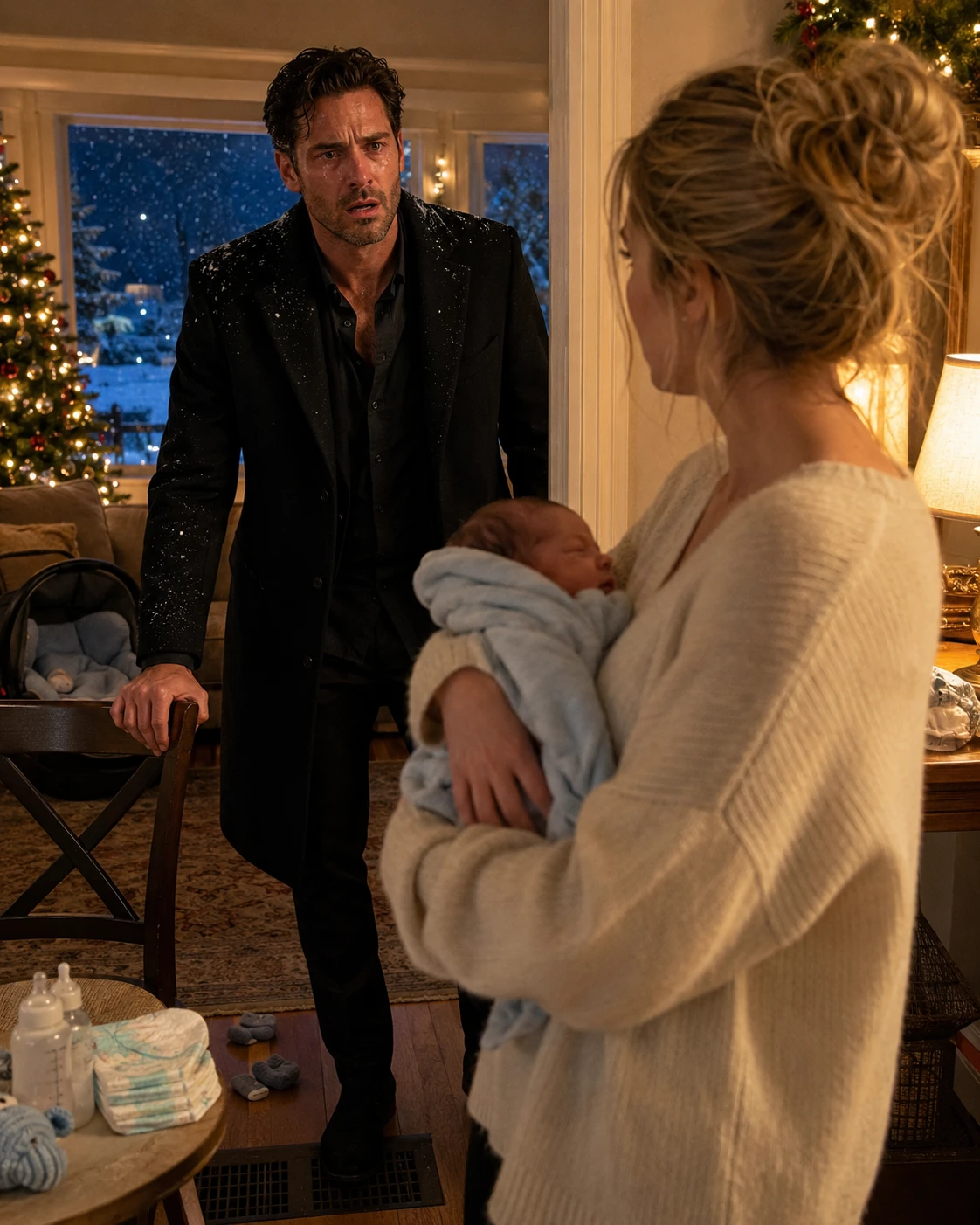
Inside, the house smelled of cinnamon, laundry soap, and something faintly sweet, like warmed milk. A fire burned low in the living room. There was no man’s coat on the rack. No extra wineglass. No deep voice calling from the kitchen.
Then I saw the baby carrier beside the couch.
My entire body went still.
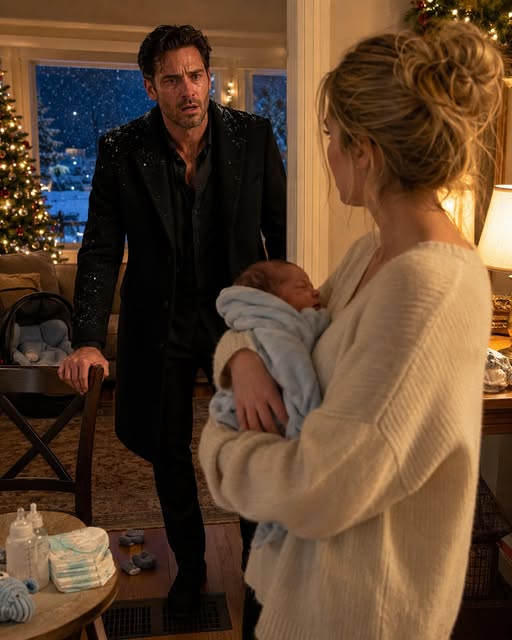
Tiny socks hung near a heater vent. A package of diapers sat open on a chair. Bottles lined the counter beside a blue drying rack. A folded blanket lay across the arm of the sofa, embroidered with small white clouds.
The room was not hiding a lover.
It was sheltering a life.
I turned slowly.
Emily stood in the doorway holding a newborn baby wrapped in a pale blue blanket. He was impossibly small, his face wrinkled and peaceful, one little fist resting beneath his chin. He slept against her chest like the world was safe, like the woman holding him had not been abandoned to face storms alone.
My mind began counting against my will.
Five months since the divorce.
Nine months since the last night Emily and I had spent together.
The last night had been strange, tender, almost desperate. We had already been living like two people on opposite sides of a frozen lake. But that evening, after another argument, Emily had come to the doorway of my study and said, “Do you ever miss me while I’m standing right in front of you?”
I had looked at her then. Really looked.
For one night, we had remembered the marriage before the money hardened it.
Now that memory stood before me, sleeping in her arms.
“Emily,” I said.
My voice broke before I could ask the question.
Her eyes filled. Her arms tightened around the child.
“Gavin,” she whispered, **“meet your son.”**
The floor seemed to move beneath me. I grabbed the back of a chair.
“My… what?”
The baby stirred, opened his tiny eyes for one brief second, and I saw green.
My green.
“No,” I breathed.
Not because I doubted her.
Because I believed her instantly, and belief was worse.
Emily’s face crumpled. “His name is Noah James Carter.”
Noah.
My middle name.
A sound tore out of me, somewhere between a laugh and a sob. I had signed billion-dollar deals without blinking. I had faced congressional hearings, hostile takeovers, public scandals, lawsuits that could have ruined other men. But nothing had ever made me feel smaller than that sleeping child.
**My son had entered the world without my hand, my voice, my protection, or my name.**
“Why?” I whispered. “Why didn’t you tell me?”
Emily stared at me as if I had asked why the house was burning while I stood there holding the match.
She opened her mouth.
Then three sharp knocks thundered against the front door.
The baby startled and began to fuss.
Emily went white.
Not pale. White.
The kind of terror that empties the blood from a face.
“Emily?” I said.
She did not look at me. She looked at the door.
“No,” she whispered.
Another knock. Slower this time.
Then a man’s voice came from the porch.
“Emily, open the door. I know he’s there.”
The strange thing was not that the voice sounded familiar.
The strange thing was that it sounded like mine.
## Part Two: The Man Wearing My Face
For several seconds, none of us moved.
The fire clicked in the hearth. Snow brushed the windows. Noah began to cry softly, a thin helpless sound that seemed to cut through all my arrogance and reach the one decent part of me still alive.
Emily backed away from the door.
“Don’t,” she whispered.
But I was already walking toward it.
“Gavin, please.”
“Who is that?”
Her eyes flickered with a misery so tangled I could not read it. “Someone who tried to warn me.”
“Warn you about what?”
The voice outside came again. “Emily. Your lights are on. I saw his car.”
I opened the door.
A man stood on the porch in a dark wool coat dusted with snow. He was perhaps my age, perhaps a few years rougher, with a narrow scar through his left eyebrow and hair gone gray at the temples. His hands were bare despite the cold. He held a manila envelope against his chest.
And he had my face.
Not a resemblance. Not the vague similarity of cousins or strangers people point out in airports.
**He had my face.**
The same jaw. The same eyes. The same mouth, though his had learned bitterness in a different school.
For the first time in my life, I saw what I might have looked like if money had never polished me.
The man stared at me.
“Well,” he said softly. “Merry Christmas, brother.”
I hit him.
I am not proud of that either.
My fist caught his cheek and sent him sideways against the porch railing. Emily cried out behind me. The envelope fell into the snow. The man straightened slowly, wiped blood from the corner of his mouth, and laughed without humor.
“That answers whether you knew.”
“Who the hell are you?” I demanded.
“My name is Theo Ward.”
“That means nothing to me.”
“It meant nothing to me either until I spat into one of those genealogy kits my daughter gave me for Father’s Day.” His eyes shifted past me toward Emily and the baby. “Is she all right?”
“She?” I said.
“Emily. And the baby.”
Rage flared again. “You stay away from them.”
Theo looked at me then, and for the first time I saw not mockery but pity.
“I have been trying to keep your family alive while you were too busy believing your mother.”
The word mother struck the air like a stone through glass.
Behind me, Emily whispered, “Let him in.”
I turned. “You know him?”
“I know enough.”
“Enough to let a man who looks like me come to your door on Christmas Eve?”
Her face tightened. “He came to my door before you did. And unlike you, he came to help.”
That landed harder than my fist had landed on him.
Theo bent, picked up the envelope, and stepped inside. I wanted to stop him. I wanted to throw him back into the snow and keep reality in its proper shape. But reality had already split open. My son was in my ex-wife’s arms. A stranger with my face stood dripping snow onto her rug. And somewhere beneath my anger, a colder question had begun to form.
What had Emily been afraid of?
Theo set the envelope on the coffee table. “Margaret’s attorney filed these at four this afternoon.”
“My mother’s attorney?” I said.
Theo looked at Emily. She nodded once.
He opened the envelope and handed me a sheaf of papers.
Emergency custody petition.
Mental health concern.
Postpartum instability.
Unfit environment.
Request for temporary guardianship of minor child Noah James Carter by Margaret Ellison Rowan.
At the bottom was a statement allegedly from me, Gavin Noah Rowan, supporting the petition.
My signature sat there in black ink.
I had not signed it.
Emily watched my face as I read. Her eyes were not accusing now. They were exhausted beyond accusation.
“I thought you knew,” she said.
I shook my head. “I have never seen this.”
“You expect me to believe that?”
“No.” My throat tightened. “But I’m asking you to.”
She shifted Noah against her shoulder. He had quieted, but his tiny mouth still trembled from crying.
I looked again at the forged signature. It was excellent. Not perfect, but excellent.
Theo said, “That is not the only thing forged.”
He pulled out printed emails, call logs, photographs, screenshots of messages. Some were from Emily to my office months earlier.
Gavin, I need to speak to you. It’s important.
Please call me back.
I’m pregnant.
Then replies from an address that appeared to be mine.
Do not contact me again except through counsel.
Any claim regarding pregnancy will be handled as an extortion attempt.
If you try to use a child to damage my reputation, I will bury you.
The room went silent.
I read the words once. Then again.
They were written in my style. Concise. Cold. Weaponized.
But I had never written them.
Emily’s voice was flat when she spoke. “After the first message, I thought you were angry. After the second, I thought you were cruel. After the third, I thought you were dangerous.”
I looked up. “Emily, I swear to you—”
“You swore many things to me.”
That stopped me.
Because she was right.
I had sworn to love her. To protect her. To listen before judging. I had broken those vows so quietly and so often that by the time the marriage ended, neither of us could identify the day it died.
Theo sat on the edge of the sofa. “There were also visits.”
Emily closed her eyes.
“What visits?” I asked.
She answered without looking at me. “A black SUV parked outside the clinic after my first appointment. Someone followed me home from the pharmacy. One night, a man stood across the street in the rain. He wore your coat.”
“My coat?”
“The charcoal one. The one with the silver buttons.”
I had donated that coat months earlier after my mother said it made me look tired.
Theo’s jaw tightened. “Margaret kept it.”
The fire seemed suddenly too hot.
“No,” I said, because some part of me was still a son before it was a man. “My mother can be controlling. She can be cruel. But this—”
“This is not control,” Emily said. **“This is a cage.”**
Theo leaned forward. “You want context? Your mother found out Emily was pregnant before Emily could reach you. She also found out Emily had been asking questions about Rowan Promise.”
At that name, my stomach tightened.
Rowan Promise was the division I had once been proudest of. We made emergency monitoring systems for older adults living alone—fall detection, medication alerts, direct hospital notifications. It began because my grandfather died on his kitchen floor after waiting nine hours for help that never came.
At least, that was the story I told in interviews.
Emily had once volunteered at a senior center that used our devices. She came home furious one afternoon and told me the equipment failed too often, that the poorest residents received refurbished units, that alerts were routed through understaffed call centers.
I had told her she did not understand scale.
She told me scale was the word men used when individual suffering became inconvenient.
That was one of our last real fights.
Theo tapped the envelope. “Emily kept digging. She found complaints your board buried. She found names. Elderly people, Gavin. Veterans. Widows. Retired teachers. People whose children thought your device was watching over them.”
I remembered Emily standing in my study, eyes bright with tears and anger.
“These are not numbers,” she had said.
And I, God forgive me, had replied, “Everything is numbers until it becomes a lawsuit.”
Now the sentence came back like a verdict.
Emily looked down at Noah. “I was going to tell you everything. The pregnancy. The devices. The threats. But then I got those messages. And then your mother came to see me.”
“My mother came here?”
“Not here. To my doctor’s office.” Emily’s mouth trembled. “She congratulated me. She touched my stomach without asking. Then she said Rowan children belong in Rowan houses.”
I could hear my mother’s voice in the sentence.
Cultured. Calm. Deadly.
“She told me,” Emily continued, **“that if I tried to keep the baby from the Rowan family, she would make sure a judge saw me as unstable, greedy, and alone.”**
“You should have told me.”
Her eyes flashed. “I did. Again and again. You never answered.”
I had no defense. Even if every message had been intercepted, even if every word had been forged, there remained the larger truth: Emily had believed I could say those things because I had spent years becoming the kind of man who might.
Outside, headlights washed across the curtains.
Theo stood.
Emily clutched Noah.
A black SUV stopped at the curb.
Theo looked at me. “That will be Margaret.”
## Part Three: The Things We Refuse to See
My mother had always understood entrances.
Margaret Rowan did not walk into rooms. She arrived as if history had been expecting her.
Even through the curtain, I could picture her: silver hair pinned perfectly, cashmere coat, diamonds small enough to seem tasteful and large enough to announce power. She had raised me to believe emotion was something one controlled in public and discharged in private, preferably where no one could use it against you.
“Go upstairs,” I told Emily.
She stared at me. “No.”
“Emily—”
“I will not hide in my own house while Rowan people decide what happens to my child.”
“Our child,” I said.
The words slipped out before I could examine them.
Her expression changed. Not softened. Not forgiven. But changed.
Theo moved to the window. “There are two men with her.”
“Security?” I asked.
“Lawyers do not usually wear earpieces.”
The old Gavin would have opened the door and commanded the room through force of name. But that version of me had already failed everyone present.
So I did something unfamiliar.
I asked, “What do you need me to do?”
Emily looked at me for a long moment. The baby slept against her chest, unaware that adults had arranged a battlefield around his first Christmas.
“Believe me,” she said.
That was all.
Believe me.
Not save me. Not fight for me. Not buy me justice.
Believe me.
The words entered me like medicine poured into a wound.
“I believe you,” I said.
Then I turned to Theo. “Is there another way out?”
He blinked, as if he had expected a command and received a man. “Back door. Alley behind the garage. My truck’s two blocks over.”
My mother knocked.
Not three sharp blows, but two elegant taps.
“Emily,” she called. “Open the door, dear. Let us not make this undignified.”
Emily’s face hardened. “She always says dear before she does something unforgivable.”
I almost laughed. The sound nearly broke me.
We moved quickly.
Theo took the diaper bag. I took a wool blanket from the chair, then hesitated because I did not know how to help with a newborn and hated myself for not knowing. Emily saw me standing there with the helplessness of a man who could buy hospitals but not swaddle a child.
“Hold this,” she said, handing me a small knit cap.
The cap fit in my palm like a blue prayer.
At the back door, Noah began to fuss again. Emily murmured to him, rocking gently.
“It’s all right, sweetheart. Mama’s here.”
Mama.
I had never heard her called that. The word transformed her before my eyes. She was not only the woman I had lost. She was the shelter my son knew before he knew language.
My mother’s voice came from the front porch again, cooler now.
“Gavin. I know you are inside.”
I stopped.
Emily whispered, “Do not answer.”
But another instinct rose in me, old and trained.
A son obeys.
A man chooses.
For once, I chose.
We slipped out into the snow.
Theo led us through the narrow alley behind the house, past garbage bins capped in white and fences strung with sleeping lights. Emily walked carefully, one hand protecting Noah’s head from the wind. I walked beside her, useless and desperate, wanting to carry something heavier than guilt.
At Theo’s truck, an old Ford with rust along the wheel wells, I opened the rear door.
Emily looked at it doubtfully.
“It runs,” Theo said. “Which is more than I can say for most things in this family.”
The absurdity of it struck us all at once. Emily let out a shaky laugh. It became a sob. She pressed her forehead to Noah’s blanket.
“I am so tired,” she whispered.
Something inside me tore.
Not dramatically. Not like thunder.
More like old fabric giving way at a seam.
“I know,” I said. “I should have known sooner.”
She looked at me then. “Yes. You should have.”
We drove away while my mother stood on Emily’s porch, framed by Christmas lights, looking into an empty house.
Theo drove. Emily sat in the back with Noah. I sat beside Theo, watching the city blur through snow.
“Where are we going?” I asked.
“To meet the woman who lost us both,” Theo said.
I turned.
He kept his eyes on the road.
“What does that mean?”
“It means Margaret Rowan was never your mother.”
The sentence did not land at first. It hovered, impossible.
Then Theo continued.
“Not by blood.”
I stared at him. “You are lying.”
“I wish I were. Lying would have saved me thirty years of wondering why every family that took me in eventually sent me back.”
Emily spoke softly from the back seat. “Gavin, listen to him.”
I could not look at her.
“Who?” I asked.
Theo swallowed. “Her name is Evelyn Ward. She is seventy-nine. She lives at St. Agnes Memory Care. She gave birth to twin boys in a charity ward the week before Christmas, 1963. She was told one died. Then she was told the other had been transferred and died too.”
The truck heater rattled.
I heard my own heartbeat.
“No.”
Theo gave a bitter smile. “That seems to be your favorite word tonight.”
“My father—”
“Howard Rowan and Margaret had a stillborn son that same night at the same hospital. They had money. Evelyn had none. Records disappeared. Nurses retired early. One infant became Gavin Rowan. The other became Theodore Ward, property of the county until someone needed a temporary tax deduction or a farmhand.”
I wanted to strike him again, but not because I thought he lied.
Because some part of me believed him.
I thought of my mother refusing childhood photographs before age three. “You were a sick baby,” she had always said. “We did not want reminders.”
I thought of my father’s distance. Howard Rowan had never been cruel exactly, only uninterested, as if I were an investment performing adequately but without charm.
I thought of Emily once saying, after a tense dinner at the Rowan estate, “Your mother looks at you like she owns you.”
I had answered, “She made me who I am.”
Now Theo said quietly, **“That may be the one true thing she ever told you.”**
St. Agnes Memory Care sat on a hill overlooking Lake Washington, an old brick building with a chapel on one side and strings of colored lights around the entrance. Inside, the lobby smelled of pine disinfectant and sugar cookies. A group of residents sat near a piano, singing “Silent Night” in voices cracked but earnest.
I had donated three million dollars to this place and never visited.
Emily knew everyone by name.
“Merry Christmas, Mr. Alvarez,” she said to a man in a wheelchair.
“You brought the baby!” he called.
“Just for a little while.”
An elderly woman with careful lipstick waved from beside the piano. “Emily, I saved you a cookie.”
Emily smiled, and the smile struck me like sunlight through a boarded window. This was the world she had chosen after leaving mine. It was smaller, yes. But it was human.
Theo led us down a hall to Room 214.
A woman sat by the window in a blue robe, watching snow fall through darkness. Her hair was white and thin, braided over one shoulder. Her hands rested folded in her lap.
“Evelyn,” Theo said gently.
She turned.
Her eyes moved over him, then me.
For a moment, the room stopped breathing.
She lifted one trembling hand.
“Two,” she whispered.
Theo closed his eyes.
I could not move.
Emily stepped forward with Noah.
Evelyn looked at the baby, and tears spilled down the soft worn map of her face.
“They told me Christmas took my boys,” she said. “But Christmas brought them back.”
I had no memory of this woman. No duty to love her. No story that included her.
Yet when she began humming a lullaby, something in my bones recognized grief older than language.
I sat beside her.
She touched my cheek.
“You were the quiet one,” she said.
I laughed once, brokenly. “I’m not sure anyone would agree.”
She smiled. “A mother knows.”
My mother, I thought.
Then corrected myself.
Margaret.
Emily stood behind me, Noah sleeping against her shoulder. In that room, with carols floating faintly through the hall, the life I had defended so fiercely began to look like an expensive coat sewn from stolen cloth.
## Part Four: The Woman Who Built a Kingdom from Silence
Dawn came gray and cold.
Christmas morning.
At any other time, I would have awakened to staff, schedules, messages, and the particular loneliness of important men. Instead, I woke in a vinyl chair at St. Agnes with my neck aching, my son sleeping in a bassinet borrowed from the nurses’ station, my ex-wife curled beneath a blanket on a small sofa, and my twin brother drinking coffee that looked strong enough to strip paint.
I had slept perhaps twenty minutes.
In that time, the world had rearranged itself.
Theo had spent the night showing me documents. Birth records with altered dates. A nurse’s sworn statement taken before her death. DNA reports. Photographs of Evelyn Ward at twenty-two, holding one newborn while a second bassinet stood beside her bed.
There was also evidence of the forged messages to Emily. My executive assistant, Claire, had rerouted personal emails marked Carter through a private server controlled by Margaret’s attorney. Security footage showed one of my old coats being removed from storage at the Rowan estate. The custody petition had been prepared six weeks before Noah was born.
My mother had not reacted to events.
She had planned them.
At six-thirty, I called an emergency meeting of the Rowan Technologies board for nine o’clock. I told them attendance was mandatory. I also called my personal attorney, not the firm my mother used, and sent copies of everything to a federal investigator Emily trusted from her work with the senior center.
Then I called Margaret.
She answered on the first ring.
“Gavin,” she said. “Where is the child?”
Not Emily.
Not my grandson.
The child.
I looked through the glass window into the room where Emily slept beside Noah.
“With his mother.”
A pause.
“You sound tired.”
“I am seeing things clearly for the first time. It takes effort.”
Her tone cooled. “Do not be dramatic. Emily is unstable, and that man with her is dangerous. I do not know what story he has told you, but—”
“His name is Theo Ward.”
Silence.
There it was.
Not surprise.
Calculation.
“You should come home,” she said.
“I am going to the board.”
“You will do no such thing.”
“I will be there at nine.”
“Gavin, listen to me carefully. Everything you have, everything you are, exists because I protected you.”
I closed my eyes. “From whom?”
Another pause.
Then she said, “From the kind of life that ruins people before they are old enough to deserve it.”
I thought of Theo in foster homes. Evelyn in a memory ward. Emily alone in a clinic parking lot, one hand over her unborn child while a black SUV idled across the street.
“You did not save me,” I said. **“You selected me.”**
Her breath sharpened.
For the first time in my life, I hung up on Margaret Rowan.
At nine o’clock, Rowan Tower rose above downtown Seattle like a black glass monument to appetite. Snow gathered along the ledges. The lobby’s Christmas tree glittered with silver ornaments, each one identical, each one placed by professionals.
Emily did not want to come.
“I have spent enough of my life being judged in Rowan buildings,” she said.
“I will not ask you to stand beside me.”
“You are asking without asking.”
She was right.
So I told her the truth.
“I am afraid.”
She looked at me then, not tenderly, but honestly. “Good. Fear may make you careful.”
Theo laughed from the doorway. “That is the warmest encouragement this family has produced in decades.”
Emily almost smiled.
We took Noah with us because Emily refused to let him out of her sight, and I had already learned not to confuse protection with control.
The boardroom on the forty-seventh floor was full when we arrived. Twelve directors sat around the long walnut table. Some had worked with me for years. Some owed their fortunes to my decisions. All of them looked annoyed at being summoned on Christmas morning until they saw Emily, the baby, and Theo.
Then annoyance became hunger.
Men and women who had spent their lives smelling scandal could taste it in the air.
Margaret stood at the windows.
She wore winter white.
She looked magnificent.
She looked monstrous.
“Gavin,” she said. “End this before you humiliate yourself.”
I walked to the head of the table.
For years, that chair had seemed like a throne. That morning, it looked like a witness stand.
“No,” I said.
A few directors shifted.
My mother’s eyes narrowed. “You are unwell.”
“I am ashamed. There is a difference.”
Emily stood near the door with Noah. Theo stood beside her, arms folded.
I placed the documents on the table.
“Rowan Technologies has hidden safety complaints from Rowan Promise customers, including elderly clients whose emergency alerts failed. We will be turning over all internal records to federal authorities as of today.”
The room erupted.
“Gavin—”
“This is insane—”
“On whose authority?”
“Mine,” I said. “For the next ten minutes.”
Margaret stepped forward. “You will destroy your father’s company.”
“No.” I looked at Emily. “That was done long before today.”
Then Theo placed the DNA reports on the table.
I watched Margaret’s face.
It was like watching a marble statue develop a crack.
“This,” I said, “concerns my birth.”
One director, old Samuel Pike, leaned forward. “Your birth?”
Margaret’s voice was low. “Do not.”
I almost obeyed.
Even then.
Even after everything.
That is the terrible power of the person who raised you. Their command remains in your bones long after your mind has rejected it.
Emily seemed to sense it. She shifted Noah gently, and his tiny face turned toward me.
My son.
My future.
Not an asset.
Not a weapon.
A child.
I continued.
“My legal identity appears to have been built on falsified hospital records. Theo Ward is my identical twin brother. Our biological mother, Evelyn Ward, was told both her sons had died.”
The boardroom went silent.
Margaret laughed once. “This is sentimental theater.”
Theo’s voice cut in. “I have the nurse’s statement.”
“A dying woman’s confusion.”
“Bank transfers?”
“Old accounting errors.”
“DNA?”
“Coincidence dressed up by desperate people.”
I looked at her. “Emily’s emails?”
Margaret’s gaze flicked to Emily. “Your ex-wife is not as innocent as you believe.”
Emily lifted her chin. “No. I am not innocent. I made the mistake of loving your son longer than was wise.”
My mother’s mouth tightened.
Then Emily walked to the table and placed a worn leather folder beside the documents.
“I found this after my father died,” she said. “I did not understand all of it until Theo helped me connect the dates.”
I frowned. “Emily?”
She looked at me, and there was sorrow in her eyes that had nothing to do with our divorce.
“This is the part I was trying to tell you before everything went bad.”
Margaret said sharply, “Be quiet.”
Emily did not.
“My father, James Carter, was an engineer. Not famous. Not rich. He worked nights repairing hospital equipment and spent years designing a pendant that could detect falls and send emergency calls through a home phone line. He built it after my grandmother broke her hip and lay alone until morning.”
The room seemed to tilt again.
Emily opened the folder.
Inside were old sketches, patent drafts, dated letters, and a photograph of a younger James Carter standing beside a prototype device.
On the top page was a name written in blue ink.
Carter HomeGuard System.
Emily’s voice trembled, but she did not stop.
“Howard Rowan met my father through a hospital charity board. He offered to invest. Instead, he took the designs, filed modified patents through Rowan Medical Systems, and buried my father in legal threats until he gave up.”
No one spoke.
I stared at the sketch.
It looked crude, almost primitive.
But I recognized the architecture.
The foundation of Rowan Promise.
The moral story I had told for years—the grandfather on the kitchen floor, the company born from grief—had been true.
But it had not belonged to us.
It had belonged to Emily’s family.
I looked at her. “Why didn’t you tell me?”
A sad smile touched her mouth. “I tried.”
The three words were so simple that they crushed me.
I tried.
She had tried to tell me about the baby. The threats. The elderly residents. Her father’s stolen work.
And I had not heard her because I had stopped listening long before she spoke.
Margaret’s composure finally snapped.
“You foolish girl,” she hissed. “Your father was a tinkerer with no capital and no vision. Howard made that device matter. Howard made it scale.”
Emily’s eyes filled, but her voice stayed steady.
“My father died in a rented room with a box of rejected letters under his bed. Your husband died with his name on a building.”
Margaret turned to me. “Gavin, do not let nostalgia confuse you. Wealth is not stolen simply because poorer people had ideas first.”
There it was.
Not denial.
Philosophy.
The gospel of every empire built on someone else’s hunger.
I looked at the board, at the people who had applauded me for being brilliant, decisive, ruthless. Then I looked at Emily, who had once asked me to see people instead of numbers. Finally, I looked at Noah.
The baby yawned.
A tiny ordinary yawn.
The most powerful thing in the room.
“I resign as CEO effective immediately,” I said.
Chaos exploded.
Margaret went still.
I continued over the noise. “My shares will be placed in trust pending legal review of the Carter patents, the Ward identity fraud, and the Rowan Promise investigation. I will cooperate fully. I will not defend the indefensible to preserve a name that was never mine.”
Margaret whispered, “You ungrateful boy.”
I looked at her then—not as a child, not as an heir, but as a man finally standing outside the cage.
“You taught me gratitude meant obedience,” I said. **“My son will learn it means truth.”**
## Part Five: The Name We Chose
By noon, the story had already begun to leak.
By evening, Rowan Technologies had lost billions in market value.
By New Year’s, Margaret Rowan was under investigation for fraud, coercion, and conspiracy. Claire resigned before she could be fired. Several board members discovered, with great moral urgency, that they had always had concerns.
That is how power behaves when the lights come on.
It points at someone else’s shadow.
I did not return to the penthouse for three weeks.
Emily did not invite me back into her life simply because I had finally done one decent thing. That is important. People like the idea that a grand gesture repairs what daily neglect destroyed. It does not. **Trust is not rebuilt by thunder. It is rebuilt by weather. Day after day. Small mercy after small mercy.**
I rented a modest apartment near St. Agnes. Not humble, exactly—I was still learning that word—but quiet enough to hear myself think. I visited Evelyn every morning. Some days she knew me. Some days she called me by Theo’s name. Some days she looked at me with the polite confusion reserved for strangers in nursing homes.
But on Christmas week, she had given me one gift that no court could validate and no scandal could diminish.
She had touched my face and called me son.
Theo and I learned each other awkwardly.
He had a grown daughter in Spokane and two grandchildren who called him Pops. He distrusted expensive restaurants, lawyers, and anyone who used “circle back” in conversation. He had spent thirty-eight years as a mechanic, which meant he could fix almost anything except his opinion of me.
“You talk like a board meeting even when you ask for coffee,” he told me once.
“You dress like a man who lost a fight with a thrift store,” I replied.
He smiled. “There may be hope for you.”
Emily watched us from a careful distance.
She let me see Noah every afternoon at first, then evenings, then mornings when she was too tired to argue with her own compassion. I learned how to warm bottles, how to support his head, how to change diapers without looking like a man defusing a bomb.
The first time Noah fell asleep on my chest, I cried so quietly I thought Emily did not notice.
She noticed.
She always had.
One evening in January, snow began again while we sat in her kitchen. The same kitchen where I had once imagined another man drinking wine. Noah slept in a bassinet near the stove. Emily poured tea. She moved slowly, still recovering, still carrying the invisible weight of months spent afraid.
“I need to ask you something,” I said.
She sat across from me. “All right.”
“Did you name him Noah because of me?”
She looked down into her cup. “Partly.”
Partly.
The word opened a door.
“And James?” I asked.
Her eyes lifted.
“My father.”
I nodded. “The real beginning of Rowan Technologies.”
“The beginning of something,” she said. “My father never wanted an empire. He wanted old people to be able to call for help when they fell.”
That sentence stayed between us.
Simple.
Devastating.
I thought of how many times I had stood on stages beneath my own name, speaking about innovation, legacy, transformation. I had used language polished enough to hide the human handprints beneath it.
“Emily,” I said, “I am sorry.”
She closed her eyes.
“I know I have said that before,” I continued. “And I know apologies can become another kind of demand when a man expects forgiveness in return. I am not asking for that. I am sorry for not listening. For making you lonely inside a marriage. For letting my mother’s voice become louder than yours. For becoming someone you had to escape.”
A tear slipped down her cheek.
“I loved you,” she said.
I swallowed. “Past tense?”
She smiled sadly. “I don’t know what tense grief uses.”
We sat there with the tea cooling between us.
Then Noah sighed in his sleep, a tiny old-man sound that made us both laugh.
That was the first moment I believed our story might not be over.
Not restored. Not erased. Not made clean.
But continued.
In March, the first settlement was announced. A fund was created for every Rowan Promise customer harmed by device failures or ignored alerts. The Carter designs were legally acknowledged as foundational prior art. Emily refused a private fortune in exchange for silence. Instead, she established the James Carter Home Safety Foundation, dedicated to providing reliable emergency devices to seniors who could not afford them.
Theo joined the board.
He insisted the first rule be: “No one uses the word scale unless they can name three people being scaled.”
Emily laughed for nearly a minute.
I had not heard that sound in years.
Margaret’s trial took longer. She never apologized. Not to Evelyn. Not to Theo. Not to Emily. Not to me. In her mind, theft committed for legacy became sacrifice. Cruelty committed for family became protection.
The last time I saw her before sentencing, she sat across from me behind a glass partition, still perfectly dressed.
“You gave up everything,” she said.
“No,” I told her. “I gave up what was never mine.”
Her eyes hardened. “And what did you get in return?”
I thought of Noah gripping my finger. Emily asleep on the sofa while I washed bottles. Theo teaching me how to change oil in a truck older than some executives. Evelyn humming a lullaby to two gray-haired sons.
“A life,” I said.
She looked away first.
Spring came slowly that year.
On Easter Sunday, Emily invited me to her house for dinner. Theo came with his daughter and grandchildren. Mr. Alvarez from St. Agnes came too, wearing a tie with painted rabbits on it. Evelyn was brought by a nurse and spent most of the afternoon smiling at the baby.
Emily’s blue house was too crowded, too warm, too noisy.
Perfect.
After dinner, I stood on the porch watching the sunset stain the neighborhood gold. Emily came out beside me with Noah in her arms. He was bigger now, round-cheeked and alert, studying the world as if he had serious concerns about its management.
“He looks like you when he frowns,” Emily said.
“Poor child.”
She laughed softly.
For a while, we watched Theo’s grandchildren chase each other through the yard.
Then Emily said, “I’m still angry.”
“I know.”
“I still wake up some nights thinking someone is at the door.”
“I know.”
“I don’t know if I can ever be your wife again.”
The words hurt, but they did not destroy me. Love, I had learned, is not proven by demanding a happy ending.
“I would rather be trusted slowly,” I said, “than forgiven falsely.”
She looked at me.
Noah reached out and grabbed my collar with surprising strength.
Emily smiled. “He wants you.”
I took him carefully. Even after months, I still treated him like a miracle that might object to poor handling.
He stared at me with those green eyes.
My eyes.
Theo’s eyes.
Evelyn’s eyes.
Not Rowan eyes.
Ward eyes.
Human eyes.
And here is the twist I did not understand until that exact moment, standing on the porch of the house I once entered like a thief:
**I had gone to Emily’s home on Christmas Eve to catch the man who had replaced me.**
**I found my son.**
**I found my brother.**
**I found my mother.**
**I found the woman whose father my family had robbed.**
But the most shocking truth was not that my life had been stolen from someone else.
It was that I had been the thief too.
Not by forging papers. Not by switching babies. Not by stealing patents.
By believing love could wait outside the boardroom until I had time for it.
By believing silence was peace.
By believing a woman’s pain was less urgent than a company’s reputation.
By believing money could build a home.
Noah pressed his tiny hand against my cheek.
Emily watched us, her face soft with caution.
Inside, Theo began singing off-key with the children. Evelyn’s laughter rose from the living room, thin and bright as a bell.
The ceramic angel in Emily’s window glowed behind us, chipped wing and all.
It did look as if it had survived a fire.
I finally understood why Emily had kept it.
Some things are not beautiful because they were never broken.
**Some things are beautiful because they were broken, burned, abandoned, and still found a way to hold light.**
I looked at Emily.
“I don’t deserve another chance,” I said.
“No,” she replied.
Then she reached over and touched Noah’s blanket, her fingers brushing mine.
“But maybe he deserves to see us try.”
Snow was gone from the porch by then. Christmas had passed. The old world had ended.
And in the small blue house at the end of the block, with my son breathing against my chest and the woman I loved standing beside me—not behind me, never again behind me—I understood that the greatest inheritance I could give Noah would not be my name, my fortune, or my company.
It would be the truth.
All of it.
Even the parts that hurt.
Especially those.