## PART ONE — THE KISS I NEVER GOT
**“Can you kiss me?”** I whispered it before I even saw his face.
It was not the sort of thing a woman like me said. At fifty-seven, I had survived a divorce, raised a son through his angry years, buried both parents, and learned how to smile through board meetings where men repeated my ideas louder and received applause for them. I had learned dignity the hard way. I had worn it like pearls.
But dignity has a cruel habit of abandoning a woman at the precise moment she needs it most.
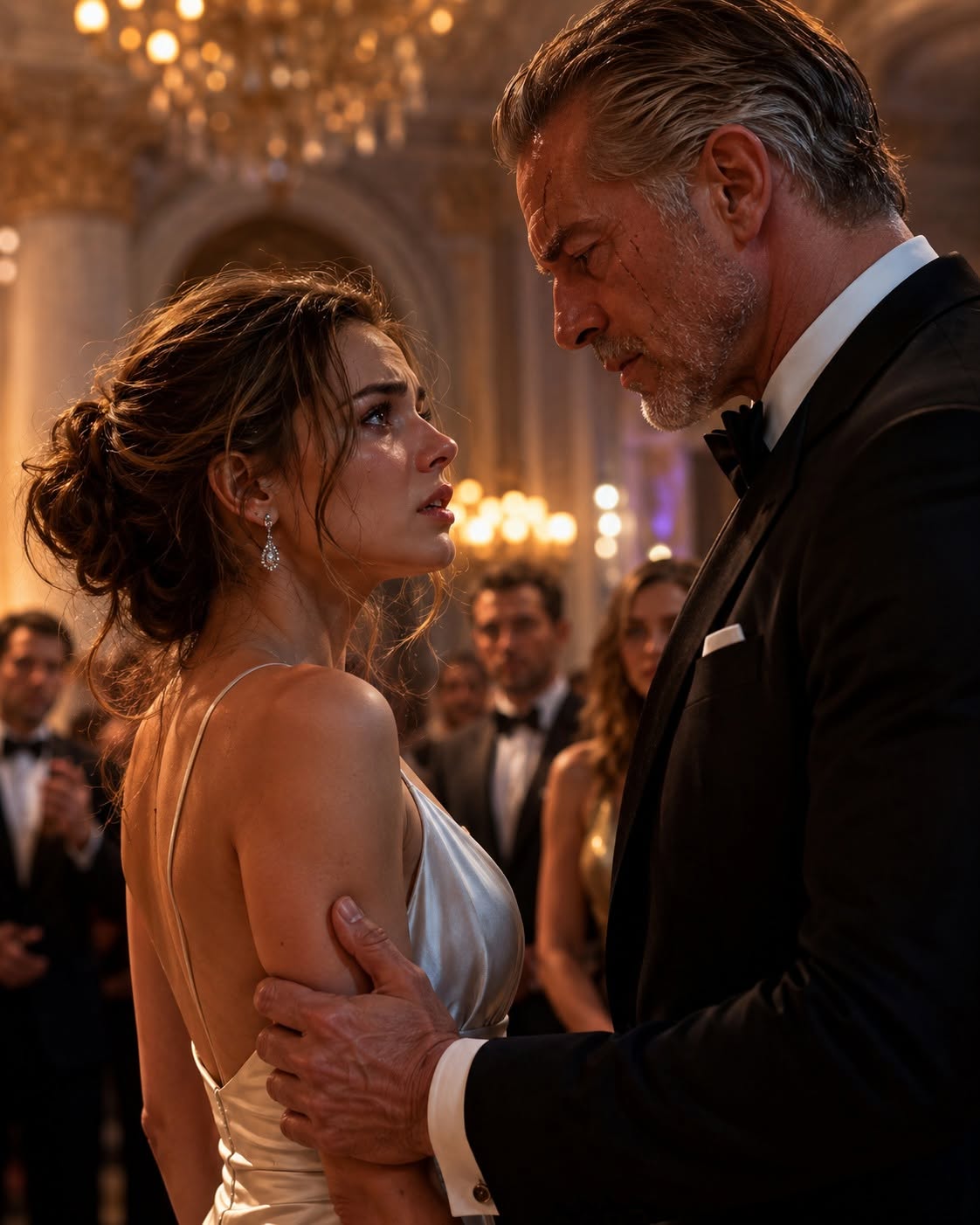
Across the ballroom of the Sterling Hotel, beneath chandeliers the size of small moons, my fiancé had his hand on my sister’s waist.
Nathan Wexler’s fingers rested there with a familiarity no man should have with his future sister-in-law. His collar was crooked, his silver hair mussed at the temple, his smile soft with the lazy satisfaction of a man who believed no one had seen him do anything wrong.
Maribel stood pressed close to him in a sapphire dress I had helped her choose. Her lipstick was smudged at one corner. Her eyes were bright, not with guilt, but with triumph.
**My sister had spent eight months stealing the man who had placed a diamond on my finger.**
I had built that gala for Nathan. I had written his speech, selected the roses, seated the donors, called in favors, soothed egos, and convinced half of Chicago’s aging elite that his charitable foundation was not merely another tax shelter dressed in compassion.
And now I was the fool in an ivory dress, gripping a stranger’s sleeve and begging him to save what little pride I had left.
“Please,” I said again. “Kiss me. I want to make him jealous.”
The man beside me did not answer.
For one terrible second, I thought he would laugh. Worse, I thought he would pity me. There are looks a woman over fifty knows too well—the soft tilt of the head, the sad eyes, the silent conclusion that heartbreak in middle age is somehow embarrassing. As if love after youth is a costume one should have put away.
Then he turned.
The air around me changed.
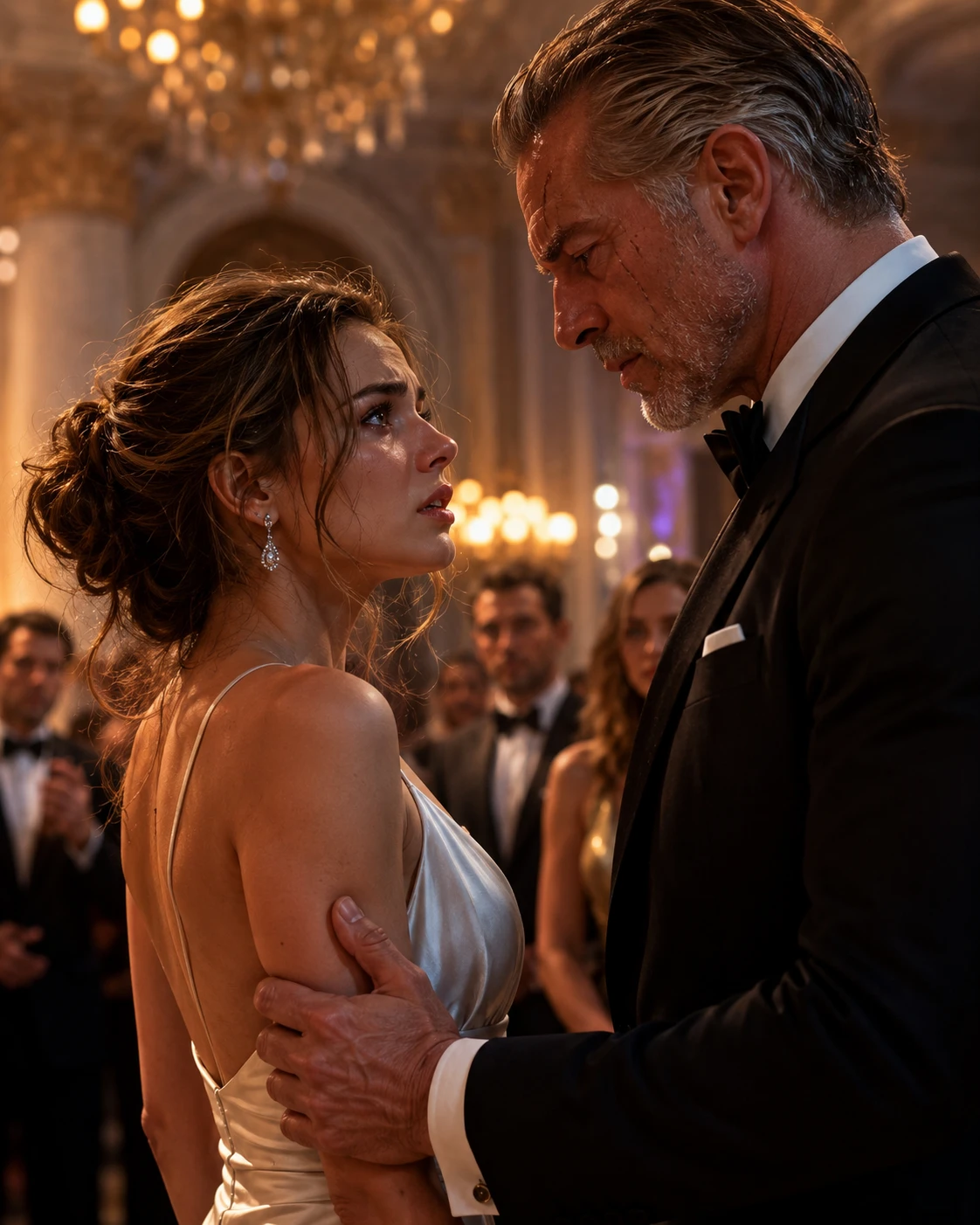
He was older, perhaps sixty, though there was nothing frail about him. Tall. Broad-shouldered. Silver at the temples. A scar cut through one eyebrow, pale and clean like lightning preserved beneath skin. His black suit was simple, expensive, and not trying to impress anyone. He had the kind of stillness that made loud men lower their voices.
“I know this sounds insane,” I said, my fingers still clenched around his sleeve. “But the man near the archway is my fiancé, and he’s been cheating on me with my sister.”
The stranger’s eyes moved past me.
“To the left of the marble column?” he asked.
I nodded.
A small part of me wanted him to say I was wrong. I wanted him to explain that Nathan had merely been steadying Maribel after too much champagne. That the scene I had witnessed eighteen minutes earlier in the service corridor had been grief, confusion, a misunderstanding.
But I had seen Nathan’s hands in her hair.
I had seen Maribel’s back against the wall.
I had heard her whisper, “Vivian will never know.”
**Nothing ages a woman faster than realizing she has been the last to learn the truth of her own life.**
“I just need him to see I won’t collapse,” I said.
The stranger’s mouth barely moved. “He noticed me before he noticed you.”
A chill passed through me.
I looked again.
Nathan had gone pale. Not angry. Not jealous. Pale.
Maribel’s smile thinned. Her hand slipped from his arm.
“What does that mean?” I whispered.
“It means your fiancé isn’t afraid of losing you yet,” the stranger said. “He’s afraid of who you’re standing beside.”
I turned back slowly. “Who are you?”
His gaze lowered to mine.
“Dominic Bellardi.”
The name traveled through the room faster than music. A man at the bar froze with his glass halfway to his mouth. One of Nathan’s board members turned sharply, as though looking away could erase what he had heard. A woman near the orchestra crossed herself.
I knew that name the way respectable families knew certain names—through warnings, locked doors, and whispers adults ended when children entered a room.
Dominic Bellardi. The old boss of South Chicago. The billionaire who owned vineyards, hotels, politicians, and men who thought themselves untouchable. Newspapers called him a retired organized crime figure because newspapers have always preferred polite lies.
My hand loosened.
Before I could step back, he caught my fingers.
Not tightly. Not cruelly.
He turned my palm upward, as though there might be a wound there.
“Walk with me,” he said.
“I asked you to kiss me,” I said, because heartbreak had made me reckless.
“I heard you.”
“You haven’t said yes.”
His eyes remained on Nathan. “I haven’t said no.”
Then his hand settled at the small of my back.
It was not possessive. Not theatrical. Just steady.
And because my knees were trembling, I let him guide me across the ballroom.
Every step felt like crossing a courtroom where I was both the accused and the evidence. Conversations died as we passed. Crystal glasses lowered. The violinist missed a note and recovered too quickly.
Nathan tried to smile when we reached him, but the expression collapsed halfway.
“Vivian,” he said too loudly. “You don’t know who that man is.”
Dominic stopped in front of him.
“No,” Dominic said. “But you do.”
The silence was so complete I heard my own pulse.
Nathan’s jaw tightened. Maribel looked from him to Dominic, her confidence draining like color from wet silk.
Dominic reached inside his jacket.
For one wild second, I thought of guns, old newspaper headlines, bodies pulled from rivers.
Instead, he removed a sealed black envelope.
My name was written across it in white ink.
**Vivian Eleanor Hart.**
My full name.
Not Vivian Wexler, as the gala program already presumed I would be.
Not Mrs. Nathan Wexler, as the donors had begun calling me.
Vivian Eleanor Hart.
The name I had fought to reclaim after my divorce. The name I had nearly surrendered again for the sake of one last chance at love.
Dominic handed me the envelope.
“What is this?” I asked.
“The reason I came here tonight.”
Nathan lunged a half step forward. “Don’t open that.”
His voice broke on the word open.
Maribel stared at him. “Nathan?”
I looked at my fiancé—the man who had kissed my forehead that morning and told me I made him want to become better. The man whose foundation I had rescued from scandal. The man who had promised me a late-life marriage built not on hunger, but peace.
Then I looked at Dominic Bellardi, whose eyes held no pity at all.
Only patience.
Only certainty.
**That was when I understood: humiliation had been the smallest truth in the room.**
I broke the seal.
## PART TWO — THE ENVELOPE WITH MY NAME ON IT
Inside the envelope was a photograph, a bank record, and a letter written on heavy cream paper.
The photograph was old. Not ancient, but softened by time. A young woman stood on the steps of a church in a pale blue dress, her dark hair pinned under a small hat. She looked painfully familiar, though I could not place her.
Beside her stood a man I recognized immediately.
My father.
Not the tired, gray, quiet father of my childhood, who smelled of pipe tobacco and machine oil. This man was young, handsome, unsmiling. His hand rested on the woman’s shoulder with tenderness so private it felt indecent to witness.
My throat tightened.
“That’s impossible,” I whispered.
Dominic’s voice softened. “No, Vivian. It is not.”
Nathan said, “This is absurd. Vivian, hand it to me.”
I did not.
I unfolded the letter.
My hands shook so badly the paper whispered.
Dear Vivian,
If this has reached you, then either I am dead, or I have failed to protect you in person.
My name is Elena Bellardi.
I was your mother.
The ballroom vanished.
Not slowly. Instantly.
The chandeliers blurred. The music became water. Someone gasped, perhaps Maribel, perhaps me. My breath left my body in a sharp, ugly sound.
My mother had been Margaret Hart. Gentle Margaret, who baked lemon cakes on Sundays and kept a rosary beside the telephone. Margaret, whose hands smelled of lavender soap. Margaret, who died when I was thirty-one and whose grave I visited every Christmas Eve.
I heard myself say, “No.”
Dominic said nothing.
Nathan whispered, “Vivian, don’t listen to him.”
I turned on him with a fury so sudden it burned through shock.
“Did you know about this?”
His silence answered before his mouth did.
Maribel stepped away from him. “Nathan?”
He reached for my arm. “Vivian, this is complicated.”
I slapped his hand away.
**There are moments when grief becomes a blade sharp enough to cut fear in half.**
“Did you know?”
Nathan looked around the ballroom, measuring witnesses, donors, cameras. Always measuring. Always calculating.
“Yes,” he said finally. “But not the way he’s making it sound.”
Dominic’s smile was thin. “And how should it sound, Nathan?”
Nathan’s eyes flashed. “Like old history. Like something that would have hurt her for no reason.”
“No reason?” My voice rose. “You knew I might have another mother and you decided that was yours to keep?”
“I was protecting you.”
A laugh escaped me, brittle and unfamiliar. “From what? The truth? Or from him?”
Nathan said nothing.
Dominic looked at me. “Your father married Margaret after Elena died. Margaret raised you. By every decent measure, she was your mother. But she did not give birth to you.”
The letter trembled in my grip.
I read on.
I gave you to Thomas because my family was at war, and because I believed distance was the only mercy I could offer my child. I made him swear you would never carry the Bellardi name. Not because I was ashamed of you. Because I loved you enough to let you be ordinary.
Ordinary.
All my life, I had longed to be something more than ordinary. I had clawed my way into rooms where men like Nathan smiled at me as if I were useful but never essential. I had believed elegance, marriage, money, and admiration might finally prove I had mattered.
And there, in a dead woman’s hand, was the reason I had been ordinary by design.
I looked at Dominic. “Who was Elena to you?”
His face changed.
It was subtle. The lowering of his eyes. The tightening of his mouth. The first crack in the wall.
“My sister.”
My heart struck hard.
“Your sister?”
He nodded. “My younger sister. My favorite trouble. My worst loss.”
I heard Maribel begin to cry softly. I wanted to comfort her out of habit and hated myself for it.
Nathan stepped closer. “Vivian, whatever he says, remember who he is.”
Dominic did not even glance at him. “Yes. Remember who I am.”
He turned to Nathan.
“And remember what you are.”
Nathan’s face hardened. “Careful.”
Dominic’s laugh was quiet. “I have been careful for thirty-five years.”
A waiter dropped a tray somewhere behind us. Glass shattered. No one moved.
I forced myself to look at the bank record.
It showed a trust account in my name.
Not a modest trust.
Not a generous one.
An impossible one.
My eyes stumbled over the figure three times before understanding it.
**Two hundred and forty million dollars.**
I stopped breathing.
“This is fake,” I said.
“It is not,” Dominic replied.
Nathan spoke quickly. “Those funds are disputed.”
Dominic tilted his head. “By thieves.”
The word hit Nathan like a slap.
My mind began assembling terrible pieces.
The way Nathan had appeared in my life eighteen months earlier at a charity luncheon. The way he had admired my practicality. The way he had said, almost dreamily, that a woman with no children at home and no demanding family obligations was a gift to a man trying to rebuild his legacy. The way he had proposed quickly, sweetly, with a ring I later learned had belonged to his grandmother.
The way he insisted my name be added to certain foundation documents.
The way he hired an attorney to “simplify things” before the wedding.
The way he encouraged me to trust him with “our future.”
My voice came out flat. “You were marrying me for the money.”
Nathan’s face flushed. “No.”
Dominic said, “Yes.”
Maribel sobbed. “Nathan, tell her that isn’t true.”
Nathan looked at my sister, and in that look I saw the answer to a second question I had not yet asked.
He had not loved her either.
Maribel had been, like me, a tool.
Prettier perhaps. Younger by four years. Easier to flatter. But still a tool.
I almost laughed.
**My sister and I had spent our lives competing for crumbs from people who were feeding on both of us.**
“Nathan,” I said, “what did you need from Maribel?”
He closed his mouth.
Dominic answered for him. “Access.”
“To what?”
“To you.”
Maribel shook her head. “I don’t understand.”
But I did. Or I was beginning to.
Maribel knew my passwords. My habits. My fears. My sentimental weaknesses. She knew the name of my first dog, the year my son was born, the street where I lived at nine years old. She knew which documents I ignored and which letters I would open.
She had always been able to get inside my life because I had always left the door unlocked for her.
Nathan’s hand went to his pocket.
Dominic’s voice sharpened. “Don’t.”
Two men in black suits I had not noticed before moved from the edge of the room. They did not rush. They simply appeared, and Nathan’s hand froze.
He laughed bitterly. “So that’s it? You ruin me in public?”
“No,” Dominic said. “You did that when you put your hands on her sister in a hallway while planning to rob her before marriage.”
My skin burned. People were listening. Every word would be repeated. Every humiliation preserved.
I turned to Dominic. “Why tonight?”
His eyes met mine.
“Because tomorrow morning, you were scheduled to sign documents transferring control of your trust into a marital management account.”
Nathan’s face went gray.
I whispered, “I didn’t know.”
“No,” Dominic said. “That was the point.”
I thought of the binder Nathan’s attorney had sent. The sticky notes. Sign here. Initial here. Nothing urgent, darling, just housekeeping before the honeymoon.
Housekeeping.
He had nearly swept my life into his pocket.
Maribel stepped toward me, crying harder now. “Vivian, I swear I didn’t know.”
I wanted to hate her completely. It would have been easier. Cleaner.
But her mascara had begun to run, and suddenly she looked like the little girl who used to crawl into my bed during thunderstorms because she was afraid lightning could read her thoughts.
“Did you love him?” I asked.
She covered her mouth.
That was answer enough.
I nodded once.
Then I turned back to Nathan.
“You should leave,” I said.
For a moment, he looked genuinely shocked. “Vivian—”
“No.” My voice did not shake. “You don’t get to say my name like it belongs to you.”
The room held its breath.
Nathan looked at Dominic, then at the guests, then at the cameras near the donor wall. His public life was bleeding out onto polished marble.
“This isn’t over,” he said.
Dominic leaned closer. “For you, it is.”
Nathan left the ballroom with two security men behind him.
Maribel reached for me.
I stepped back.
Her face crumpled.
“I’m sorry,” she whispered.
“So am I,” I said.
And I meant it in more ways than she could survive hearing.
## PART THREE — THE MAN WHO KNEW MY MOTHER
Dominic took me to the hotel library because I refused to go home and refused to remain in the ballroom.
The Sterling library smelled of leather, old paper, and the kind of money that believes silence can be purchased. Rain tapped against the windows. Outside, the city glittered as if nothing had happened.
Inside, I sat with my mother’s letter on my lap and felt my entire childhood rearrange itself.
Dominic poured two glasses of water from a crystal pitcher. No whiskey. No theatrics.
“You expected me to faint?” I asked.
“I expected you to be angry.”
“I am.”
“At me?”
“At everyone.”
He accepted that with a nod.
I studied him more closely now. Without the ballroom’s fear surrounding him, he looked older. Not weak. Just human. There were lines around his mouth that spoke of long endurance. His left hand trembled slightly when he set down the pitcher.
“Did my father know you were alive?” I asked.
“Yes.”
“And he never told me?”
“He promised Elena he would not.”
“My father was a gentle man.”
“He was a brave one.”
I wanted to argue, but grief stopped me. My father had taught me how to change a tire, balance a checkbook, and leave a room when someone wanted to make me small. He had never once spoken of danger. Yet perhaps that was the point. Perhaps he had swallowed the dangerous part of his life so I would never taste it.
“What happened to Elena?” I asked.
Dominic sat across from me.
For the first time, he looked away.
“She fell in love with Thomas Hart,” he said. “Your father was an accountant for one of our legitimate businesses. Quiet. Honest. Too honest for us, really. Elena adored him because he never tried to impress her.”
Despite everything, I smiled faintly. “That sounds like him.”
“She became pregnant in 1968. Our family was in conflict with men who would have used a child as leverage. Elena begged me to let her go. I refused.”
His voice roughened.
“I was young enough to think control was protection.”
Rain traced the glass.
“She ran anyway,” he continued. “Thomas hid her. Margaret, his widowed cousin, helped them. For six months, they lived under false names. Then someone found them.”
My fingers tightened around the letter.
“Elena died when you were three months old.”
The room tilted.
I had no memory of her. None. Not a scent, not a song, not even a phantom warmth. And yet my body hurt as if it had always known.
“Was she murdered?”
Dominic closed his eyes briefly. “Yes.”
The word entered me quietly and destroyed something.
“By whom?”
“A man named Carlo Venn.”
I did not know the name.
Dominic continued. “He is dead. That was my doing.”
I should have recoiled. I should have judged him. But I was too tired for clean morality.
“Did my father know?”
“Yes.”
“And Margaret?”
“Yes.”
“So everyone knew except me.”
“Everyone who loved you believed not knowing kept you alive.”
I stared at him. “And did it?”
He did not answer quickly.
Finally, he said, “Yes.”
It was the worst possible answer because I believed him.
I looked at the bank record again. “Why the trust?”
“Elena owned shares in Bellardi land before she died. Vineyards, commercial property, hotels. Your father refused money at first. Margaret convinced him that denying your inheritance was not the same as protecting you.”
“So you watched me?”
“Yes.”
“All my life?”
“Yes.”
The room went cold.
“Birthday cards from an anonymous aunt?” I asked.
He nodded.
“The scholarship fund that paid for Northwestern after Dad said a church group helped?”
He nodded again.
“The buyer who paid above asking for my house after my divorce?”
“Me.”
I stood so fast the letter slid to the floor.
“You had no right.”
“I know.”
“No,” I snapped. “You don’t get to say that like it fixes anything. You watched me struggle. You watched me marry the wrong man the first time. You watched my son stop speaking to me for almost two years. You watched me take consulting jobs until midnight to keep my business alive.”
His face remained still, but his eyes did not.
“Yes,” he said. “I watched.”
“Why didn’t you come?”
“Because every time I came close to your life, men from mine looked in your direction.”
“Convenient.”
“True.”
I wanted to wound him. I wanted him to flinch the way I had flinched in the ballroom.
“Did you love her?” I asked.
He understood.
“My sister?”
“No. Margaret. My mother. The woman who raised me.”
His expression changed with such sudden pain that I knew I had struck something real.
“Yes,” he said.
The word was barely audible.
I sat down again.
Dominic looked at his hands.
“Margaret was the finest woman I ever knew. She could have left Thomas to handle it alone. She could have refused to raise another woman’s child under threat from men like me. Instead, she held you in a church basement while Elena was buried without a name on her stone.”
My throat tightened.
“She sang to you,” he said. “You would not stop crying, and Margaret sang until morning.”
The anger drained out of me, leaving something worse.
“She never told me.”
“She kept her promise.”
“Did she know you loved her?”
A sad smile touched his mouth. “Margaret knew everything.”
The silence that followed was not empty. It was crowded with ghosts.
After a while, I said, “Why reveal it now? Why not last year? Ten years ago?”
Dominic leaned back. “Because Nathan found the trust.”
“How?”
“Your father’s old attorney died. His son took over the files. Nathan bought the son’s debts.”
I closed my eyes.
Of course he did. Men like Nathan never stumbled into evil. They researched it.
“He planned the relationship?” I asked.
“From the beginning.”
A small sound escaped me.
It was not quite a sob.
I thought of our first lunch. The way he had listened when I told him my mother had died too young. The way he had touched my wrist and said, “Some people carry loneliness with such grace.”
I had believed he saw me.
**He had not seen me. He had inventoried me.**
“And Maribel?” I asked.
Dominic’s mouth tightened. “Nathan approached her after he approached you. She was vulnerable. He knew how to make her feel chosen.”
I laughed without humor. “Maribel has always needed to be chosen.”
“By men?”
“By anyone.”
Dominic’s eyes softened. “And you?”
I looked out at the rain.
“I needed to be finally safe.”
There. The truth.
Not loved wildly. Not desired like a girl in a summer dress. Safe. I had wanted a hand to hold at doctors’ appointments, a man to complain about the thermostat, someone to notice if I did not come down to breakfast.
Nathan had studied that need and built a trap around it.
Dominic said, “You are safe now.”
“No,” I replied. “I am informed. That is not the same thing.”
For the first time, he smiled with genuine approval.
“No,” he said. “It is not.”
The library door opened.
Maribel stood there, pale and small in her sapphire dress. She had removed her heels and held them in one hand.
“Viv,” she whispered.
I closed my eyes. “Not now.”
“Please.”
Dominic rose. “I will give you privacy.”
“No,” Maribel said quickly. “Stay. I don’t trust myself not to lie if there isn’t a witness.”
That sounded so much like our childhood that I almost broke.
She entered, shut the door, and stood near the shelves as though awaiting sentence.
“I knew he was using you for something,” she said. “I didn’t know what.”
I stared at her.
She swallowed. “At first I thought he really loved you. Then he started asking questions. About Dad. About old papers. About whether you kept birth certificates and tax files. I told myself he was just practical.”
“While sleeping with him?”
Her chin trembled. “Yes.”
The word was ugly. It needed to be.
“Why?” I asked.
She began crying again, but quietly this time.
“Because he looked at me like I had won.”
That sentence did what her apologies could not.
It showed me the wound beneath the betrayal.
Maribel had spent her life believing I was the responsible one, the respected one, the one people trusted. She had been the beautiful one, which sounds like a gift until beauty becomes the only room anyone lets you enter. At sixty-one, beauty had become a fading currency. Nathan had made her feel rich again.
“I hated you sometimes,” she whispered. “Not because you did anything. Because you didn’t have to try so hard to matter.”
I almost laughed at the cruelty of it.
“I have spent my entire life trying to matter.”
She looked up.
And there we were, two aging sisters in a hotel library, both betrayed by the same hunger wearing different dresses.
“I don’t know how to forgive you,” I said.
She nodded. “I don’t deserve it tonight.”
“No, you don’t.”
She flinched but stayed.
Then she reached into her small evening bag and removed a silver flash drive.
“He gave me this to hide in your house tomorrow while you were at the salon,” she said. “He said it would protect him if anything went wrong.”
Dominic’s eyes sharpened.
Maribel held it out to me.
“I didn’t look at it,” she said. “I was afraid if I knew, I’d have to become someone better.”
I took it.
It felt very light.
It felt like a bomb.
## PART FOUR — THE THINGS MEN HIDE IN PLAIN SIGHT
Dominic had the flash drive opened on a secure laptop in a private office two floors above the ballroom.
The gala continued beneath us, though Nathan was gone. People are remarkable that way. Give them scandal, and they will whisper through dessert, but the wealthy hate wasting prepaid orchestras.
Maribel sat beside me on a leather sofa, wrapped in a hotel blanket. Without lipstick and diamonds, she looked older than I remembered. Or perhaps I had finally stopped seeing her as the girl who stole my dolls and started seeing the woman who had never stopped reaching for something not meant to save her.
Dominic’s associate, a woman named Lucia, worked at the laptop. She was in her forties, calm, dark-haired, and dressed in a suit so perfectly tailored it might have been armor.
After several minutes, she said, “Mr. Bellardi.”
Dominic moved behind her.
His face darkened.
“What?” I asked.
Lucia looked to him for permission.
“Show her,” he said.
The first file was a video.
Security footage.
A nursing home hallway, dated six years earlier.
My stomach tightened before I understood why.
“Where is that?” I asked.
Dominic’s voice was low. “St. Agnes Memory Care.”
Maribel inhaled sharply.
Our aunt Clara had died there.
Aunt Clara had been Dad’s older sister, sharp-tongued and half-blind by the end. She had once told me, during a confused afternoon, “Your mother had black hair, not brown,” and I had assumed dementia had made a stranger of her memory.
In the video, Nathan Wexler walked down the hallway.
Six years younger. Still polished. Still handsome.
He entered Clara’s room.
The video had no sound.
Ten minutes passed in accelerated silence. Then Nathan emerged holding a folder.
I leaned forward, cold creeping through me.
“I didn’t know him six years ago,” I said.
“No,” Dominic replied. “But he knew of you.”
Lucia opened another file.
Scanned documents. Birth records. Letters. Copies of my father’s correspondence with an attorney. A photograph of me at forty, standing beside my son at his college graduation.
Nathan had been collecting me for years.
**My life had not been a romance to him. It had been a case file.**
Maribel covered her mouth. “Oh my God.”
Then Lucia opened a folder labeled MARGARET.
Inside were medical records.
My mother’s medical records.
No, Margaret’s.
I corrected myself and felt disloyal for doing so.
“What are those?” I asked.
Lucia hesitated.
Dominic said, “Vivian.”
The softness in his voice frightened me more than anything else.
“What are those?” I repeated.
Lucia opened the first document.
A death certificate.
Margaret Hart, age sixty-nine. Cause of death: cardiac arrest.
I knew that. I had lived that grief.
Lucia opened the next document.
A toxicology report.
My eyes moved over words I did not understand until one stopped me.
Digitalis.
I looked up. “What does that mean?”
Dominic’s face had gone ashen.
Lucia said carefully, “In the wrong dose, it can cause fatal heart rhythm problems.”
“My mother had a heart condition.”
“Yes,” Lucia said. “But this report suggests her medication levels were unusually high.”
I shook my head. “No. She died in her sleep.”
Lucia did not answer.
Dominic stepped away, one hand on the desk.
“What are you saying?” I asked.
The room became too small.
Lucia opened another file.
A bank transfer.
Nathan Wexler to a private caregiver.
Dated three days before Margaret’s death.
I stood.
“No.”
Maribel began to cry again, but this time there was no sound.
Dominic turned toward the window, his shoulders rigid.
I could not make the thought form. My mind rejected it as the body rejects poison.
Nathan had not just planned to marry me.
Nathan had not just slept with my sister.
Nathan had been circling my family for years.
And Margaret—my mother in every way that mattered—had perhaps not simply died.
“She knew something,” Dominic said.
His voice was barely human.
“She must have realized Nathan was asking questions. Margaret would have protected you.”
“She was old,” I whispered. “She was tired. She forgot things.”
“She never forgot you.”
The sentence broke me.
I sat down hard, my hands over my face, and the sob that came out of me seemed to belong to a much younger woman. A daughter. A child. Someone who still believed mothers could not be taken twice.
Maribel knelt in front of me.
“I’m sorry,” she whispered. “Viv, I’m so sorry.”
I wanted to push her away. Instead, I gripped her hand so tightly she winced.
Dominic spoke to Lucia in a language I did not know. Italian, perhaps. His voice was quiet, controlled, dangerous.
Lucia shook her head. “There’s more.”
“No,” I said.
But there was always more.
The final file was an audio recording.
Lucia pressed play.
Nathan’s voice filled the office.
“Once Vivian signs, the trust moves through the marital account. After that, the sister becomes irrelevant.”
Another man asked, “And if Bellardi interferes?”
Nathan laughed. “Bellardi is old. Sentimental. He won’t start a war over a woman who doesn’t even know she belongs to him.”
Dominic did not move.
The other man said, “What about the son?”
My son.
My Daniel.
The room stopped breathing.
Nathan replied, “Daniel Hart lives in Oregon and hasn’t spoken to his mother in months. If needed, we make it look like Vivian had a breakdown after the wedding. Pills. A fall. Tragic, but not surprising at her age.”
At her age.
At her age, I was supposed to disappear politely.
At her age, loneliness was supposed to make me grateful.
At her age, my fear was supposed to be believable.
**Nathan had not merely intended to steal my fortune. He had prepared the world to accept my death.**
Maribel made a strangled sound.
I stared at the laptop.
Something inside me went very still.
Not numb. Not empty.
Still.
Like a lake freezing over.
Dominic looked at me, and I saw that he expected terror.
Instead, I said, “Call my son.”
Lucia found Daniel’s number in seconds.
My relationship with my son had been strained since his divorce. He thought I judged him. I thought he blamed me for not fixing everything. We loved each other fiercely and spoke like people trying not to bleed on the furniture.
He answered on the fifth ring.
“Mom?”
At the sound of his voice, I nearly collapsed.
“Daniel,” I said. “Listen carefully. I need you to take Lily and Grace to a hotel tonight.”
His tone changed instantly. “What happened?”
“I’ll explain. But first promise me.”
“Mom.”
“Promise me.”
A pause.
“I promise.”
I closed my eyes.
For years I had believed Daniel no longer needed me. But he heard something in my voice and became my son again in one breath.
I told him enough. Not all. Enough.
When I said Nathan’s name, Daniel cursed so violently that Lucia raised an eyebrow.
“I never liked him,” he said.
“You liked him fine.”
“I was being polite because you looked happy.”
That hurt and healed me at once.
Dominic took the phone after a moment and spoke to Daniel with a gravity that made no promises but conveyed absolute seriousness. When he handed it back, Daniel’s voice had changed.
“Mom,” he said quietly, “are you safe with him?”
I looked at Dominic.
His eyes were tired. Grief-stricken. Lethal.
“Yes,” I said. “I think I am.”
“Then listen to him. Just for tonight.”
After we ended the call, I stood.
“What happens now?” I asked.
Dominic said, “Police. Attorneys. Protection.”
“No.”
He frowned. “Vivian.”
“No,” I repeated. “Not only that.”
Maribel looked up at me.
I wiped my face.
“Nathan wanted me weak. Confused. Ashamed. He wanted a grieving older woman the world would dismiss.” I looked at the laptop. “Then that is exactly what I will give him.”
Dominic studied me.
Slowly, something like admiration returned to his face.
“What are you proposing?”
I looked at Maribel.
She understood before I spoke and went pale.
“No,” she said.
“Yes.”
“Vivian, he’ll kill you.”
“He already planned to.”
Maribel’s lips trembled.
I reached for her hand.
“For once,” I said, “we are going to let a man underestimate both of us at the same time.”
## PART FIVE — THE LAST DANCE AT THE STERLING
At 11:42 that night, I returned to the ballroom alone.
I had washed my face, pinned my hair, and changed nothing else. My ivory dress still gleamed beneath the chandeliers. From a distance, I looked like a woman determined to survive embarrassment with grace.
Perfect.
The room hushed as I entered.
People expected tears. Collapse. Perhaps a dignified early departure.
Instead, I walked to the stage where Nathan was supposed to have delivered his speech.
The microphone waited.
I touched it once.
A soft thump rolled through the speakers.
“Good evening,” I said.
No one moved.
“I apologize for the interruption earlier. Some of you witnessed a private matter become regrettably public.”
A few guests shifted, relieved by the familiar language of polite society. Private matter. Regrettably. Public.
Words that sweep blood under rugs.
I looked out at them, at the donors and judges and executives and widows in diamonds. People who had spent their lives knowing how much truth to ignore.
“I have been thinking,” I continued, “about what women of a certain age are expected to do when humiliated.”
A nervous laugh fluttered and died.
“We are expected to be composed. To avoid scenes. To protect reputations, especially those belonging to men who have not protected us.”
I saw Nathan enter at the back of the room.
He had returned.
Of course he had.
Men like Nathan cannot resist attending their own resurrection.
His tuxedo was straightened. His face composed. Two men stood near him, not hotel security. His eyes locked on mine, warning me.
Dominic was nowhere visible.
Good.
My voice remained steady.
“Tonight I learned that the man I intended to marry did not love me. That was painful.” I paused. “But not unique.”
A few women looked down.
“I also learned that my sister betrayed me. That was worse.”
Maribel stood near the side entrance, pale but upright.
I turned my gaze to her.
“And I learned that betrayal is sometimes only the doorway. Behind it may be theft, cruelty, and crimes so old they have begun to look like natural causes.”
Nathan started moving down the center aisle.
“Vivian,” he called, smiling tightly. “Darling, come down.”
Darling.
The word nearly made me laugh.
I looked at him. “No.”
The microphone carried it cleanly.
He kept walking. “You’re upset. Everyone understands.”
“Do they?”
I faced the room again.
“Do you understand? Do you understand how easily a woman’s grief can be used against her? How loneliness can be studied? How trust can be turned into a signature?”
Nathan’s smile vanished.
He was close now.
“Turn off the microphone,” he snapped at a hotel manager.
The manager did not move.
That was when Nathan realized Dominic owned the hotel.
I removed the flash drive from my hand.
Nathan stopped.
His face became something I had never seen before.
Not charming. Not elegant. Not wounded.
Animal.
“Vivian,” he said softly. “Don’t.”
I smiled at him then.
It was not a kind smile.
“You said that earlier.”
Behind him, the large donor screen lit up.
Lucia had done her work.
The ballroom filled with Nathan’s recorded voice.
“After that, the sister becomes irrelevant.”
A collective gasp moved through the room.
Nathan turned toward the screen.
His voice continued.
“If needed, we make it look like Vivian had a breakdown after the wedding. Pills. A fall. Tragic, but not surprising at her age.”
Chaos erupted.
Maribel covered her face. Several guests stood. Someone shouted for security. Cameras lifted. Phones began recording. Nathan spun back toward me, hatred burning through the last of his mask.
“You stupid woman,” he hissed.
The microphone caught that too.
The room heard.
**That was the moment Nathan Wexler stopped being a gentleman betrayed by scandal and became exactly what he had always been.**
He rushed the stage.
I stepped back.
Before he reached the stairs, Dominic appeared from the side.
No drama. No shouting.
Just presence.
Nathan froze.
Dominic looked at him with a sorrow that surprised me.
“You could have walked away,” he said.
Nathan laughed wildly. “From that money? From her? She didn’t even know what she was.”
I stepped forward.
“I know now.”
Nathan’s eyes flicked to me. “Do you? You think he saved you? You think this old gangster showed up tonight out of love?”
Dominic went still.
Nathan smiled.
And suddenly the air changed.
There it was—the hidden knife. The last secret.
Nathan lifted his voice for the room.
“Ask him why your mother died, Vivian.”
Dominic’s face emptied.
A roaring filled my ears.
Nathan saw he had struck and pressed harder.
“Ask Saint Dominic who told Carlo Venn where Elena was hiding.”
I looked at Dominic.
He did not deny it.
The ballroom blurred.
“What is he talking about?” I asked.
Dominic closed his eyes.
Nathan laughed. “There it is. The great protector. The grieving brother. He gave up his own sister.”
“No,” Maribel whispered.
Dominic opened his eyes and looked at me.
In them, I saw ruin.
“I did not know Carlo would kill her,” he said.
The words fell like stones.
I could not breathe.
“I was twenty-eight,” he continued, voice low but carrying in the terrible silence. “Elena ran with your father. I believed Thomas had stolen her, manipulated her. I told Carlo where they were because I wanted her brought home.”
My hand flew to my mouth.
Dominic’s voice broke.
“Carlo brought back her necklace.”
No one spoke.
Not one person.
The old stories had painted Dominic Bellardi as a monster. Then tonight had made him a savior. But truth, I was learning, does not care for clean costumes.
He had protected me for decades not because he was noble.
Because he was guilty.
Nathan looked delighted. “There. Now you know. He built your cage first, Vivian. I only found the key.”
I stared at Dominic.
All my life had been shaped by men making decisions in the name of protection. My father’s silence. Nathan’s lies. Dominic’s watchful guilt.
Even love had been a locked room.
Dominic lowered his head.
“I am sorry,” he said.
Two words. Too small. Too late. Yet filled with the weight of a lifetime.
Nathan turned to the room. “You’re all witnesses. Whatever she signs, whatever she says tonight, she’s under the influence of a confessed criminal.”
That was his plan. Even now. Even ruined. He would twist guilt into strategy.
Then Maribel stepped forward.
“No,” she said.
Nathan sneered. “Maribel, don’t humiliate yourself further.”
She climbed onto the stage barefoot, sapphire dress brushing the stairs.
For the first time in my life, my sister did not look like she wanted to be admired.
She looked like she wanted to be free.
“You recorded everything,” she said to Nathan.
He frowned.
“The night Margaret died,” Maribel said. “You told me you kept recordings because powerful men always need insurance. You said everyone confesses if you wait long enough.”
Nathan’s expression changed.
Maribel reached into the bodice of her dress and removed a tiny black device.
Lucia’s eyebrows rose from across the room.
Maribel looked at me. Tears streamed down her face, but her voice was steady.
“I turned it on when I gave you the flash drive.”
The ballroom seemed to inhale.
Maribel held the recorder toward the microphone.
Nathan’s voice emerged, not from an old file, but from minutes earlier, sharp and clear.
“She didn’t even know what she was.”
Then his next sentence.
“From that money? From her?”
Then, lower, almost lost beneath the crowd noise but audible enough:
“Margaret should have minded her own business. Old women are so easy to dose.”
A woman screamed.
Nathan lunged.
Dominic moved faster than I thought an old man could move.
But he was not the one who stopped Nathan.
I was.
I stepped between them and swung the microphone stand with both hands.
It struck Nathan across the shoulder, not gracefully, not heroically, but hard enough to send him sprawling onto the stage.
For half a second, the whole room froze.
Then a laugh burst out of Maribel.
Wild. Shocked. Half sob.
I laughed too.
Not because it was funny.
Because after all the poison, lies, deaths, files, signatures, and stolen years, Nathan Wexler had been brought down by a furious woman in an ivory dress wielding banquet equipment.
Police entered moments later.
Real police this time, not bought security. Lucia had called them before I returned to the ballroom. Nathan shouted about lawyers, influence, dementia, entrapment. He shouted until they cuffed him.
Then he looked at me one final time.
“You’re nothing without the Bellardi name,” he spat.
I walked to the edge of the stage.
“No,” I said. “That is where you were wrong from the beginning.”
I looked at Dominic.
His face was ravaged.
Then I looked at Maribel, barefoot and trembling beside me.
At the guests who had come to watch charity and received judgment.
At the chandeliers, glittering above us like frozen lightning.
“My name,” I said, “is Vivian Eleanor Hart.”
And for the first time that night, the room applauded.
Not politely.
Not richly.
Humanly.
As if something trapped inside all of us had found a door.
### EPILOGUE — SIX MONTHS LATER
Nathan Wexler did not go quietly.
Men like him never do. They hire attorneys who use words like unstable, emotional, confused. They suggest women over fifty are unreliable narrators of their own suffering. They claim recordings were manipulated, documents misunderstood, grief exaggerated.
But Nathan had made one mistake no lawyer could repair.
He had believed everyone was as vain as he was.
Maribel testified.
Lucia testified.
Dominic testified.
And I testified for eleven hours without crying until the prosecutor asked me about Margaret. Then I wept openly, and for once I did not apologize for it.
The investigation into Margaret’s death became national news for a time. Reporters camped outside my house. People I barely knew sent flowers. Women I had never met mailed letters telling me about men who had called them dramatic, forgetful, too old to start over, too lonely to be believed.
I read every letter.
Sometimes Maribel read them with me.
Forgiveness did not arrive like sunlight. It came like winter thaw. Muddy. Slow. Uneven.
Some mornings I still looked at my sister and saw Nathan’s hand on her waist. Some mornings she looked at me and saw the sister she had wounded beyond repair.
But she kept showing up.
She came to court. She came to therapy. She came to Margaret’s grave and stood beside me in the snow.
“I don’t know how to make it right,” she said.
“You can’t,” I told her.
She nodded.
Then I took her hand.
“But you can stop making it worse.”
That was where we began.
Dominic disappeared from public life after the trial. Not from mine entirely, though I did not make it easy for him.
He wrote letters.
Real letters, on paper, with careful handwriting and no excuses.
He told me about Elena. How she hated olives but loved olive trees. How she sang off-key. How she once put sugar in his shoes because he told her women should not learn to drive. How she laughed when she was angry, which I realized I did too.
For months I did not answer.
Then one spring afternoon, I drove to the Bellardi vineyard outside the city.
Dominic was sitting beneath a bare arbor, older than he had looked at the gala. A cane rested beside his chair.
He stood when he saw me.
I said, “I still blame you.”
He nodded. “You should.”
“I don’t know if I’ll ever forgive you.”
“I know.”
I looked out over the vines, green just beginning to show.
“Tell me about my mother,” I said.
He closed his eyes as if the request hurt.
Then he began.
Not as a boss. Not as a savior. Not as a monster.
As an old man with blood on his hands and love left in them.
I listened.
And somewhere in the telling, Elena became more than a photograph. Margaret remained my mother. Thomas remained my father. Maribel remained my sister. Daniel began calling every Sunday again.
As for the trust, I used part of it to create the Margaret Hart Foundation for Women Over Fifty Starting Over. We funded legal aid, emergency housing, financial counseling, grief therapy, and scholarships for women who had been told their best years were behind them.
At the first public luncheon, someone asked me whether I regretted attending the Sterling gala.
I thought of Nathan’s pale face.
Maribel’s bare feet.
Dominic’s black envelope.
The microphone stand.
The applause.
And the question I had whispered to a stranger because I thought humiliation was the worst thing that could happen to me.
“No,” I said.
Because here is the truth no one tells you when you are young: **sometimes the life you built must burn brightly enough for you to see the door behind it.**
I never got that kiss from Dominic Bellardi.
Thank God.
A kiss would have made it a romance.
What he gave me was harder, crueler, and far more valuable.
**He gave me the truth.**
And once a woman has survived the truth, no man on earth can frighten her with a lie.