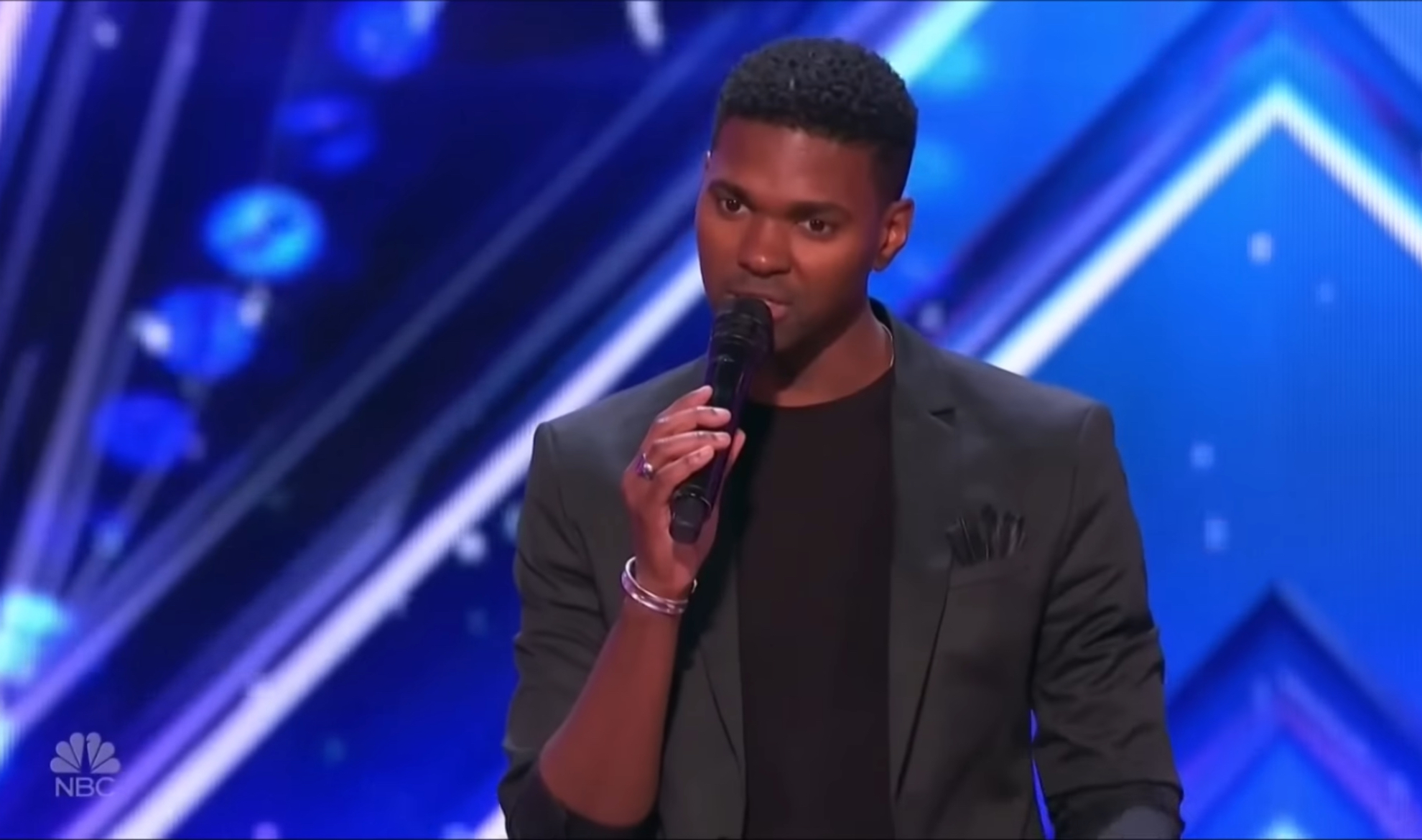
Johnny Manuel, a singer from Flint, Michigan, walked onto the America’s Got Talent stage carrying more than just a few nerves — he carried a story of early promise, disappointment, and the fragile hope of a second chance. He told the audience he had been signed to a record label at 14, an achievement most teenagers can only dream about. For Johnny, that milestone felt like the first step on a straight path to stardom, but life had another script. That early opportunity didn’t pan out the way he imagined, and the youthful certainty that comes with a contract quickly gave way to the complicated reality of the music business. Years later, he returned to the spotlight with a quiet, resolute mission: to finally embrace who he is, share his music on his own terms, and reclaim the future that had once seemed promised.
He didn’t pick an easy song for that moment. Johnny chose Whitney Houston’s “I Have Nothing” — a piece that has humbled plenty of seasoned vocalists and become a benchmark for emotional intensity and technical prowess. It’s a song that asks performers to do two demanding things at once: hold notes with immaculate control, and make every phrase feel alive with feeling. From the moment he took his first breath, you could tell Johnny understood the stakes. He didn’t treat the song like a checklist of vocal acrobatics; instead, he let it unfold like a story he had lived. That choice, of all choices, spoke volumes about his confidence and about how deeply he wanted this to mean something.
The opening lines arrived with surprising tenderness, as if he were testing the waters, gauging the room and allowing himself to feel the memory of all the doors that had closed. Then, almost imperceptibly, his voice grew — not just louder, but more layered with texture and intention. What might have sounded like bravado in another context read instead as the work of someone who’d learned from setbacks. There was an economy to his performance: he didn’t throw every trick in his repertoire at the song. He selected moments to expand his range, to sustain notes so cleanly they seemed to hang in the air, and to color a phrase in a way that made the audience lean in.
The transformation was palpable. At one point, a soft phrase swelled into a sustained, crystal-clear high note that felt like a release after years of holding back. That note landed with such emotional resonance that you could hear a collective intake of breath from the crowd. It was the kind of moment that turns an audition into a confession — vulnerable, brave, and utterly human. Even in the technically intricate passages, Johnny never lost sight of the song’s heart. He threaded his technical skill through genuine feeling, and that balance made his performance feel less like a demonstration of ability and more like a personal declaration.
As the final chorus soared, the arena responded. People were on their feet, cheering and clapping not just for the notes he hit, but for the story he’d told through them. There’s a particular kind of energy that comes when a performer’s history and current moment collide onstage, when the audience senses that what they’re witnessing is a turning point. The judges mirrored that reaction. Mel B praised the sheer power of his voice, acknowledging the command he’d shown throughout the song. Heidi Klum, with a teasing smile, called him a “shy Johnny” who might secretly be a “diva,” encouraging him to let more of his personality shine through. It was a light, human exchange that underscored how his performance had balanced humility with undeniable flair.
Simon Cowell, ever the straight-talking critic, recognized something more than a strong vocal performance: he saw star quality. His remark that Johnny could “nail and sell a song” was an affirmation of marketability as well as artistry, a nod to the fact that Johnny’s comeback could translate into a real career reboot. The four yeses he received felt less like a relief and more like validation — a recognition that the risk he’d taken in returning to the stage was worth it.
Johnny’s audition was more than a single good night; it was a hinge point that connected his past to a possible future. The standing ovation said as much: people weren’t merely applauding a performance, they were honoring a journey. For someone who had seen an early dream fray, the moment offered a tangible reset. He came back not to erase what had happened before, but to bring everything he had learned into a new chapter. Walking off the stage, it was clear that this wasn’t the end of the story — it was a powerful beginning.