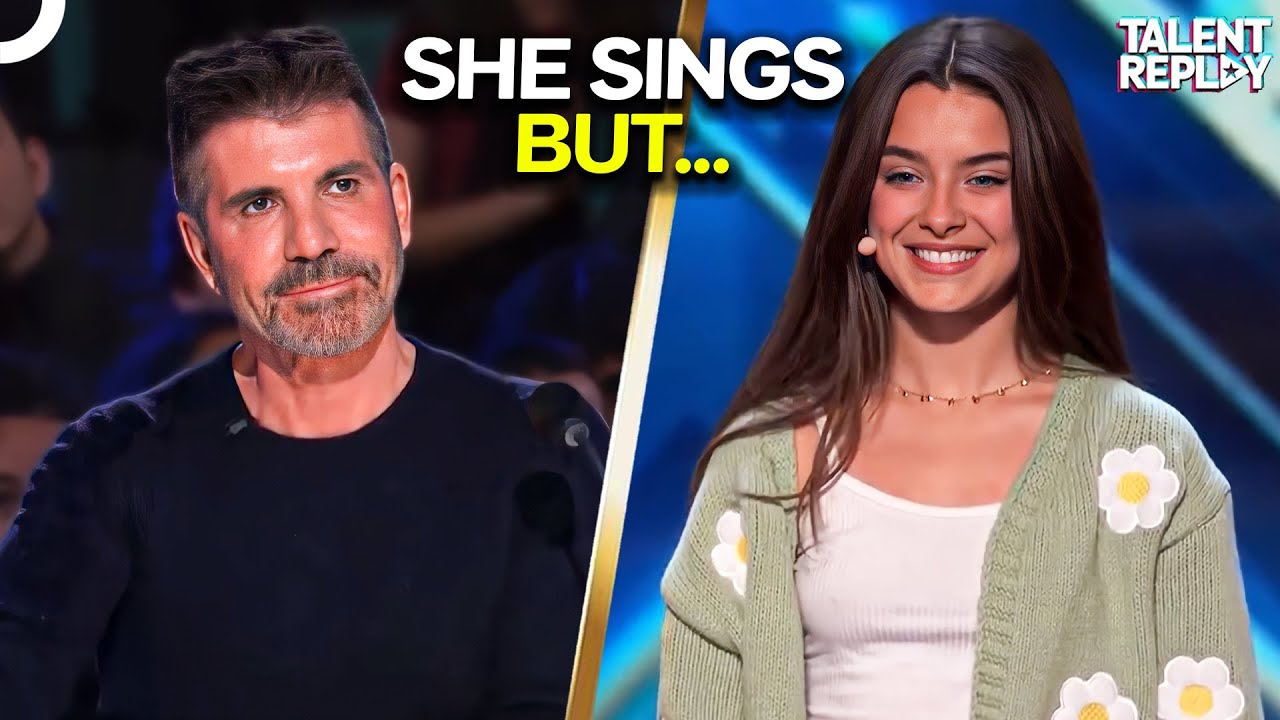
When Ninah Sampaio stepped onto the America’s Got Talent stage, she looked like any other hopeful: young, focused, and a little wide-eyed at the sight of the cameras and the famous judges sitting beyond the lights. She smiled politely, explained her plan — she was going to sing P!nk’s “Try” while solving a Rubik’s Cube — and the room reacted the way you might expect: polite laughter, a few nervous chuckles, and the kind of skeptical curiosity that fills talent-show arenas when an act sounds more like a party trick than a polished performance.
That skepticism evaporated almost immediately. The opening piano notes began, and Ninah delivered the song with a voice that cut through the hum of the studio: strong, emotionally grounded, and unexpectedly powerful for someone who had been introduced as a novelty. She didn’t treat the performance like a stunt; she treated it like music. Her phrasing honored the song’s vulnerability, and when the chorus hit she threw herself into the emotional center of the lyrics, making plain that she wasn’t simply copying P!nk — she was inhabiting the song.
All the while, her hands moved with astonishing speed and precision across the cube. If you’ve ever tried to solve one, you know it’s a tactile puzzle that rewards patience and concentrated thought; the idea of doing it while maintaining vocal control and stage presence seems almost absurd. But Ninah made the two disciplines look like they belonged together. Her left hand navigated algorithms while her right hand cued breath and expression. There were tiny visual flourishes — a flick of the wrist here, a quick glance at the judges there — that kept the audience connected to her even as her mind raced to find the next sequence of moves.
There’s a special kind of tension when two difficult things happen simultaneously. The audience felt it, leaning forward in their seats as the music swelled and the cube’s colored stickers blurred into motion. Judges who might have been poised to dismiss the act as a gimmick found themselves watching two stories unfold at once: a singer telling a heartfelt story and a solver executing a complex mental routine. You could practically see the judges’ brains doing the math — how rare it is to combine world-class vocal control with knuckle-speed puzzle-solving while under intense lights and time pressure.
The climactic moment arrived as the song climbed into its most dramatic register. Ninah’s voice soared, full and controlled, and with one final, decisive twist she completed the cube. She lifted it high with the same intensity she used to hit the last note, presenting the solved puzzle like a trophy and sealing the performance with a physical punctuation mark. The timing was flawless: the visual of the finished cube synchronized with the emotional peak of the song, creating a moment that felt both theatrical and profoundly satisfying.
The response was immediate and exuberant. The crowd rose in a spontaneous wave of applause, whistles, and cheers. The judges, who had begun with mild amusement, were now grinning in disbelief and clapping along. They praised her originality, her vocal talent, and her nerve. What could have been a forgettable gimmick became, in the judges’ words, one of the most original and entertaining auditions of the season. All four votes sent her through to the next round.
What made Ninah’s performance linger in viewers’ minds wasn’t just the spectacle of both feats occurring at once. It was the way she treated both elements with respect. The singing wasn’t downgraded to background for the cube trick, nor was the puzzle-solving turned into a prop to distract from vocal weaknesses. Instead, she treated each task as equal parts of a single narrative: a demonstration of focus, discipline, and a willingness to take emotional risks in public. Her face registered the same honesty whether she was reaching for a high note or executing a swift algorithm; that consistency made the moment feel authentic rather than contrived.
There were small human touches that grounded the performance, too: the relieved grin that crossed her face when the cube came together, the brief look of triumph she shared with the crowd, and the way she exhaled after the final chord as if letting the audience in on the effort it had taken. Those micro-moments helped turn an attention-grabbing idea into a genuinely moving piece of theater.
After the show, clips of Ninah’s audition spread quickly online. People rewound the video to see how she had coordinated her hands with her breaths; others marveled at the audacity of tackling a song like “Try” while under that kind of pressure. Comment threads praised her for combining intellect and artistry, for reminding viewers that talent doesn’t always come in one tidy package. In a season full of surprising acts, Ninah’s audition stood out because it illustrated a simple truth: creativity often comes from blending unlikely skills, and when you do it with heart, the audience notices.