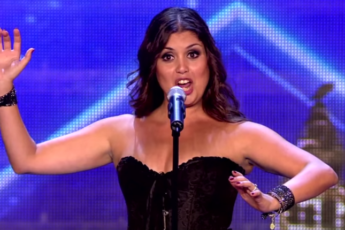

Daneliya Tuleshova, a 13-year-old from Kazakhstan, stepped onto the America’s Got Talent stage carrying a dream that felt as large as the auditorium itself: to become an American pop star, inspired by her idol Beyoncé. You could see it in the way she clutched the mic and glanced briefly at the judges — a combination of hope and the kind of nervousness that comes with standing on a stage where millions might be watching. For many, that mix of vulnerability and ambition was instantly relatable; it made her more than just another contestant — it made her someone you wanted to root for.
At first, Daneliya’s nerves were obvious. She hesitated as she introduced herself, and there was a softness in her posture that suggested she was still gathering courage. Simon Cowell sat with that familiar, discerning expression, and you could tell she was particularly aware of his presence. That awareness could have crushed a lesser performer, but it only made what came next more powerful. The audience leaned in, sensing the moment when something small might blossom into something remarkable.
When the first notes of “Tears of Gold” left her lips, the transformation began almost imperceptibly. Her voice, which had been quiet and tentative moments before, found an anchoring confidence. It was as if stepping into the song unlocked a different version of herself — one who owned every phrase and breathed life into every lyric. The shy girl who had walked up to the microphone seemed to melt away, replaced by a performer with the swagger and poise of someone far beyond her years.
The judges’ reactions mirrored that shift. Heidi Klum’s smile widened and she commented on the metamorphosis in front of them: the awkward, shy girl had morphed into someone with undeniable stage presence and “swag.” Howie Mandel made a similar observation, likening her to a caterpillar becoming a butterfly — an apt image for a moment so clearly about growth and emergence. The applause swelled not just because of the technical quality of her singing, but because people felt they were witnessing a genuine emergence of self-confidence.
What made the performance especially arresting was the maturity of Daneliya’s voice. At 13, many singers are still finding their range and identity, but she handled the song’s emotional contours with a level of control and depth that suggested years of practice and an intuitive understanding of phrasing. There were moments when she leaned into softer, breathier tones that conveyed fragility, then pivoted into powerful belts that filled the theater with resonance. Those contrasts made the song feel lived-in rather than merely performed.
Small details added to the emotional impact. The way she closed her eyes during certain lines suggested she was internalizing the story of the song; a subtle tilt of her head emphasized a particularly aching lyric. Her facial expressions shifted naturally in time with the music, making it clear she wasn’t just singing the notes — she was telling a story. These tiny, humanizing gestures made the performance feel intimate despite the bright stage lights and the roar of the crowd.
Beyond the immediate theatrics, Daneliya’s journey to that moment made the performance even more meaningful. Traveling from Kazakhstan to a stage like AGT is no small feat for a teenager. It implies countless hours of practice, the kind of sacrifice that involves early mornings, late-night rehearsals, and perhaps missing out on ordinary teenage experiences. That backstory — the perseverance and the dream of emulating a star like Beyoncé — gave her performance a sense of purpose. It wasn’t just an audition; it was a culmination of effort, hope, and a willingness to step into the unknown.
The audience’s reaction after she finished was electric. There was not just applause but a palpable sense of collective admiration, as if people were moved by both the technical brilliance of her singing and the emotional authenticity she brought to the song. The judges’ praise felt earned; it wasn’t empty flattery but recognition of a young artist who had, in a single performance, shown what she might become.
In the end, Daneliya’s rendition of “Tears of Gold” served as a powerful statement about potential and transformation. She arrived nervous and tentative, but by the final chord she had demonstrated a clarity of artistic vision and a stage presence that hinted at a bright future. For viewers watching at home and for everyone in that theater, her performance was more than entertainment — it was an inspiring reminder that talent paired with determination can create moments that feel nothing short of magical.