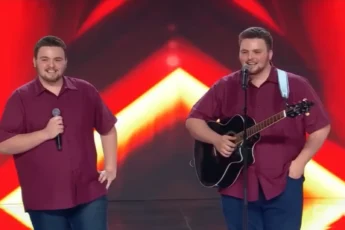

When SOS stepped onto the Britain’s Got Talent stage, there was an immediate sense that something different was about to happen. Gone were the slick, choreographed boyband moves most viewers expect; in their place stood a group of childhood friends and brothers armed with guitars, drums, and a no-nonsense attitude. The choice to tackle a Backstreet Boys classic felt at once risky and brilliantly provocative. It wasn’t a quaint nostalgia act — it was a deliberate, loaded statement: we know the rules, and we’re going to rewrite them.
From the first chord, the room’s energy shifted. The opening riff came in raw and muscular, a far cry from the soft synths and polished harmonies of the original. Their lead singer didn’t smirk or wink at the irony; he dove headfirst into the performance with a voice that balanced grit and melody, pushing the familiar chorus into darker, more urgent territory. The band’s tight instrumentation—crisp snare hits, a bass line that pulled the song into a lower register, and a distorted guitar tone that growled around the melody—worked as a single, focused force. They didn’t just cover the song; they reconstructed it, peeling back layers of pop gloss to reveal a core that felt surprisingly suited to a heavier interpretation.
Small theatrical choices amplified the transformation. The lighting shifted from warm, nostalgic hues to stark strobes and deep blues as the arrangement reached its most aggressive moments. The guitarist moved deliberately across the stage, trading short call-and-response licks with the singer that felt almost conversational. At one point, a drum fill landed like a punctuation mark, and you could feel the audience physically lean forward. These details added texture: the drummer’s slight smile after a particularly tight fill, the bassist closing his eyes during an extended groove, the slick stomp of the frontman’s boots on the riser. Together, they painted a picture of a band that had played together long enough to move as one.
That sense of history came through in their chemistry. It was easy to imagine them rehearsing in cramped garages or local pubs, swapping parts and refining that heavier arrangement until it fit like a glove. The brothers, in particular, seemed to share an unspoken shorthand—one glance, one nod, and they were perfectly synchronized. It’s the kind of rapport that doesn’t come from rehearsed gimmicks but from years of making noise together and shaping a shared sound. That authenticity is what made the twist feel earned rather than gimmicky.
The judges’ reactions were as intense as the performance itself. Simon Cowell, never one to hand out praise lightly, leaned forward and asked pointed questions about their artistic direction, sparking a tense but electric exchange about whether SOS should focus on originals or keep reinventing covers. His skepticism felt genuine: he was testing whether their sound could survive beyond the spectacle of a shockingly bold arrangement. Yet even his probing couldn’t hide the thrill in his voice when he acknowledged their technical chops. The other judges echoed that mix of surprise and admiration. Compliments came for their stage presence, the lead singer’s vocal control, and the band’s ability to reinterpret a well-worn pop anthem without losing its emotional core.
The audience’s response was immediate and visceral. Initial cheers gave way to a cacophony of applause and whistles as SOS drove the final notes home. Phones rose to capture the moment; viewers at home later admitted they rewound the clip to watch the transformation again. There was something cathartic about seeing a pop favorite stripped of its expected trappings and rebuilt with attitude and muscle. For many in the room, it felt like a reclamation — proof that songs can take on new life when artists dare to reimagine them.
Online, the conversation erupted. Clips of the performance spread rapidly across social platforms, accompanied by debates about genre boundaries and the state of mainstream music. Some fans hailed SOS as a breath of fresh air, celebrating a band that could bridge the gap between ’90s nostalgia and modern rock. Others questioned whether their version might alienate purists of the original. Those discussions only amplified the performance’s impact; polarizing moments tend to travel fastest, and this one had controversy wrapped around its technical brilliance.
What made the moment particularly compelling was how it reframed the idea of a “boyband.” Historically, the label conjures images of matching outfits, coordinated dance routines, and radio-friendly hooks. SOS challenged that stereotype. Their version suggested that bands formed in adolescence can grow up, evolve, and still retain the emotional directness that made them appealing in the first place. They showed that the tag “boyband” need not be a limitation; instead, it can be a starting point for reinvention.
When the judges ultimately awarded them four unanimous yeses, it felt less like a consolation and more like validation for a group willing to stake a claim on their own terms. The exchange that followed with Simon about originals versus covers hinted at a crossroads: will SOS ride this wave of reinvention into a catalog of hard-hitting originals, or will they continue to surprise audiences by remolding familiar songs? Either way, their Britain’s Got Talent moment made one thing clear—this band isn’t interested in fitting neatly into a box, and that kind of defiance can be exactly what turns heads in today’s crowded music landscape.