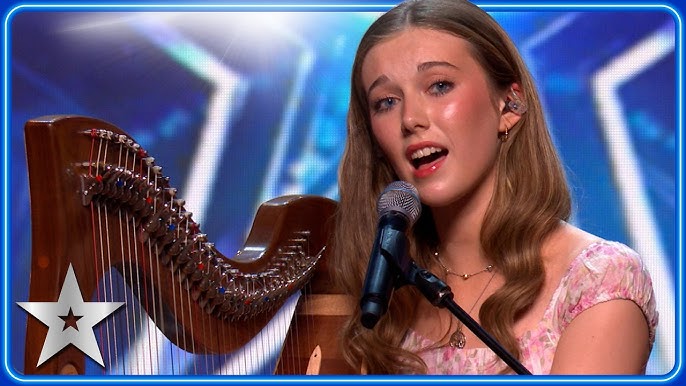
The moment seventeen-year-old Neve walked onto the Britain’s Got Talent stage, there was a slight ripple of curiosity that swept through the audience. She hugged her harp close as if it were a secret companion, and she gave a shy, nervous smile toward her mother in the front row. At first glance, she looked every bit the quiet teenager most people imagine practicing scales in a sunlit bedroom. What happened next, though, quickly erased any stereotype about what a harpist could be.
Choosing to perform a modern pop song — Alex Warren’s emotional hit — was itself a bold move. The harp has long been pigeonholed into orchestral swells or gentle background textures, but Neve took the instrument out of its comfort zone and placed it front and center in a contemporary arrangement. Her fingers danced across the strings with surprising agility, plucking sharp, rhythmic patterns that provided more than accompaniment; they drove the song’s heartbeat. She wove in harp flourishes at unexpected moments — a bright arpeggio to lift a chorus, a muted glissando to underline a verse — turning the instrument into an equal partner to her voice rather than a decorative afterthought.
Then there was her singing. Neve’s vocal delivery was a study in contrasts: delicate yet steadfast, intimate yet expansive. When she started the first verse, you could hear a breathy clarity that made the lyrics feel immediate and personal, as if she were speaking directly to a friend. As the song swelled, she revealed a surprising power in her higher register, notes that glowed without ever sounding forced. The judges’ faces changed almost in real time — eyes widening, eyebrows lifting — as they absorbed the unusual combination of harp and contemporary pop vocal. KSI, known for his blunt commentary, sat forward and murmured something about her voice being “angelic,” a reaction that seemed to surprise him as much as everyone else. Simon Cowell, rarely given to hyperbole, praised her for a “sensational” approach that felt both original and fully formed.
Small details made the performance resonate in a way that clips could not fully capture. In quieter passages, the camera lingered on Neve’s hands as they moved with calm precision, fingers brushing the strings like a painter pulling a fine line. Her breath matched the harp’s phrasing so naturally that it felt choreographed even when it wasn’t, a testament to countless hours of patient practice. The audience, initially polite and expectant, grew silent in concentrated attention; you could feel the collective intake of breath as Neve hit a tender, sustained note. A few rows back, you could see tears glistening on a cheek, a sign that this was landing on a personal level for some viewers.
There was also a palpable emotional arc to the performance that mirrored Neve’s own journey. She started with visible nerves — a flutter in her smile, fingers that hesitated for a beat — but as the song progressed, she found a calm center. That transition made the final high note all the more affecting: it didn’t feel like a technical exercise, but a moment of personal revelation. For those watching, it was easy to project the image of a teenager who had spent late nights practicing in a small room, who had leaned on music as a place of solace and self-expression. Her mother’s beaming face in the audience only reinforced the intimacy of the scene — this was a family milestone as much as a televised audition.
Beyond the immediate reaction in the theater, the social media element of the audition was inevitable. Neve’s performance combined the visual novelty of a harpist in a pop context with a vocal delivery that made people stop and listen. Clips posted online picked up traction quickly: viewers shared moments of her delicate finger work, her unexpected vocal runs, and the judge reactions that ranged from stunned silence to enthusiastic praise. Comment threads were full of people marveling at how a classical instrument could be reframed for a generation raised on streaming playlists and algorithm-driven trends. Many pointed out that Neve’s success challenged the often rigid idea that classical training and popular music are separate worlds.
The judges’ unanimous endorsement — a four-yes vote that sent Neve through to the next round — felt like more than a stamp of approval. It read as a small cultural shift, a recognition that talent can be versatile and that traditional instruments can find new life in modern soundscapes. Their comments focused not only on her vocal quality but on her ability to make an old instrument feel timely and vital. That kind of feedback is especially meaningful for young performers who might worry that their musical passions are out of step with current trends.
When Neve left the stage, there was a sense of uplift in the room — a mixture of pride, wonder, and anticipation. Her audition wasn’t just a standout moment for Britain’s Got Talent; it felt like a blueprint for how young artists can synthesize classical technique with contemporary sensibilities. By the end of the night, conversations were already starting about how she might shape her artistry going forward: which songs she could transform next, how she might expand her arrangements, or whether she would lean into original material that blends harp textures with pop hooks. For now, though, what mattered most was the immediate, undeniable truth: Neve had taken an instrument often relegated to the background and made it the beating heart of a viral pop performance, proving that innovation sometimes begins with the simplest of choices — the courage to play a familiar song in a new voice.