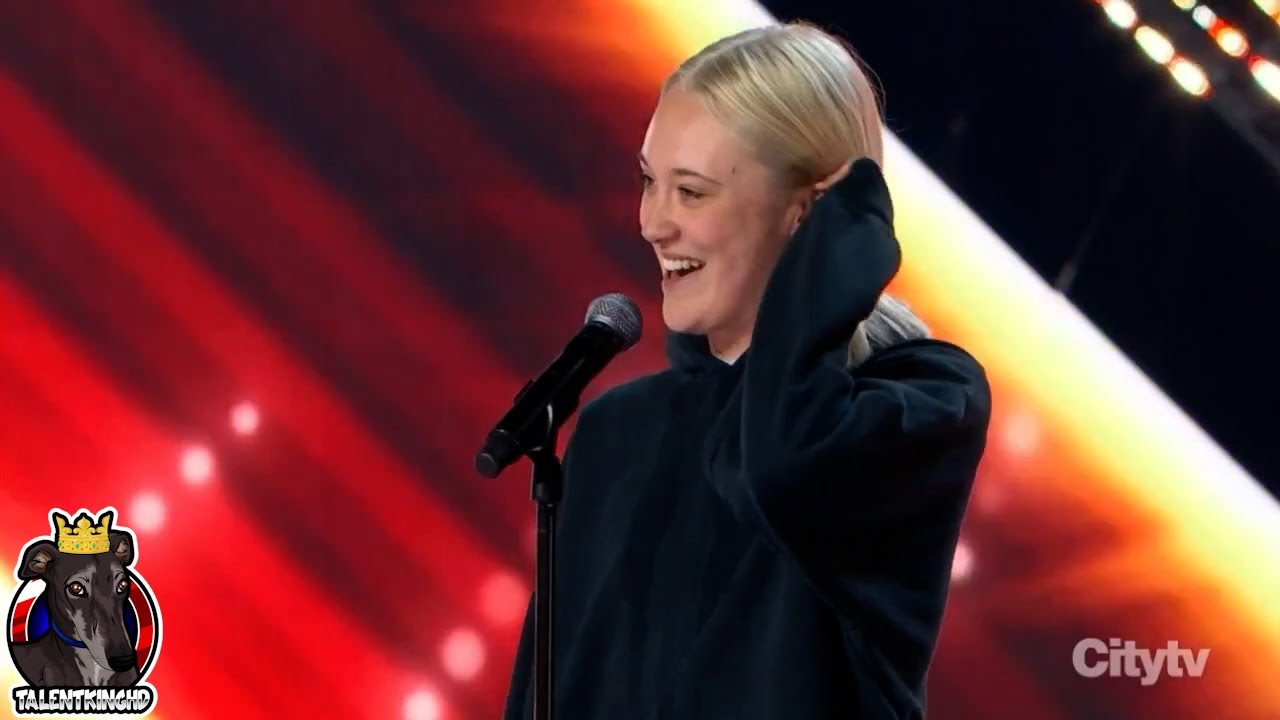
It was one of those improbable, cinematic moments that feels like it was scripted but absolutely wasn’t. Meave was doing something millions of people do every day: she was busking, her small setup tucked against a brick wall just off the tourist flow in Niagara Falls. A battered guitar case lay open for tips, a folding chair held a paper cup of coffee gone lukewarm, and a cheap speaker sat silent — she hadn’t planned on performing for anyone that night beyond passersby. She’d planned to finish her set, pack up, and go home to eat pizza and call it an ordinary evening. Instead, one of Canada’s Got Talent’s judges heard her voice cutting through the ambient noise of the falls and the chatter of international tourists, and in an instant her life took a hard left.
The judge walked over, curiosity written plainly on his face. He stood there for a moment, watching Meave’s lips move and listening as her voice rose and dropped with a timbre that sounded lived-in and sincere. Without much fanfare, he asked if she’d like to come inside and audition. It was the sort of spur-of-the-moment invitation people dream about but don’t expect to receive. Meave’s initial surprise was obvious — she blinked, glanced down at her coffee, and then laughed, as if checking that this was not an elaborate prank. With a couple of hurried assurances and a phone call backstage, she was whisked through the doors and into a world of bright lights, technicians, and the unmistakable hum of a live audience waiting to be astonished.
There was no time to rehearse, no soundcheck, and no way to prepare for the sudden shift from sidewalk acoustics to a fully staged theater. Meave didn’t have a backing track queued up, and she hadn’t brought a polished set list. What she did have was her voice — raw, weathered by hours performing outdoors, and steeped in the kind of emotional authenticity you can’t manufacture. She chose “House of the Rising Sun,” a song that requires more than technique; it needs heart. And without the safety net of a microphone engineer fussing over levels or a band to lean on, she took a breath and sang.
From the first unaccompanied line, the theater went quiet in a way that made it feel like the sound had been vacuumed out of the room, leaving nothing but her voice suspended in the air. There were no ornate flourishes, no vocal acrobatics for show. Instead, Meave’s performance relied on control: the way she softened a phrase just enough to make the next swell feel enormous, the steady, haunting vibrato that hinted at experience and pain, the tiny inflections that made the lyrics feel like a conversation rather than a recitation. She painted with tone instead of color, drawing listeners into the story line by line.
Concrete details made the moment tangible. You could see a judge lean forward, elbows on knees, as if trying to catch every syllable; another touched their fingertips to their chin, eyes closing briefly to savor a particularly aching note. The camera cut to the audience and you could read the slow arc of disbelief: eyebrows raised, mouths parted, then steady nods as people realized they weren’t just witnessing a good voice — they were witnessing something rare. Someone in the front row wiped away a tear. A handful of teenagers started a slow clap that spread like a ripple until the entire theater was applauding before the final notes had fully faded.
When Meave finished, the applause swelled into something that felt less like polite appreciation and more like collective astonishment. She stood there, chest heaving with the exertion of pouring herself out in front of strangers, looking as surprised as anyone that the night had spun so wildly out of ordinary. The judges’ feedback reflected that mixture of shock and reverence. They spoke about how music has a way of finding people at the exact moment they need it, how talent sometimes hides in plain sight until luck — or fate, as a couple of them put it — intervenes. They called her voice a “buried treasure,” as if they had just unearthed something rare and precious from the sidewalks.
One judge’s reaction was almost poetic: he said the universe must have been conspiring to get her on that stage, that random things line up for a reason. Another judge, visibly moved, complimented not just her tone but her storytelling ability, noting how she made an old song feel like a new confession. Their emotional responses were not the performative kind; they felt real, earnest, and a little awestruck. That authenticity translated into unanimous support. The four “yes” votes were emphatic and immediate, each one punctuating the moment like a stamp of approval that this was more than a lucky stumble — it was a discovery.
As Meave walked off the stage, the idea that she’d been planning to eat pizza at home that night felt like a different life entirely. The footage of her being plucked from the street is already making the rounds online — clips of the audition, snippets of backstage laughter, the judge’s first impressed look — and it’s easy to see why it’s resonating. In a world inundated with staged viral moments, this one feels refreshingly accidental and honest. It’s a reminder that sometimes opportunities present themselves in the most mundane places, and that talent, when given a sudden, bright platform, can change the course of a life overnight.