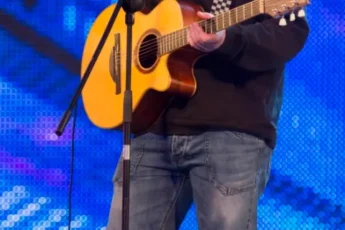

Sometimes a performance becomes unforgettable not because of big effects or dramatic staging, but because of the simplest, most sincere things: a voice, a melody, and a moment of truth. That happened during a Britain’s Got Talent audition when a young singer named Isaac Waddington walked onto the stage and, without any grand gestures, delivered a cover of Billy Joel’s “She’s Always a Woman” that felt like it was being sung just for you. From the very first note, there was a hush — not the polite kind that precedes applause, but a deeper kind of silence where everyone leans forward, listening as if the air itself had grown thinner to make room for the music.
Isaac didn’t try to dazzle. He didn’t rely on vocal acrobatics or manufactured emotion. He simply opened his mouth and let the song unfold, and what surprised everyone was the depth in his voice. It was mature beyond his years: warm, textured, and honest. That unexpected timbre caught the judges off guard for a beat, then captured them. You could see expressions change subtly across their faces — curiosity turning into appreciation, casual interest into genuine attention. The audience, too, quieted. Conversations stopped mid-sentence; phones were lowered. There was a collective realization happening in real time: this wasn’t just another audition, it was something more fragile and rare.
What made the performance so powerful wasn’t an attempt to reinvent the song, but the thoughtful way Isaac inhabited it. He respected the melody and the lyrics, but he also made the piece his own by delivering each line as if he were telling a small, private story. When he sang, “She can kill with a smile,” it wasn’t a showy flourish but a soft, pointed observation that landed in the chest. He didn’t over-emote; instead, he trusted the text and let subtle shifts in phrasing and tone carry the feeling. That calm confidence — the sense that he knew exactly what he wanted to say without needing to shout it — made the performance feel intimate, like he’d invited the entire room into a quiet, meaningful conversation.
There were small details that made the moment stick. The way Isaac closed his eyes at the end of certain phrases, as if to check his own heartbeat; the slight catch in his voice on a line that hinted at a personal connection to the lyrics; the pause he allowed before the bridge, giving the words space to settle in the listeners’ minds. These weren’t manufactured theatrics; they were tiny human moments that built trust between performer and audience. You could almost imagine the scene in someone’s life that inspired the empathy in his delivery, even if the singer never offered an explanation. Music can do that — it can point to something private and let listeners fill in the rest.
As the song moved on, the room’s reactions became part of the story. A judge lifted a hand to her mouth, eyes glistening; another judge leaned forward, elbows on the table, completely absorbed. In the audience, heads tilted, breath held, then exhaled in unison when Isaac reached the final, gentle lines. It wasn’t the thunderous ovation of a pop spectacle, but something steadier and warmer — the kind of applause that shows deep respect. When the last note faded, there was a beat of stunned silence, as if everyone was making sure the moment was real, then the room erupted into heartfelt clapping and whoops. It was the kind of response that told you people had witnessed something honest and worth remembering.
That’s the remarkable thing about performances like this: they remind you that technical prowess and flashy production aren’t the only measures of greatness. Sometimes a simple melody, delivered with sincerity and a clear connection to the lyrics, can move people more profoundly than any elaborate arrangement. Isaac’s audition was a reminder that vulnerability on stage — the willingness to be straightforward and genuine — often resonates more deeply than any attempt to impress.
By the time he finished, it felt as if the whole room had been given a brief, bright gift. The applause said it all: appreciation, surprise, and a shared sense that they’d just witnessed the beginning of something special. Years from then, people might still mention that quiet, unforgettable moment on Britain’s Got Talent when a young singer stepped forward and, without trying to be anything other than himself, made a simple song linger in everyone’s memory. That’s the power of honest music — it doesn’t need to shout to be heard; it only needs to be true.