
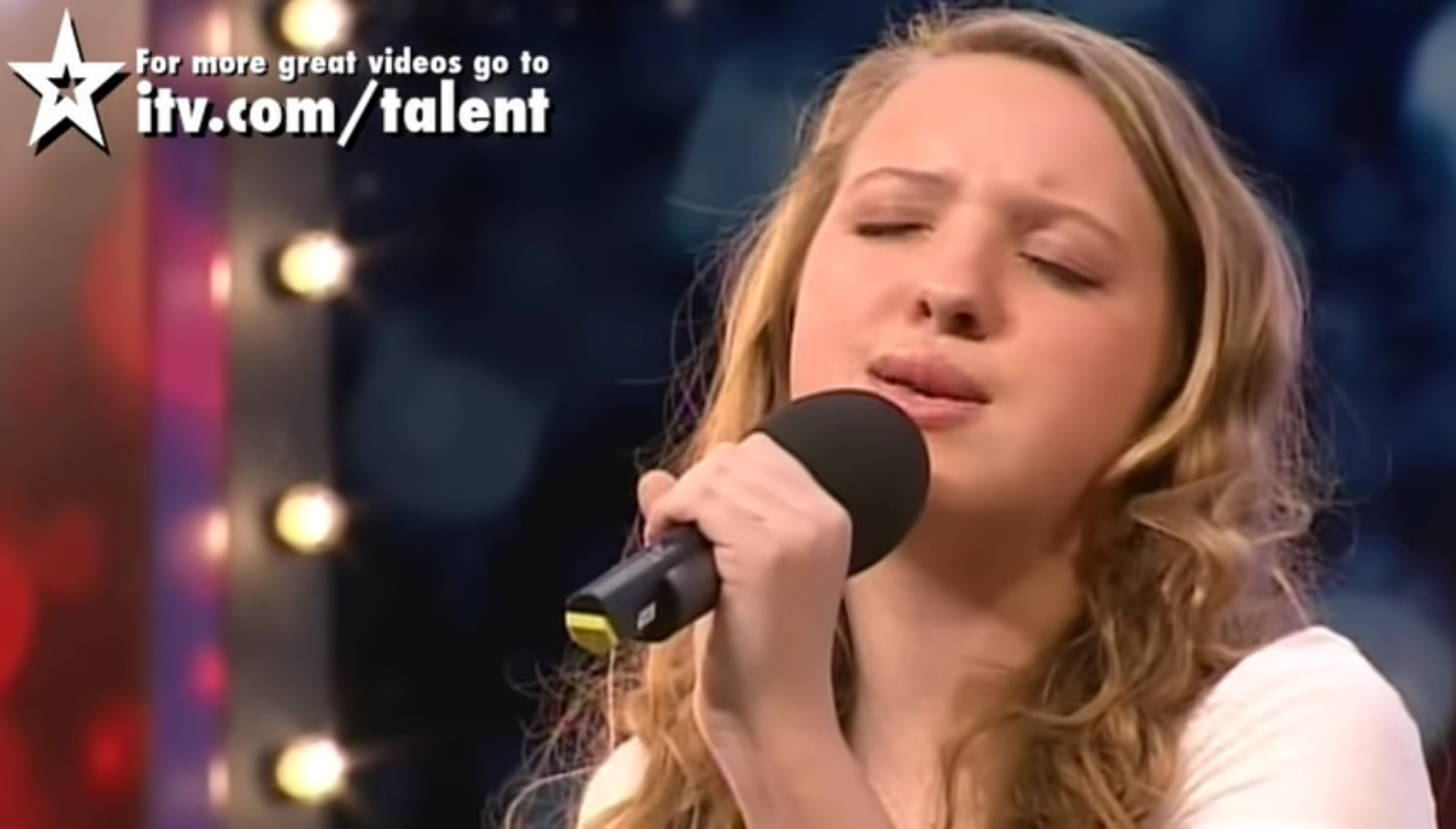
Thirteen-year-old Olivia Archbold walked onto the Britain’s Got Talent stage with a kind of quiet that immediately felt honest and disarming. She seemed to shrink a little beneath the overpowering lights and the cavernous set, her shoulders rounded as if trying to make herself smaller — a posture that drew an audible, sympathetic murmur from the audience. In the brief pre-performance interview she spoke softly about her dream to be an “actual star,” and confessed with a shy smile that she was rarely without a song, whether walking down the stairs or sitting in math class. That glimpse into her everyday life made her relatable: here was a normal kid with ordinary habits and extraordinary ambition. Backstage, her family watched nervously, openly hoping she would find the courage to push past the nerves that naturally come with such a huge stage.
When Olivia stepped up to the microphone, there was an almost tangible hush. She chose to sing “In the Arms of the Angels,” a song that asks a lot of any singer — emotional depth, control, and the ability to hold delicate lines without losing feeling. For a teenager who’d described herself as shy, it was a bold pick. But the moment the first note left her lips, something remarkable happened. The girl who had seemed uncertain moments before transformed into a singer whose voice filled every corner of the auditorium with a warmth and clarity that felt utterly at odds with her small frame.
Her opening line felt like a gentle invitation that quickly grew into something much bigger. Olivia’s voice carried a tone both pure and nuanced; she didn’t rely on heavy ornamentation or vocal fireworks, but rather on steady breath control and sincere phrasing. The way she handled the song’s long, floating lines spoke of careful practice and innate musicality. Instead of pushing or forcing the notes, she allowed them to bloom naturally, and in doing so she brought the audience along with her. People who had possibly come expecting a cute audition were soon sitting forward in their seats, rapt and quietly emotional.
There were small, human moments that made the performance feel real rather than simply polished. Once or twice, just between phrases, she would take a soft, almost imperceptible breath and look down as if collecting herself — the exact kind of honest vulnerability that connects with listeners. The judges’ cameras captured close-ups of her face: a slight tremor in her hands, a determined set to her jaw, and then that same gentle smile when she landed the song’s more challenging passages. Those tiny gestures underscored what many viewers sensed intuitively: this was a young person pouring something sincere into her art, not merely performing it.
Technically, she handled the song with surprising maturity. The melody requires an ability to sustain notes with accurate pitch and consistent tone, and Olivia navigated those demands with poise. She graded the dynamics well, allowing the quieter moments to feel intimate and the swelling phrases to carry emotional weight without ever sounding strained. Her vibrato, tasteful and controlled, added color without becoming the focal point, which kept the listener focused on the song’s meaning rather than on vocal gymnastics. In sum, she demonstrated a kind of vocal intelligence — knowing what to do and when to do it — that many singers twice her age struggle to master.
The judges’ reactions moved from quiet surprise to genuine admiration. Amanda Holden described the voice as “utterly beautiful,” remarking that Olivia didn’t seem to realize just how good she was — a sweet observation that captured the charm of watching such talent arrive almost accidentally. Piers Morgan echoed the sentiment with a note of respect; he pointed out that many young performers select songs “way, way too big for them,” only to falter under the pressure. Olivia, he said, had sung the song “so well” and had, remarkably, made it her own. That comment — about ownership of the material — was significant. It suggested that she wasn’t just attempting to replicate someone else’s performance but was instead finding her own emotional connection to the lyrics.
When the judges gave their verdicts, the unanimous chorus of “yeses” felt less like a formality and more like recognition. There was a collective sense that Olivia had done more than impress a panel of professionals; she had touched an audience with something genuine and rare. Stepping off the stage, she looked both relieved and a little stunned by the reaction, the shy kid from earlier now carrying the quiet confidence that comes from meeting a moment head-on.
Beyond the applause and the advancement to the next round, the audition hinted at what makes a performer memorable: authenticity. Olivia’s performance wasn’t built on gimmicks or manufactured drama; it was anchored in a clear love for singing and a willingness to expose vulnerability. At thirteen, she showed a combination of technique, emotional understanding and humility that suggested a bright future. For the audience that night, and for the millions who would later watch at home, Olivia Archbold’s audition was a reminder that sometimes the biggest surprises come from the smallest, most unassuming people — and that a single, honest performance can change everything.