
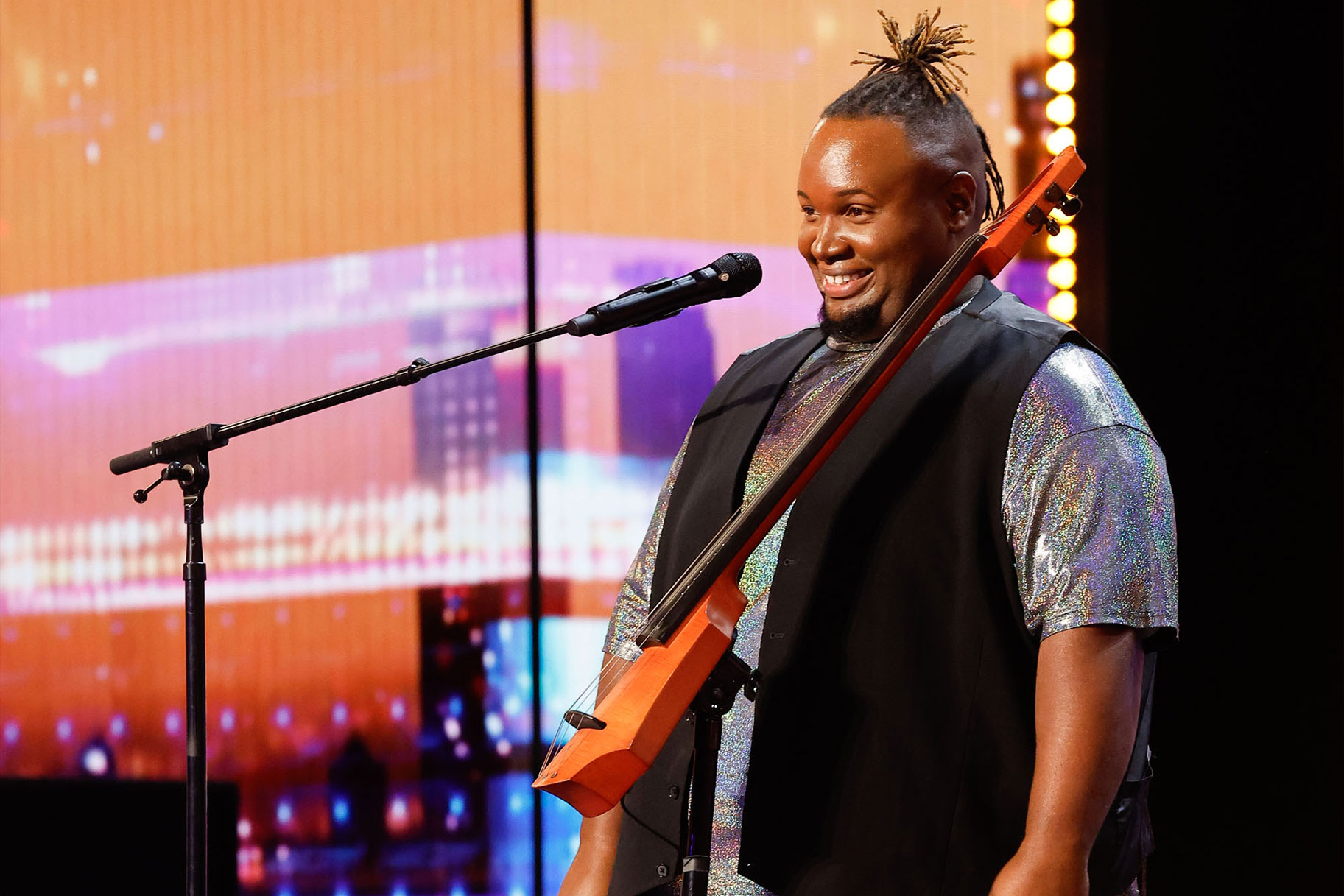
BJ Griffin walked onto the America’s Got Talent stage with a quiet confidence that suggested this moment had been a long time coming. At thirty-four, the entertainer from Virginia Beach carried with him a backstory that made his presence on that bright studio floor feel hard-earned. He spoke candidly about a crossroads in his youth — choosing to quit high school football against his parents’ wishes to follow a different dream. It was the kind of decision that shapes you: one that costs you sleep, provokes family conversations, and forces you to confront whether the voice inside you is worth listening to. For BJ, the answer had always been music.
What made his audition immediately intriguing was less his age or his backstory and more the instrument he brought: an electric cello. In a field dominated by singers and guitarists, an electric cello hints at something different from the first moment you see it — a promise of innovation, of classical timbre reimagined through a contemporary lens. BJ explained simply that he’d been “holding himself back” for too long and wanted to share healing through his music. That phrase — healing through music — felt less like a line and more like a mission statement as soon as he positioned the cello and took a breath.
He chose to perform Al Green’s “Let’s Stay Together,” a song with a timeless, tender groove and a vocal line that demands both soul and restraint. It’s a number that can expose flaws as easily as it can highlight strengths, but BJ approached it with a calm mastery. The opening notes from the electric cello set a different mood than a piano or guitar would have: velvet, resonant, and at once familiar and fresh. His voice entered the mix warm and steady, not trying to mimic a particular era or artist but blending the classic R&B phrasing with his own textured tone. The juxtaposition was powerful — the cello’s sustained low end provided a kind of emotional foundation, while his voice floated and dipped with the phrasing’s tender urgency.
There was something quietly theatrical about his stage presence. He didn’t need to sprint across the stage or rely on pyrotechnics; instead, BJ used small, intentional movements to convey feeling. A tilt of his head, a closed-eye moment on a long phrase, a subtle bow of the cello toward the audience — these were gestures that made the performance intimate. At times he swayed as if he and the instrument were in a private conversation, and at other moments he reached outward, inviting the audience into that exchange. Those little details — the breath that steadied a sustained note, the minute shift in dynamics as he softly softened a line — revealed a performer who understood the art of connecting rather than merely delivering.
Technically, the marriage of his soulful vocal approach with the electric cello was seamless. The cello’s low-register resonance filled the room in a way that gave his voice room to color and soar, particularly in the chorus where the lyric’s plea becomes almost devotional. The arrangement felt modern without being gimmicky; the cello’s electric sound carried enough grain and bite to cut through the mix, while his vocal phrasing smoothed the edges into a cohesive whole. At one point, a delicate cello run underscored a softer verse, giving the lyrics an aching quality that brought a hush over the audience. It was a testament to the idea that unconventional pairings — classical instrument and contemporary soul — can produce something singular when handled with taste.
The judges’ reactions were immediate and enthusiastic. Howie Mandel, often energetic and expressive, singled BJ out as his favorite in the singing category that night, praising not just the performance but the energy and glow BJ brought to the stage. There’s a particular kind of endorsement when a judge calls a contestant a favorite; it implies an emotional connection that goes beyond technical appraisal. Simon Cowell, who has heard thousands of auditions and can err toward bluntness, couldn’t help but elevate the moment. “That’s what you call a moment,” he said, nodding to the way BJ had created a distinct musical instant that stood apart from the rest of the night. He lauded the voice as “stunning” and distinctive — praise that underscored BJ’s ability to be both tasteful and memorable.
For BJ, the unanimous four “yeses” were more than advancement in a televised competition; they were a public affirmation of a life choice. The decision to leave football behind, to risk family expectations and pursue music, had led him to a place where the art he made resonated with strangers and industry veterans alike. In that sense, the audition felt redemptive — not because he needed approval, but because the audience and judges witnessed the payoff of his persistence and courage.
Beyond the applause, the performance suggested the broader potential of BJ’s artistry. By blending classical instrumentation with soulful contemporary vocals, he showed how genres can converse rather than compete. He demonstrated that a silvery cello can be just as raw and present as an electric guitar or a horn section, and that a singer’s willingness to take unconventional musical paths can create a unique signature. For viewers at home and for those in the room, BJ Griffin’s audition was a reminder of why people take musical risks: to find a voice that feels authentically theirs and to share healing, one song at a time.