
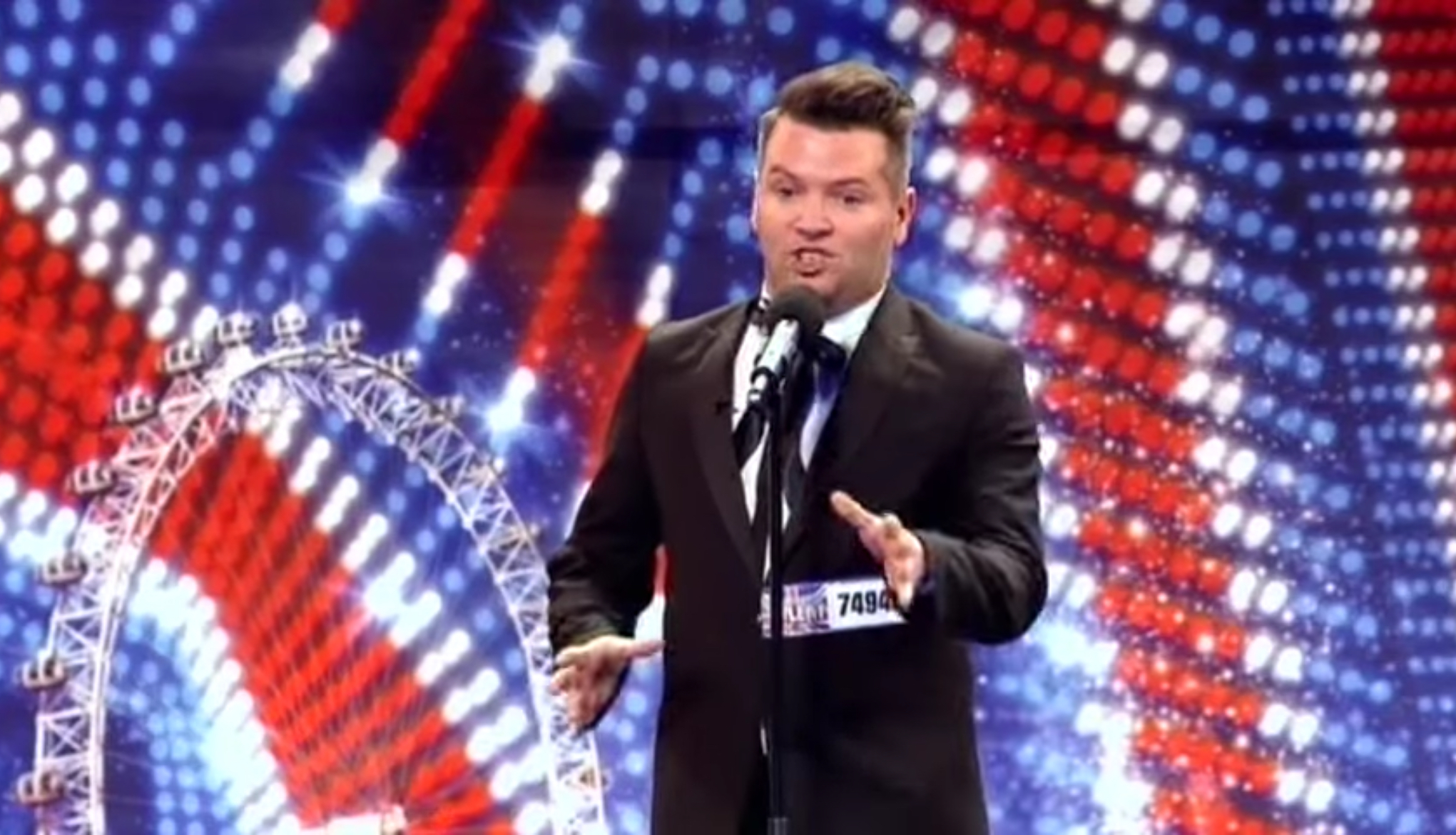
At thirty-five, Edward Reid carried into the Britain’s Got Talent audition a quiet confidence wrapped in a self-deprecating humor that put people at ease. A drama teacher from Coatbridge, he introduced himself with an easy warmth, explaining that his weekdays were filled directing elderly drama groups—affectionately nicknamed the “Nifty 50”—and working with people with special needs. These weren’t the flashy theatre workshops of the city; they were modest community halls, afternoons warmed by tea and biscuits, and rehearsals held between bus timetables and GP appointments. He spoke about them with a fondness that landed immediately: these small, everyday theatres of life were where he found most of his joy and comic inspiration. That background made him instantly likable. Here was a man who taught others to perform, who knew how to coax a smile or a memory out of an audience, and who clearly loved the human stories that theatre can reveal.
Edward’s ambitions, he admitted with a grin that bordered on charmingly cheesy, were modest and slightly theatrical—he joked about having “an audience with Edward Reid” and even half-seriously mused about performing for the Queen. The humility in those comments only underscored his instincts as a teacher and entertainer: he was not a show-off but someone who relished making people laugh and feel. Standing under the blinding stage lights, in front of thousands watching at home and the judges’ scrutinizing gaze, he confessed to feeling intimidated. But his nervousness carried a different energy than fear; it felt like the jittery electricity performers recognize, that charged sensation that tells you something memorable is about to happen.
What followed was delightfully unexpected. Rather than launching into a dramatic monologue or a conventional song, Edward chose to assemble a medley of nursery rhymes—the simple ditties we all remember from childhood: “Old MacDonald Had a Farm,” “Humpty Dumpty,” “Little Bo-Peep”—songs that exist in the collective memory and typically live as background noise at playtime. The twist lay in his treatment. He didn’t present them as lullabies or sing-song choruses; he reimagined these melodies as if they belonged on an operatic bill: full-throated, dramatically phrased, and performed with a gravitas that made the lyrics taste both absurd and unexpectedly profound.
His take on “Old MacDonald” began with a single, solemn note, as if introducing a Wagnerian hero. The familiar “E-I-E-I-O” followed but emerged like a chorus in a cathedral—each animal call elongated, each “moo” and “baa” punctuated with sweeping arm gestures and a face that took itself entirely seriously. He treated the farmyard as a landscape of mythic proportions, somehow turning barnyard sound effects into moments of high drama. When he moved into “Humpty Dumpty,” the cadence shifted and the ordinary nursery tale of a broken egg became, in his hands, a miniature operatic scene: the rise, the fall, the stunned silence after the crack, all staged with intentionally overwrought emotion. He used theatrical pauses, exaggerated crescendos and the kind of timing a teacher hones over years to make a point land. The effect was uproarious and oddly tender; it was clear he wasn’t merely parodying the songs—he was loving them as a theatre-maker loves a prop, finding the dramatic possibility hidden in the everyday.
The audience’s reaction was immediate and wholehearted. Laughter rolled through the room like applause, warm and surprised, as viewers recognized the clever incongruity. Rather than feeling cheapened by the joke, the nursery rhymes gained a new layer of humor precisely because of the sincerity with which Edward delivered them. His careful enunciation—every consonant crisply delivered—the theatrical dips and crescendos, and the earnestness of his commitment made the comedy land again and again. Small details compounded the charm: the way he cocked his head during an especially elongated “cluck,” the sudden, breathy whisper before a big note, and the playful, knowing smile he offered the camera as if sharing the joke with a single onlooker in the back row.
The judges’ reactions were as varied and lively as the performance itself. Louis Walsh, usually terse, admitted he “didn’t think nobody saw that coming,” a double-negative delivered with glee that summed up the room’s genuine surprise. He joked that Edward might soon be booked to sing at Elton John’s child’s party—an absurd image that only added to the amusement. Amanda Holden, smiling broadly, told him she “would so buy your album,” a remark that was both playful and oddly sincere, suggesting Edward’s camp-meets-craft approach might have genuine appeal. David Hasselhoff, never shy with praise, lauded Edward for being “really creative and very funny,” nodding to the skill required to make a gag land on a massive stage.
Underneath the laughter, there was real respect. The judges recognized the training required—the breath control to sustain those operatic phrases, the dramatic timing to convert a nursery rhyme into a mini-theatre piece, and the theatrical instincts to carry a joke without descending into caricature. Edward’s work with community groups showed through in his ability to read an audience, to shape a moment for maximum effect, and to balance affection for the material with the comic distance that makes satire work.
When the votes were cast, the result felt almost inevitable: four unanimous “yeses.” The applause that followed was warm and exuberant, an approving stamp on a performance that had turned expectation on its head. Edward walked off the stage having accomplished something rare—he had made people laugh and marvel in equal measure, and he had reminded everyone that theatre can be playful and inventive. For a man who spends his life coaxing performances out of others, the moment was a joyful reversal: the teacher had become the showman, proving that cleverness married to craft can be utterly irresistible.