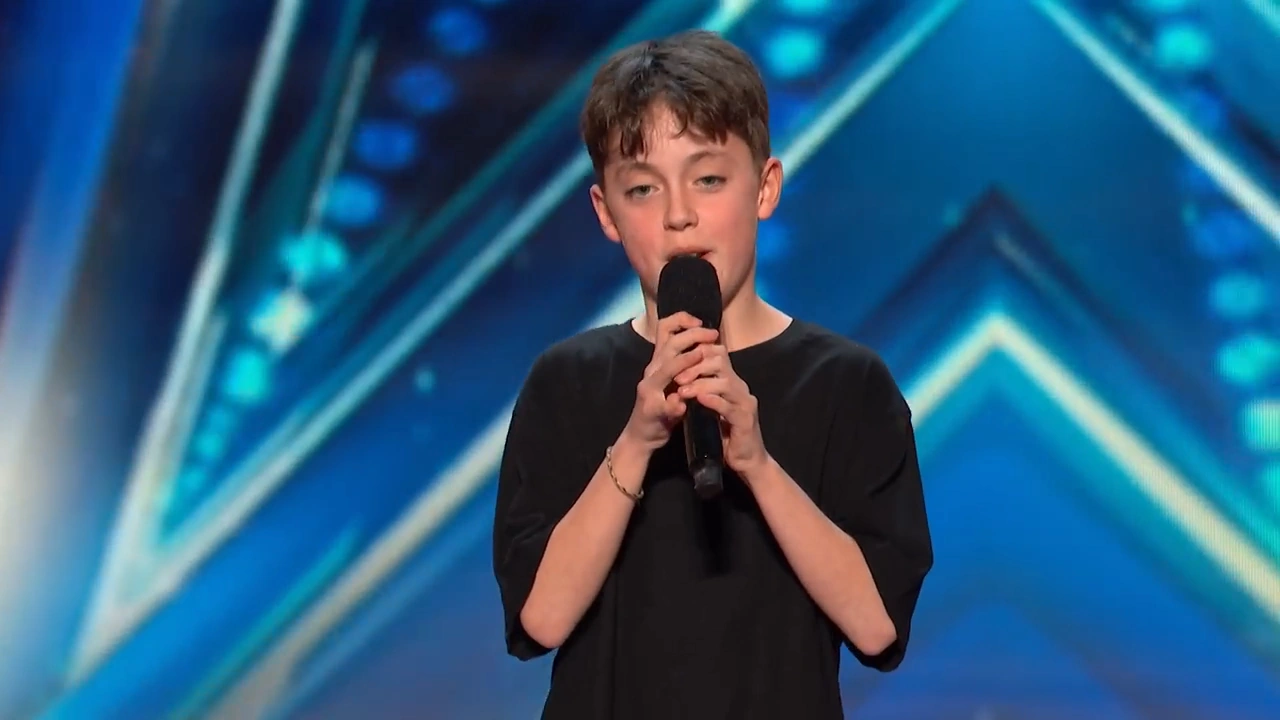
Twelve-year-old Alfie Andrew walked onto the America’s Got Talent stage with a cool, collected air that seemed almost practiced, but in the most charming way possible. He introduced himself as a singer from Manchester, England, and there was an immediate clarity in the way he spoke about his ambitions — recording his own songs, playing a sold‑out world tour — that made it easy to believe he wasn’t just dreaming but planning. Although his parents couldn’t be there — caught up in their own work in the car and beauty industries — Alfie had his aunt in the wings, smiling and nodding encouragement. That small detail made the moment feel intimate amid the cameras and lights: this wasn’t just a TV audition; it was a young person stepping out to stake a claim on a future he clearly wanted.
He admitted he was “definitely nervous,” and the line landed as honestly as any entertainer’s practiced aside. But his nerves didn’t read as fragility; they read as focus. When he sat at the piano and chose “Shallow,” the Lady Gaga–Bradley Cooper duet known for its emotional peaks and nuanced dynamics, you could feel the stakes in the room. It is a song that asks singers to balance restraint and release, quiet hurt and full‑throated yearning — a daunting assignment for someone barely into their teens. That made his choice brave, not gimmicky. He wasn’t picking a crowd‑pleaser to hide behind; he was choosing a narrative that required emotional truth.
From the very first line, the studio hushed. Alfie’s voice carried a warmth and weight not typically expected from a child of his age. There was an immediacy to his tone — a grain and richness that made each syllable feel lived in. Where many young performers might opt for bravado, Alfie mined the song’s quieter places, giving the opening verses a fragile intimacy that made the chorus hits land harder. He displayed a deft sense of dynamics: a soft, near‑spoken phrasing at the start that pulled listeners close, then a gradual opening into belts and sustained notes that rang with surprising maturity.
Details in his delivery revealed careful musical instincts. He shaped phrases with tidy breath control, allowing lines to sit just long enough to breathe meaningfully before pushing them forward. On fraught words he added a delicate rasp that conveyed vulnerability, and when the arrangement needed power, he summoned it without forcing the sound. There were little touches — a tasteful portamento here, a slight husk on an emotional syllable there — that made the performance feel considered rather than imitative. He didn’t try to mimic Gaga’s theatricality or Cooper’s rawness; instead he made the song his own by finding the emotional center and singing from it.
Visually, Alfie’s presence enhanced the music. He wasn’t showy; he let the piano and his voice do the work. Yet his posture and expressions signaled an artist aware of storytelling: a small furrowed brow on a tender line, a steadying breath before a high note, a glance toward his aunt in the wings after a particularly honest phrase. Those nonverbal moments humanized the performance, reminding viewers that behind the voice was a kid with family and history and stakes. The camera caught his fingers hovering for a beat over the keys before he launched into a climactic run, and that tiny hesitation felt like the pivot between a practiced routine and a lived moment.
The audience reaction was immediate and palpable. There was that precious kind of silence reserved for moments people suspect will be important — a silence full of anticipation and respect. When Alfie pushed into the song’s climactic passages, it wasn’t a show of raw volume but a controlled release that made the room lean forward. On the final sustained line, his tone held steady, clear and unwavering, and when the last note faded the auditorium exhaled as one. Applause rose not only in volume but in warmth; people stood and cheered, some visibly moved, others clapping with the stunned delight of having been surprised.
On the judges’ panel, reactions mixed technical appreciation with genuine emotional response. Sofía Vergara, visibly affected, seemed to absorb the performance as a listener first and a critic second, her face reflecting the quiet astonishment playing out across the room. Comments that followed highlighted not just what he could do vocally but how he made the material feel real. They praised his control, his interpretation, and the rare authenticity he brought to a song that can easily ring hollow if treated as a mere showcase. The tone of the feedback wasn’t just congratulatory; it felt like recognition — an acknowledgment that something true had been witnessed.
When the votes were cast, Alfie received a unanimous set of yeses — a tidy affirmation from professionals who recognized both potential and present skill. That outcome sent him through to the next round, but more than that, it felt like a wider recognition: that talent paired with emotional honesty can defy expectations, even at twelve. Walking offstage, there was a new spring to his step and a smile that suggested a mixture of relief, pride, and the intoxicating possibility of what might come next. He hugged his aunt as she met him, her eyes wet with pride, and for a moment the TV gloss fell away; you could see a family savoring a milestone.
For viewers and supporters in the wings, Alfie’s audition read as a moment where preparation, bravery, and a mature emotional core collided — the kind of performance that hints a young artist may already be well on their way. Whether he goes on to record albums or grow into another kind of performer, that night he reminded everyone watching of something simple and rare: when a young voice speaks with honesty, it can sound like a lifetime.