
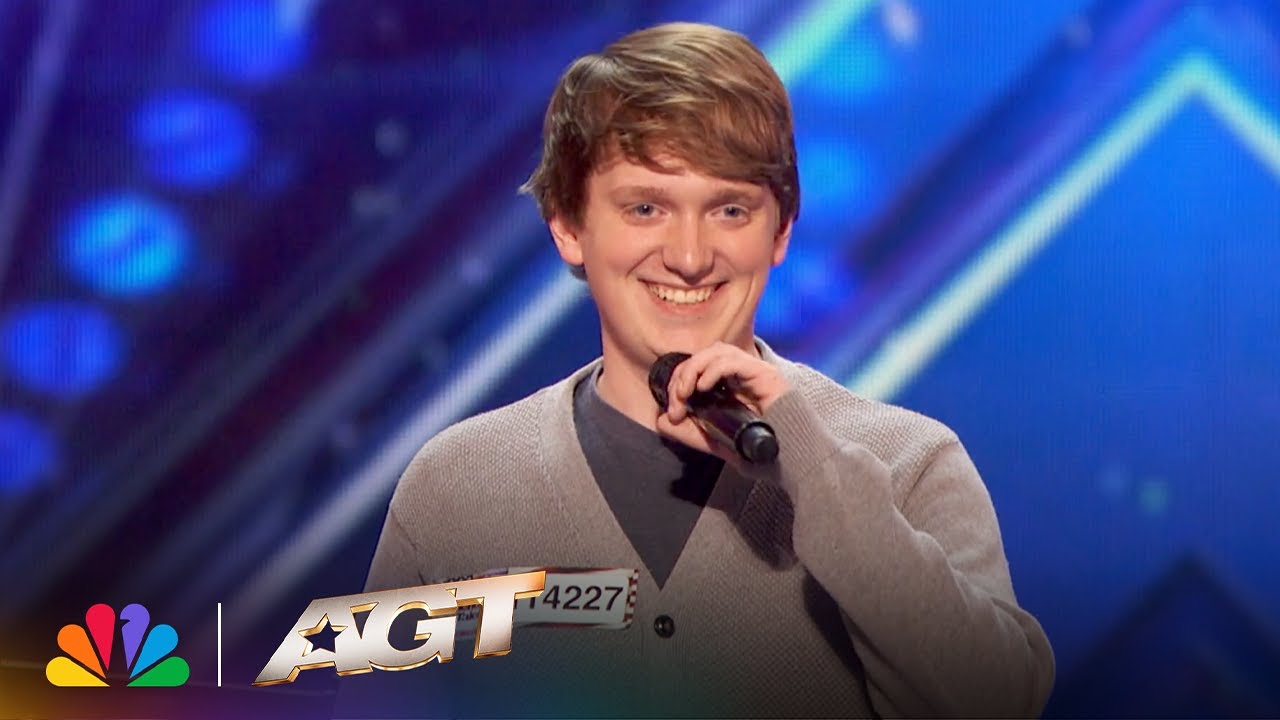
When 18-year-old Ryan Beard stepped onto the America’s Got Talent stage, he didn’t look like your typical heartthrob. He shuffled forward with an awkward, earnest grin, hair a little rumpled, eyes bright with a nervous sort of mischief. He introduced himself in that self-effacing way some people have perfected—part charm, part defense mechanism—proudly admitting he’d been homeschooled and quipping that, obviously, this was why “the ladies love him.” The audience tittered politely and the judges exchanged amused looks, assuming they were in for an awkward, sweet moment. No one in that theater — not the house crowd, not the people watching at home, and certainly not the judges — was ready for just how funny, and how cleverly executed, his performance would be.
Instead of picking a familiar cover or trying to belt out something dramatic, Ryan sat down at the piano and opened into a song entirely his own: an original comedy number about a self-proclaimed “ladies’ man” who, in truth, has zero success with girls. Right from the first chord, the tone was set. The melody was catchy enough to feel familiar, the kind your brain nods along to while you wait for the punchline. But it was Ryan’s lyrics—smart, specific, and vulnerably honest—that made the difference. He sang about small humiliations with the kind of detail that makes a scene come alive: the awkward text left on read, the disastrous attempt at flirting by quoting a movie line at the wrong moment, the way his hair refused to cooperate when he was trying to look cool. Each image painted a portrait of someone trying very hard and failing in ways that were genuinely funny rather than cruel.
What made the whole thing land was timing. Ryan punctuated the verses with perfect pauses, letting the punchlines hang just long enough for the room to register and erupt. He used facial expressions like comic punctuation—one beat wide-eyed, another beat deadpan, a quick roll of the eyes when the inevitable punchline landed. There was a moment mid-song where he pointed to the audience and sang about a girl he’d been crushing on, and the way he synchronized the tiny shrug in his voice with a sheepish grin made the whole section feel like a confessional shared between friends. You could tell these were songs born out of real awkward experiences, which made them that much more relatable.
As the performance continued, laughter built on laughter. What started as amused chuckles swelled into full-throated laughter and whoops. Every punchline landed. Every clever rhyme seemed to get a bigger reaction than the one before. It wasn’t just jokes piled on jokes; the structure of the song—verses that set up the scene and choruses that delivered the sting—made it feel like a little story unfolding. In one verse, he joked about trying to impress a date by pretending to like hiking, only to reveal he’d packed flip-flops and a bag of fast food. The audience howled at the image of a would-be outdoorsman stumbling through nature in sandals clutching a burger. In another, he imitated the robotic, overconfident voice people slip into when they’ve rehearsed a pickup line and it goes disastrously wrong. Those small, concrete examples turned generic lines into vivid, hilarious moments.
The judges’ reactions slowly shifted from fond amusement to genuine, surprised admiration. They weren’t just laughing at the jokes—they were noticing the craftsmanship. How clever were the lyrics? How tight was his phrasing? How strong was his musicality, the way he moved on and off the piano with the confidence of someone who knew exactly how to keep an audience’s attention? Simon and the others leaned forward, smiling in a way that said, “We didn’t expect this—tell us more.” Their smiles weren’t patronizing; they were impressed. It’s one thing to make people laugh. It’s another to write a song that is funny, musically satisfying, and performed with a level of stage presence that fills the room.
By the time Ryan hit the final chorus, the atmosphere had shifted completely. What began as a curiosity—an awkward, homeschooled kid with a funny song—had turned into a full-on celebration. The crowd cheered, standing up for some, clapping and applauding for others. The panel, close to unanimous smiles, banged the buzzers the good kind of way: enthusiastic, approving. Four easy “Yes” votes followed, and it felt less like a formality and more like the moment a little unknown had been coronated by sheer likability and talent.
In a season filled with powerhouse singers and tear-jerking backstories, Ryan Beard stood out not because he tried to be larger than life, but because he was honest about being small and delightfully human. He reminded everyone that sometimes you don’t need to wow with scale or drama; sometimes you just need a piano, a clever song, and the courage to laugh at yourself. That blend of humility, craft, and comedic timing turned his audition into a highlight—proof that authenticity, when done well, is unforgettable.