
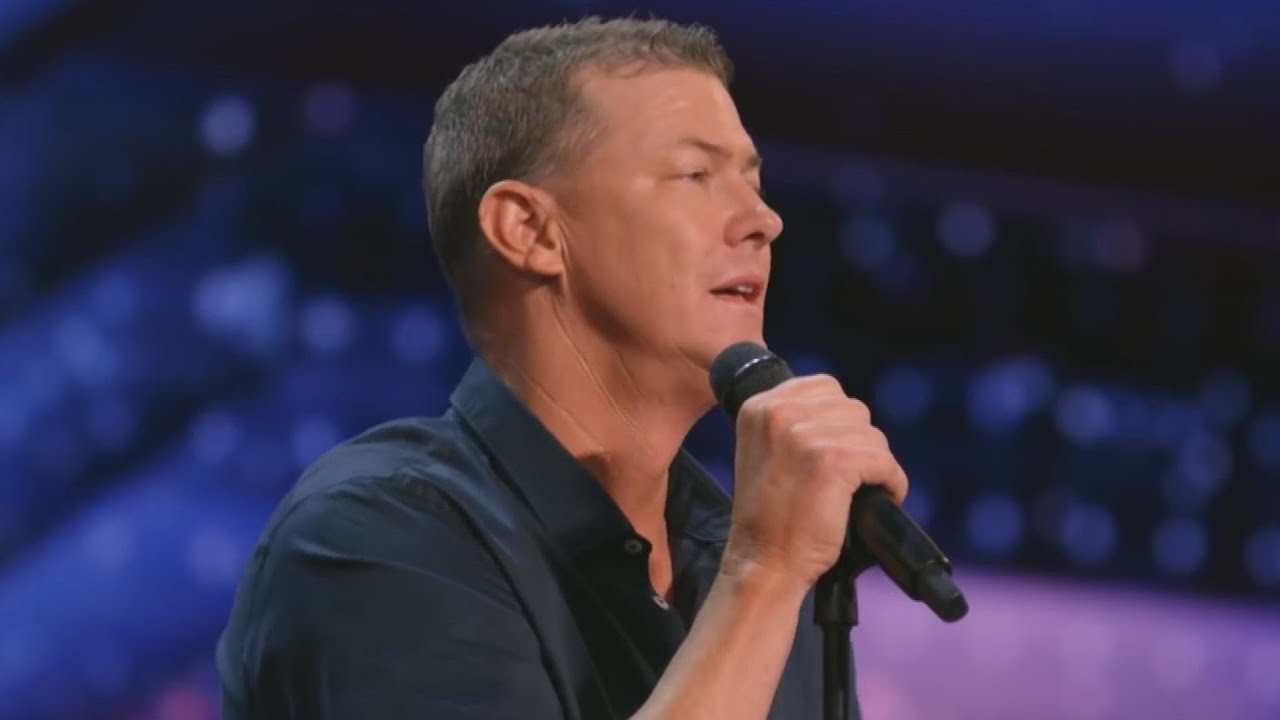
When Matt Mauser stepped onto the America’s Got Talent stage in 2021, he carried with him more than a guitar and a song. He carried the weight of the unthinkable — a grief still fresh enough to sting. Just a year earlier, his wife, Christina, had died in the same helicopter crash that took Kobe Bryant and his daughter Gianna. Christina had been everything to him: his partner in life, his bandmate on stage, the steady hand that steadied him, and the mother of their children. Walking into that bright, unfamiliar spotlight, Matt was not just a contestant; he was a husband still holding on.
He began not with bravado, but with a quiet, earnest introduction. His voice trembled as he told the judges and the audience who Christina was to him — the soft cadence of a man speaking about someone irreplaceable. “She was my everything,” he said, and the room responded the only way a room can when faced with raw human truth: it grew silent. It was a different kind of hush than the usual contest hush; this one was full of compassion and attention, as if everyone in the theater had leaned forward to make sure they heard every word.
Then the music started. He chose “Against All Odds” by Phil Collins — a song that had been Christina’s favorite, the kind of song couples sometimes keep in the background of their lives because it encapsulates what they can’t always say out loud. When the opening chords filled the studio, it stopped being a performance in the typical sense. The lyrics became a letter, the melody a telephone line to someone not in the room. As he sang about being left standing “looking into the eyes of a world that’s breaking,” his voice cracked not out of weakness but from the deep, honest vulnerability that only genuine grief can produce.
Small details made the moment feel intimate despite the size of the stage: his fingers finding the same frets he and Christina had played together, the slight catch in his breath on the bridge, the way he closed his eyes on the chorus as if picturing her in the wings. He wasn’t trying to manipulate emotion; he was inviting the audience to witness a man conversing with memory through song. The camera cut to his children in the audience at one point — their faces mirroring awe and sorrow — and you could see how much this was for them too, a demonstration that love could be expressed publicly without becoming performative.
The audience’s reaction was immediate and genuine. There were tissues waved, shoulders hunched in sympathetic solidarity, and a few people who couldn’t hide their tears. The judges’ faces told the story as plainly as his lyrics: Simon Cowell looked on with a rare softness, and Sofia Vergara’s eyes filled. When the final note faded into the studio lights, there was a beat of stunned silence that felt like everyone holding their breath, then the room erupted into a standing ovation. It wasn’t applause for technique or a booming voice; it was applause for courage, for love, and for the way music can act as a bridge between what is lost and what remains.
After he finished, Simon called the performance “beautifully honest,” a succinct acknowledgment of something no amount of judging could quantify. Sofia, wiping at her cheeks, told Matt that his wife “would be so proud.” Those words landed heavily but gently. For Matt, they were more than validation from television personalities — they were a kind of permission to keep honoring Christina in public ways that felt right for him and his family.
That night on AGT wasn’t about flashy theatrics or winning a trophy. For Matt, it was about healing. He used the platform not to compete with other acts but to demonstrate a more enduring victory: showing his children that love endures even when the people you love are gone. He proved, in front of millions, that grief can coexist with hope, and that expressing sorrow can be an act of strength. After the show, viewers flooded social media with messages of support, sharing stories of their own losses and thanking Matt for reminding them that they weren’t alone.
When you watch that clip back, what stays with you isn’t a critique of vocal range or a rundown of judges’ comments. It’s the human moment — the way he paused on certain words, the way he seemed to look out into the audience as though tracing an invisible presence. It’s simple, almost ordinary gestures that suddenly feel monumental: a breath held a touch longer on the guitar, a glance toward the sky. Those moments transform a song into something sacred.
For Matt and his family, the performance was another step in a long, ongoing process. There would be rough days ahead and small victories too. But on that stage, under the glaring lights and before a national audience, he offered a message that was as clear as any lyric: even through unbearable loss, the bonds of family and the melodies that tie us together can carry us forward. Against all odds, love — like music — lives on.