
Her Brothers Planned to Sell Their Mother’s House After the Funeral—Then a 12-Year-Old Girl Opened the Sewing Box 😳🏠
At 6:18 on a rainy Saturday morning, Carol Bennett stood in her late mother’s kitchen in Findlay, Ohio, wiping dust from a blue ceramic rooster.
The refrigerator hummed beside a calendar still turned to March. A grocery list remained attached with a strawberry-shaped magnet: oatmeal, lightbulbs, lemon soap.
Carol’s mother, Evelyn, had written every word in the careful handwriting of a retired school secretary.
Three weeks had passed since the funeral.
Now Carol’s brothers, Dennis and Mark, had gathered the family to decide what would happen to the little brick house on Willow Street.
Carol wanted to keep it.
Their mother had lived there for thirty-seven years. Every Thanksgiving, she had baked cinnamon apple cake while an old tabletop radio carried the local high school football scores through the kitchen.
But Dennis arrived carrying a folder from a real estate agent.
“The market’s good,” he said, placing the folder beside the sugar bowl. “That house could bring around one hundred eighty-six thousand dollars.”
Mark nodded from the doorway.
“No sense getting sentimental over old walls.”
Carol tightened her hand around the dish towel.
“Mom wanted the family to have a place to gather.”
Dennis gave a dry laugh.
“Mom wanted plenty of things. Wanting doesn’t pay property taxes.”
Carol’s twelve-year-old daughter, Sophie, sat quietly at the kitchen table. She wore a yellow raincoat and held the cracked snow globe Evelyn had kept beside her sewing chair.
Inside it stood a tiny white farmhouse surrounded by silver flakes.
Dennis opened the folder.
The plan was simple. Sell the house, divide the money three ways, and clear everything out before the end of the month.
Carol looked toward the hallway.
Her mother’s slippers were still tucked beneath the coat rack.
“Thirty days?” Carol asked. “That’s all the time the family gets?”
Mark shrugged.
“Most of this stuff belongs in a donation bin.”
Sophie looked up.
“Grandma’s things aren’t junk.”
Dennis leaned back in his chair.
“Nobody called them junk, sweetheart. But grown-ups have to make practical decisions.”
The words stung more than he seemed to realize.
Carol had spent the final year driving Evelyn to appointments, picking up prescriptions, washing sheets, and bringing chicken-and-rice soup whenever her mother felt tired.
Dennis lived twenty minutes away.
Mark lived nine.
Neither had visited regularly.
Yet both had arrived quickly when money entered the conversation.
At 9:05, the family met at the office of county attorney Hannah Pierce. Rain tapped against the narrow windows, and the old radiator clicked beneath a framed photograph of downtown Findlay.
Dennis sat nearest the desk.
Mark kept checking his phone.
Carol and Sophie took two chairs near the door.
Hannah adjusted her glasses and opened Evelyn’s will.
The house and remaining savings were to be divided equally among the three adult children.
Dennis smiled.
“There. That settles it.”
But Hannah did not close the folder.
“There are personal instructions concerning several household items.”
Mark sighed.
“Can those be handled later?”
Hannah’s expression hardened.
“Those instructions mattered to Evelyn.”
She listed a few small gifts: a pearl brooch for Carol, a pocket watch for Dennis, and their father’s fishing tackle for Mark.
Then Hannah mentioned Evelyn’s wooden sewing box.
Sophie straightened.
“That box is under Grandma’s chair.”
Dennis shook his head.
“It’s thread and buttons. That can go with the rest.”
Carol stared at him.
“Nothing leaves that house today.”
Dennis pushed his chair back.
“The sale papers are nearly ready. Delaying this only costs everyone money.”
Sophie’s cheeks turned pink.
“Grandma said the sewing box was important.”
Mark lowered his phone.
“When did she say that?”
“Two Sundays before she went to the hospital.”
Dennis raised his voice.
“Enough. A child does not decide what happens to a house.”
Hannah looked toward Sophie.
“What exactly did Evelyn tell her?”
Sophie held the snow globe against her chest.
“She said to open the bottom drawer when the family started arguing.”
Nobody moved.
Dennis forced a smile.
“Mom got confused near the end.”
Carol stood so quickly that her chair scraped the floor.
“She remembered every birthday, every bill, and every person who bothered to show up.”
Mark looked away.
Twenty minutes later, the family returned to Willow Street with Hannah following in her gray sedan.
The sewing box sat beneath the living room window. It was made of dark wood, with tiny brass handles and faded scratches along the lid.
Dennis reached for it.
Sophie stepped in front of him.
“Grandma said Carol had to open it.”
For the first time that morning, Dennis had no quick reply.
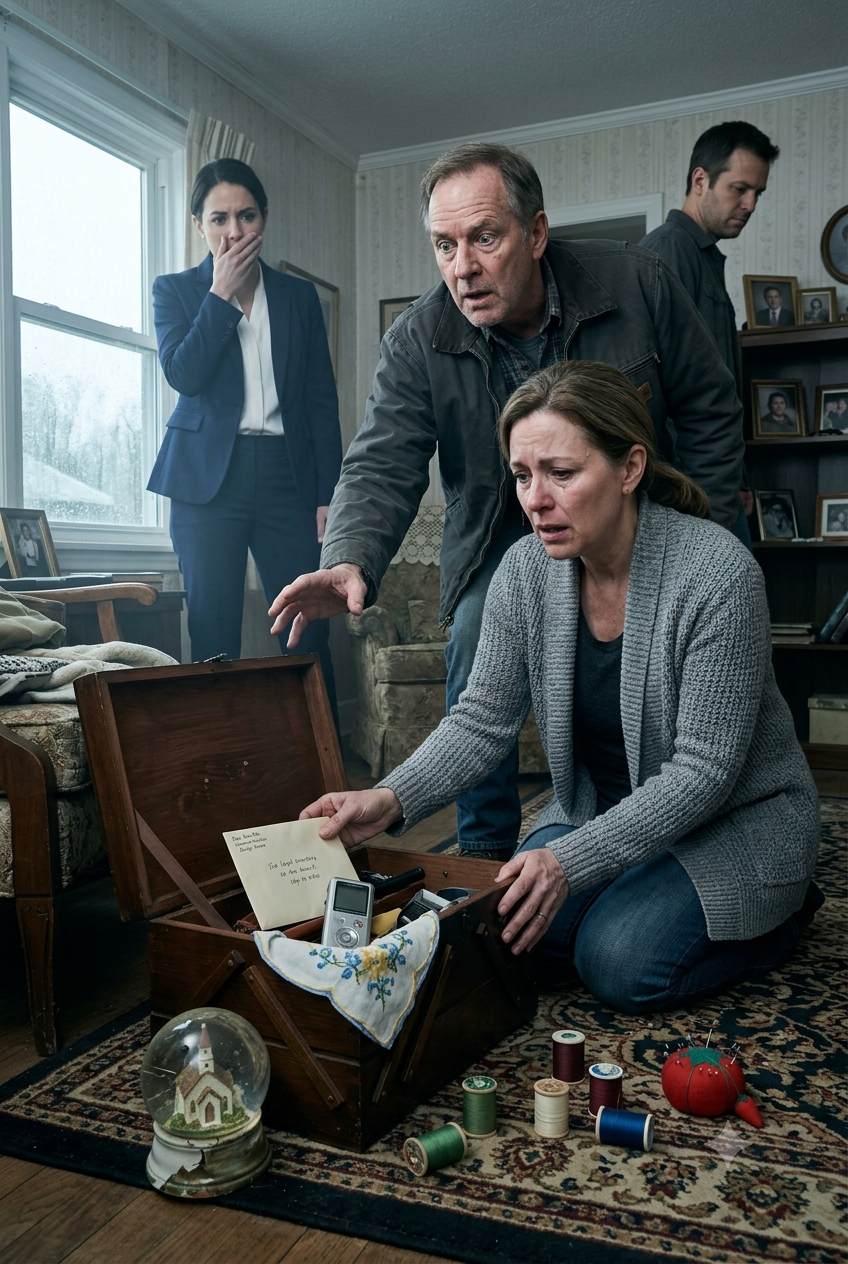
Carol lifted the top tray. Spools of green, cream, and burgundy thread rested beside a tomato-shaped pincushion.
The bottom drawer appeared empty.
Then Sophie touched a strip of loose blue fabric along the back.
“There.”
Carol pulled it aside.
Behind it was a sealed envelope and a small digital voice recorder wrapped in one of Evelyn’s embroidered handkerchiefs.
Mark’s face changed.
Dennis reached forward.
“Hand that over.”
Sophie rose from the carpet and placed herself between Dennis and her mother.
Then she pressed the recorder’s silver button.
And what happened next left everyone speechless… 😱
👉 Continued in the comments… 👇👇
Her Brothers Planned to Sell Their Mother’s House After the Funeral—Then a 12-Year-Old Girl Opened the Sewing Box
—
PART 2
Evelyn’s voice filled the living room.
It sounded tired, but perfectly clear.
She explained that Carol had paid the mortgage shortage during the previous winter after a plumbing repair emptied Evelyn’s savings.
Carol had also covered the insurance, groceries, and home-care visits without asking for repayment.
Dennis slowly lowered his hand.
Mark stared at the floor.
The recording continued.
Evelyn said the equal division in the original will had been written years earlier. A signed amendment was hidden with the recorder because she feared the papers might “disappear” if certain family members found them first.
Hannah opened the envelope.
Inside was a notarized document granting Carol the right to live in the house for as long as she wished. If Carol ever chose to sell, she would first receive repayment for every documented expense, plus half of the remaining value.
Dennis’s face turned pale.
“That cannot be legal.”
Hannah placed several receipts on the coffee table.
“It is legal, witnessed, and properly filed with a duplicate at the county office.”
There was one more surprise.
The receipts showed that Dennis had borrowed $8,700 from Evelyn two years earlier for repairs to his pickup truck. Mark had borrowed $6,200 after falling behind on rent.
Neither loan had been repaid.
Both amounts were to be deducted from their inheritance.
Mark covered his eyes.
Dennis stared at the recorder as Evelyn’s final words played.
“Carol gave time when the others gave excuses. A family home should belong first to the person who kept the family inside it.”
Sophie began to cry.
Carol knelt and pulled her close.
Dennis left without taking the pocket watch.
Mark stayed behind. He removed his baseball cap and apologized beside the old sewing chair.
Six weeks later, Carol and Sophie moved into the house on Willow Street.
The real estate folder disappeared into a recycling bin. Mark began repaying his loan in small monthly amounts and came every Sunday to repair the porch railing.
Dennis challenged the amendment, but withdrew after his attorney reviewed the documents.
Carol placed Evelyn’s sewing box on a restored table near the window.
Inside the lid, Sophie taped a handwritten card:
“Love is shown by who stays.”
Sometimes fairness arrives through grand speeches. Sometimes it waits quietly inside an old wooden box until someone brave enough tells the truth. ❤️
Would the family home have been worth fighting for, or should Carol have walked away? Share this story if loyalty should matter more than money. 👇