
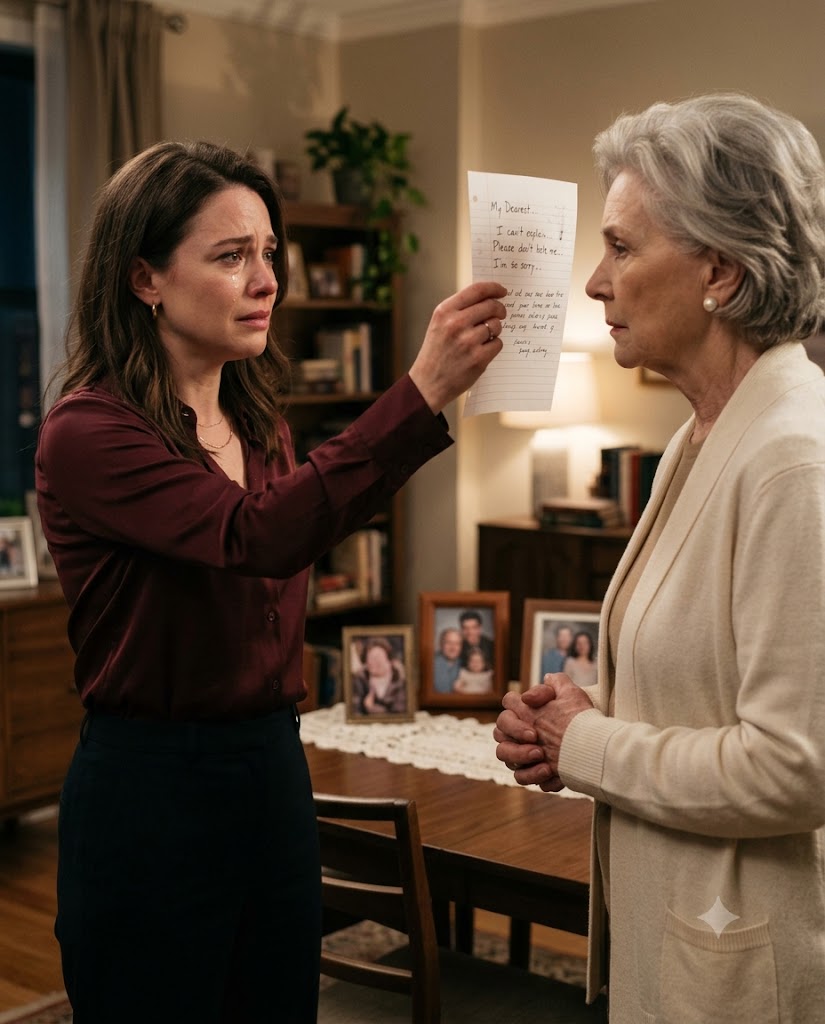
I FROZE OUR JOINT ACCOUNT AFTER FINDING MY HUSBAND’S SECRET PAYMENTS—THEN HIS MOTHER HANDED ME A LETTER WITH MY NAME ON IT
My husband’s phone lit up while he was outside taking out the trash.
Transfer completed: $900. Recipient: Margaret Cole.
Margaret was his mother.
I opened our banking app and stared at the history.
The same payment had been made every month for almost a year.
We were saving for a new roof. I had canceled dental work, stopped buying lunch at work, and taken extra weekend shifts.
Meanwhile, Daniel had quietly sent his mother nearly $11,000.
I froze the joint card before he came back inside.
“What happened to the account?” he asked when his payment was declined.
“I happened.”
His face changed when I showed him the transfers.
“She needs help,” he said. “Her pension barely covers anything.”
“Then why didn’t you tell me?”
“Because you would have made me justify every dollar.”
I hated how quickly he answered.
The next morning, Daniel left without speaking.
At noon, Margaret called and asked me to visit her apartment.
I expected tears, excuses, or accusations.
Instead, she placed a sealed envelope on the table.
“My son made me promise never to show you this,” she said.
Inside was a letter written in Daniel’s handwriting.
The first line made my hands shake.
If anything happens to me, make sure Emily never learns where the money really went.
👇👇 Part 2 in the comments 👇👇
PART 2
I read the sentence twice.
Then a third time.
“What does this mean?” I asked.
Margaret folded her hands in her lap.
Her apartment was small but neat. Nothing looked expensive. The couch was old. The curtains had faded from the sun. There were no new appliances or shopping bags.
Nothing that explained eleven thousand dollars.
“Daniel hasn’t been giving the money to me,” she said.
“Then why is your name on every transfer?”
“Because I opened a separate account for him.”
My stomach tightened.
“For what?”
Margaret looked toward the bedroom door.
“My granddaughter.”
Daniel and I did not have children.
At least, that was what I believed.
Margaret brought out a blue folder and placed it beside the letter.
Inside were hospital statements, school records, and photographs of a little girl with dark curls and Daniel’s unmistakable gray eyes.
Her name was Sophie.
She was nine years old.
I could barely speak.
“Daniel has a daughter?”
Margaret nodded.
“From before he met you.”
The room seemed to tilt.
Daniel and I had been married for seven years. We had talked about children many times. He always said he had never been a father and was afraid he would not know how.
Every one of those conversations had been a lie.
“Where is her mother?”
“Laura died three years ago after a long illness.”
I gripped the edge of the table.
“And Daniel knew?”
“He found out about Sophie shortly before Laura died.”
Margaret explained that Laura and Daniel had dated briefly in college. They separated before Laura learned she was expecting. She raised Sophie with help from her parents and never contacted him.
Years later, when she became seriously ill, she sent Daniel a letter.
A DNA test confirmed that Sophie was his daughter.
“Why didn’t he bring her home?” I asked.
“Because Laura’s sister became her legal guardian. Sophie had already lost her mother. Everyone agreed she needed stability.”
The monthly payments covered therapy, school expenses, and part of her medical insurance.
I looked again at the photographs.
One showed Daniel kneeling beside Sophie at a science fair.
He looked happy.
Not polite. Not obligated.
Happy.
“He visits her?”
“Once or twice a month.”
My throat tightened.
Those were the Saturdays he claimed to be helping a coworker renovate an old house.
He had built an entire second life out of careful excuses.
Margaret touched the letter.
“He wanted to tell you many times.”
“But he didn’t.”
“He was afraid.”
“Of what?”
“That you would leave. You had just finished paying off your own father’s medical debt. Money was tight. Then Sophie needed counseling and dental treatment. Daniel thought you would see her as another burden.”
“So he decided I didn’t deserve a choice.”
Margaret lowered her eyes.
“I told him secrecy would make everything worse.”
She was right.
When Daniel came home that evening, I was sitting at the kitchen table with the blue folder.
He stopped in the doorway.
For several seconds, neither of us moved.
“You went to Mom’s,” he said.
“Yes.”
He placed his keys down slowly.
“I can explain.”
“You have a daughter.”
His face crumpled.
“Yes.”
“You have visited her for three years.”
“Yes.”
“You used your mother’s account to hide the payments.”
“Yes.”
Each answer landed harder than the one before it.
“Why did you marry me and let me believe you had no children?”
“I didn’t know about Sophie when we married.”
“But you knew three years ago.”
He sat across from me.
“When Laura contacted me, everything happened quickly. The test, the hospital, meeting Sophie. Then Laura died.”
His voice shook.
“Sophie barely spoke for months. She woke up crying. She thought every adult she loved would disappear.”
“And your solution was to disappear from half your own life?”
“No. I tried to protect both of you.”
“You protected yourself.”
He did not argue.
That surprised me more than an excuse would have.
“I was ashamed,” he said. “Not of Sophie. Never of her. I was ashamed that I had missed so much of her life. Then every month I waited made telling you harder.”
I opened the letter.
“What did you mean by ‘if anything happens to me’?”
Daniel looked at the floor.
Six months earlier, a routine exam had revealed an irregular heartbeat. His doctor was monitoring it and believed it could be managed, but Daniel had panicked.
He wrote the letter so Margaret would continue supporting Sophie if he became unable to work.
“You hid that too?”
“I didn’t want you worrying before we knew more.”
I laughed once, but there was no humor in it.
“You keep calling secrets protection.”
He covered his face with both hands.
“I know.”
I wanted to throw him out.
I wanted to demand every detail.
But above all, I wanted to meet the child whose existence had shaped three years of my marriage without my knowledge.
“I want to see Sophie,” I said.
Daniel looked up.
“You do?”
“I need to understand what is real.”
We met her two weeks later at a public library.
Sophie was quiet and observant. She held a book about planets against her chest.
When Daniel introduced me, she looked terrified.
“Are you angry with me?” she asked.
The question broke something inside me.
I knelt so we were at the same height.
“No, sweetheart. None of this is your fault.”
She nodded, but did not smile.
We spent an hour together.
She showed me her drawings. She loved astronomy and hated mushrooms. She called Daniel by his first name because “Dad” still felt too new.
On the drive home, I told him the truth.
“I do not know whether our marriage will survive this.”
He nodded.
“But Sophie should never be hidden again.”
The next months were difficult.
We separated temporarily and began counseling.
Daniel transferred his salary to his own account. We created written agreements for shared expenses. Most importantly, he told the truth even when it was uncomfortable.
I met Sophie slowly.
Not as a replacement mother.
Not as a rescuer.
Simply as someone willing to show up.
A year later, Daniel and I were still married, but our relationship was different.
Less polished.
More honest.
Sophie began spending one weekend a month with us.
One evening, she left a drawing on the refrigerator.
It showed three people standing beneath a sky full of stars.
Under Daniel, she had written Dad for the first time.
Under herself, she wrote Me.
Under me, she had written Emily—she stayed.
I cried in the kitchen after everyone went to bed.
I had frozen our bank account because I thought money was disappearing from our family.
The truth was more complicated.
The money had been supporting a child who had already lost too much.
But love did not excuse deception.
Daniel had to learn that honesty was not something he could postpone until it felt safe.
And I had to decide whether forgiveness meant forgetting.
It did not.
Forgiveness meant remembering clearly, setting boundaries, and watching what someone chose to do next.
Daniel chose to stop hiding.
Sophie chose to trust us slowly.
And I chose to stay—not because secrets were acceptable, but because the truth finally had a place in our home.