
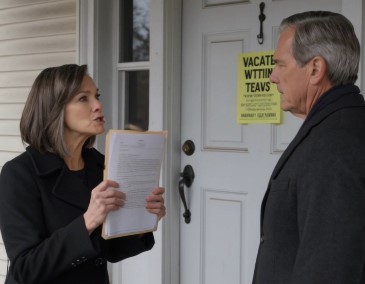
The eviction notice was taped to my mother’s front door before her funeral flowers had even wilted.
My brother said the house belonged to him now.
Then the bank manager opened a safe-deposit box our mother had hidden for twenty-seven years.
My name is Diane Walker. I’m fifty-four, and I live in Topeka, Kansas.
For the last eight years, I cared for my mother, Evelyn, in the little white house where my brother and I grew up.
The porch leaned slightly to the left.
The kitchen floor still had a burn mark from the Thanksgiving turkey I dropped when I was sixteen.
Every wall held part of our family.
My older brother, Paul, rarely visited.
He lived across town.
He was always too busy.
Too tired.
Too important.
But when Mom’s memory began to fade, Paul suddenly became interested in her finances.
He offered to “help” with the bills.
He took over her bank statements.
He insisted on keeping her checkbook.
I did not like it.
But Mom trusted him.
“He understands money,” she told me.
I trusted her judgment.
That was my mistake.
Mom died on a cold Tuesday morning with my hand wrapped around hers.
Three days later, we buried her.
When I returned from the cemetery, a yellow notice was taped to the front door.
VACATE WITHIN TEN DAYS.
Paul stood on the porch beside a realtor.
He held a folder under one arm.
“What is this?” I asked.
He did not even look ashamed.
“Mom transferred the house to me last year.”
“No, she didn’t.”
“She signed everything legally.”
“I live here.”
“Not for much longer.”
The realtor stared at the ground.
I opened the folder.
Inside was a deed bearing Mom’s signature.
It gave Paul full ownership of the house.
There was also a loan agreement.
He had borrowed nearly two hundred thousand dollars against the property.
The payments were already overdue.
My chest tightened.
“You mortgaged Mom’s house?”
“It was my house by then.”
“You used her.”
He stepped closer.
“Be careful, Diane. I paid her expenses.”
“I paid for her food. Her medicine. Everything.”
“You have no proof.”
The house was all I had.
I had left my job to care for Mom.
My savings were almost gone.
If Paul’s papers were valid, I would lose both my home and the only place where I still felt close to her.
The next morning, I met Paul at the bank.
A manager had called after discovering an old safe-deposit box in Mom’s name.
Paul smiled as we entered the private viewing room.
“Whatever is inside belongs to the estate,” he said. “And I am the executor.”
The manager placed a narrow metal box on the table.
Inside were three envelopes.
One was labeled FOR DIANE.
One was labeled FOR THE BANK.
The third was labeled FOR THE POLICE.
Paul stopped smiling.
I opened mine first.
It contained a handwritten letter from Mom.
Diane, if Paul claims I gave him the house, do not believe him.
My hands began to shake.
The bank manager opened the second envelope.
Inside was an original deed transferring the house to me.
It had been signed and notarized two years earlier.
Paul grabbed the table.
“That document is false.”
The manager compared the dates.
Then she looked at the mortgage file on her computer.
“Mr. Walker, the deed you used for the loan was recorded six months after this one.”
Paul’s face went pale.
The manager reached for the final envelope.
The one marked FOR THE POLICE.
She unfolded a letter, read the first line, and looked directly at my brother.
“Mrs. Walker states that Paul forced her to sign documents while she was heavily medicated, and that the entire conversation was recorded on—”
👇👇 Part 2 in the comments👇👇
=== PART 2 — goes in the comments ===
“—the voice recorder hidden inside her kitchen clock.”
Paul pushed back his chair.
“This is absurd.”
The bank manager pressed a security button beneath the table.
Then she removed a small recorder from the envelope.
Mom’s voice filled the room.
It was weak.
But clear.
“Paul, I do not want to sign this.”
His voice answered.
“If you refuse, I’ll tell Diane you can no longer stay at home.”
“You cannot take her house.”
“She will never know.”
Then came the sound of paper sliding across a table.
Paul telling her where to sign.
Paul promising the bank would never check.
Paul admitting he planned to use the money to cover debts from a failed business.
I looked at him.
“You frightened a dying woman into signing away my home.”
He pointed at the recorder.
“She was confused.”
“No,” the manager said. “You were very specific.”
Police arrived before Paul could leave.
Investigators later confirmed that he had brought a notary friend to the house while Mom was sedated after surgery.
The notary admitted he never verified her condition and cooperated with authorities.
The forged transfer was voided.
The mortgage was declared fraudulent.
Because the bank had failed to verify the earlier deed, it could not take my house.
Paul was charged with elder financial abuse, fraud, forgery, and theft.
He also stole more than forty thousand dollars from Mom’s accounts.
The bank records proved every transfer.
He pleaded guilty rather than face trial.
The judge ordered restitution and sentenced him to prison.
I was named executor in Mom’s valid will.
The house became mine free of Paul’s fraudulent debt.
I used part of the recovered money to repair the porch.
I kept the kitchen clock.
It still hangs above the doorway, though I removed the recorder.
Sometimes I stand beneath it and remember that Mom understood more than Paul believed.
He tried to use her illness to erase her wishes.
Instead, her own voice saved the home she meant for me.