
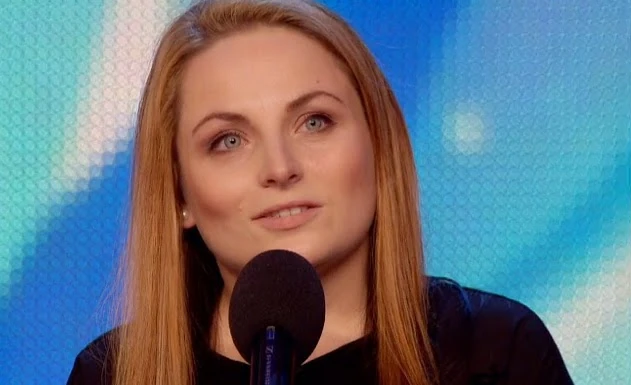
Becky O’Brien walked onto the Britain’s Got Talent stage carrying more than a song; she carried a lifetime of choices, sacrifices, and slow, steady courage. At 34, a mother of five, she described simply but poignantly how she had put her singing dreams on hold to raise her children — a decision magnified when her twins were born prematurely and needed everything she could give. Those early days of hospital visits, sleepless nights and constant worry had reshaped her priorities, and the chorus of motherhood drowned out the solo she’d once imagined for herself. On top of that, Becky quietly revealed she had left an abusive marriage, a fact that added another layer to her story of survival. It was not dramatic grandstanding; she spoke with the weary but resolute calm of someone who had endured and chosen to move forward.
The spark that finally nudged her back toward the microphone came from an unexpected place: her eldest son, Jack. One evening, as the family watched Britain’s Got Talent together, Jack turned to his mum and said, “Go on, Mum — show Simon Cowell how it’s done.” That straight-from-the-heart encouragement, the kind that only comes from a child who believes in you without reservation, was all Becky needed. It was not a flash of ambition but a gentle invitation to reclaim a piece of herself — to show not just Simon but her children and herself that she could take a stage and make it hers. When she stepped into the bright lights, the audience could sense this was more than an audition; it was a reclaiming.
She chose “Somewhere Over the Rainbow,” a song that, with its simple, yearning melody and hopeful lyrics, seemed perfectly suited to her narrative. From the first phrase, Becky’s voice announced itself as something rare. It was full-bodied, warm, and rounded in a way that gave the impression of familiarity — as if you’d heard it on old records or in a dusty radio tucked away in a grandparent’s kitchen. One judge even commented that her tone sounded “from a different era,” which felt less like a cliché and more like an acknowledgment of depth: Becky’s voice carried life experience in every note. She didn’t merely perform the song; she inhabited it. The line “somewhere over the rainbow, skies are blue” became a prayer she seemed to have rehearsed in private moments of longing.
There was a palpable emotional current running through her performance. When she sang about “where troubles melt like lemon drops,” it wasn’t an abstract image — it was a tangible hope, the kind a mother might whisper on bad nights when a child is feverish or when the past threatens to creep back in. Becky’s phrasing had the patience of someone who knows when to hold a note and when to release it; she used breath and silence as effectively as melody. Her voice could swell into power on the bridge and retreat into tender vulnerability for the quieter lines. The audience responded instinctively, leaning in as if drawn by the sincerity of the storytelling.
You could see the judges’ faces change as the song unfolded. David Walliams looked moved, his usual comic reserve softened by attention. Alesha Dixon’s eyes grew moist; she later said the authenticity of Becky’s voice made the performance profoundly emotional. Simon Cowell, who has archived thousands of auditions and is rarely effusive, watched as if witnessing a rare alignment of talent and timing. Their reactions were not just professional assessments; they were human reactions to someone who’d risked everything to sing a simple, truthful song.
More than technique, it was Becky’s backstory that amplified the effect. Audiences love a great performance, but they fall in love with the person behind it. When Becky referenced her children in the green room — the minute details, like Jack urging her to try, and the image of twins once too small to come home — those facts became co-authors of the performance. Parents in the crowd nodded in solidarity; anyone who’d ever abandoned a dream for responsibility recognized the quiet ache in her voice. The applause that followed wasn’t merely polite acknowledgment; it felt like collective relief and celebration. People stood, some noticeably emotional, applauding a woman who had carried so much and finally found a place to set a piece of herself down.
After the last note faded, the judges struggled to contain their praise. David called her talent “amazing” and “stunning,” words that might feel hyperbolic in other contexts but landed true here. Alesha described the performance as “so beautiful, so authentic,” pointing not to a manufactured showpiece but to a moment of human recognition. Simon summed it up with the perspective of someone who’s seen the show’s potential to change lives: “That was your moment and you took it and it was fantastic.” His endorsement wasn’t just about vocal ability; it acknowledged the act of stepping forward after years of putting others first.
Perhaps the most touching detail was that Becky’s children were watching, likely somewhere backstage or in the audience, eyes wide with pride. For a woman who had shelved a dream for the practical work of love — for nappies, hospital wards, arguments ended, and doors opened — the unanimous “Yes”es were validation of sorts. The four judges’ votes sent her through, but more importantly, they affirmed that the sacrifices had not been erasure. Becky’s audition did more than advance her in a competition; it announced the start of a new chapter where hope, talent, and hard-won courage could coexist. In that balance of fragility and strength, she reminded everyone watching that it’s never too late to sing your truth.