
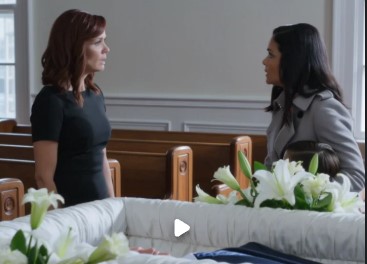
The woman standing beside my husband at his memorial was wearing my wedding ring.
Everyone believed she was his grieving sister.
Then a six-year-old boy ran toward her and called my dead husband “Daddy.”
My name is Melissa Grant. I’m forty-four, and I live in Mobile, Alabama.
For nineteen years, I believed I had a good marriage.
David worked as a regional insurance investigator.
His job kept him on the road several nights each month.
I never complained.
I raised our daughter, paid the bills, cared for his father after a stroke, and kept dinner warm whenever David promised he would be home late.
He always kissed my forehead before leaving.
“You’re the reason I can do this,” he would say.
Three months ago, police told me David had died when his car went off a bridge during a storm outside Montgomery.
They found the vehicle in the river.
His wallet was inside.
So was his work badge.
But his body was never recovered.
The insurance company declared him dead after investigators found blood on the driver’s seat and confirmed the car had been swept downstream.
I was shattered.
Our seventeen-year-old daughter, Lily, stopped speaking for days.
David’s father cried like a child.
I planned the memorial at the small church where David and I had married.
White lilies surrounded his framed photograph.
His empty navy suit hung inside the closed casket because there was no body to bury.
Then a woman I had never seen before entered the church.
She was about my age.
Dark hair.
Gray coat.
David’s gold wedding band hung from a chain around her neck.
A little boy held her hand.
She sat in the second row and cried harder than anyone.
After the service, I approached her.
“How did you know my husband?”
She wiped her eyes.
“I worked with him.”
“That ring belonged to David.”
Her hand closed around it.
“He gave it to me.”
My stomach dropped.
Before I could speak, the little boy pulled away from her.
He ran to David’s photograph.
“That’s Daddy,” he said.
The entire church went silent.
The woman grabbed his shoulders.
“Evan, please.”
I stared at her.
“Who are you?”
Her face crumpled.
“My name is Rachel.”
“And why is your son calling my husband his father?”
David’s former boss stepped between us.
“Melissa, perhaps this should be discussed privately.”
“No.”
My voice echoed through the church.
“I buried an empty casket today. I deserve the truth.”
Rachel began shaking.
She reached into her purse and handed me a photograph.
David stood beside her in front of a yellow house.
His arm was around her waist.
The little boy sat on his shoulders.
On the back, someone had written:
OUR FIRST HOME. LOVE, DAVID.
I could barely stay upright.
“How long?”
“Seven years,” Rachel whispered.
My daughter gasped behind me.
Seven years.
While I cared for his father.
While I waited through his business trips.
While he celebrated birthdays and anniversaries with us.
He had another family.
Then David’s boss took the photograph from my hand.
His expression changed.
“This house,” he said. “I recognize the address.”
Rachel stepped back.
He looked at me.
“Melissa, David investigated a life-insurance fraud claim at this property last year.”
“What does that mean?”
He pulled out his phone and called someone.
A few minutes later, two police officers entered the church.
One carried a clear evidence bag containing a hotel key card.
The officer looked at Rachel.
“We found this inside David Grant’s abandoned car.”
Rachel stared at the card and whispered, “That’s impossible.”
“Why?” I asked.
Her lips trembled.
“Because David used that hotel whenever he needed to disappear.”
The officer unlocked his tablet.
A security image appeared on the screen.
It had been taken the morning after David supposedly died.
The man walking into the hotel was—
👇👇 Part 2 in the comments👇👇
=== PART 2 — goes in the comments ===
David.
Alive.
He wore a baseball cap and carried a suitcase.
The timestamp showed 8:12 a.m.
His car had entered the river less than six hours earlier.
Lily covered her mouth.
Rachel collapsed onto a pew.
“He told me he was starting over,” she whispered.
The officer showed us more images.
David had left the hotel two days later using a false name.
He had purchased a bus ticket to New Orleans.
His employer had also discovered that he recently increased his life-insurance policy to two million dollars.
I was the listed beneficiary.
But the bank account for the payment had been changed.
The new account belonged to Rachel.
She stared at the officer.
“I knew nothing about that.”
David’s boss opened a file on his phone.
David had used his knowledge as an insurance investigator to stage his own death.
He planted blood from a medical sample inside the car.
He left his wallet and badge behind.
Then he escaped before the vehicle rolled into the river.
He planned for me to file the claim.
Once the money entered Rachel’s account, he intended to join her and Evan under new identities.
Rachel began crying.
“He told me you were already divorced.”
I looked at the ring around her neck.
“He lied to both of us.”
The police had tracked David through the hotel footage and bus records.
They arrested him that afternoon at a rented apartment near the Louisiana border.
He had fake identification, cash, and passports for himself, Rachel, and Evan.
He was charged with insurance fraud, identity fraud, evidence tampering, and abandoning the scene of a staged accident.
The insurance claim was canceled before any money was paid.
Rachel cooperated fully and was not charged.
A DNA test later confirmed Evan was David’s son.
I filed for divorce while David sat in jail.
The court awarded me our home and protected Lily’s college savings after investigators proved David had tried to empty both accounts.
David eventually pleaded guilty and received a prison sentence.
His father removed David’s photograph from his living room.
Lily refused every letter he sent.
Months later, Rachel and I met so our children could understand that neither of them caused what happened.
We were not enemies.
We were two women betrayed by the same man.
David left us an empty casket and expected us to mourn a lie.
Instead, we watched the truth close the door behind him.