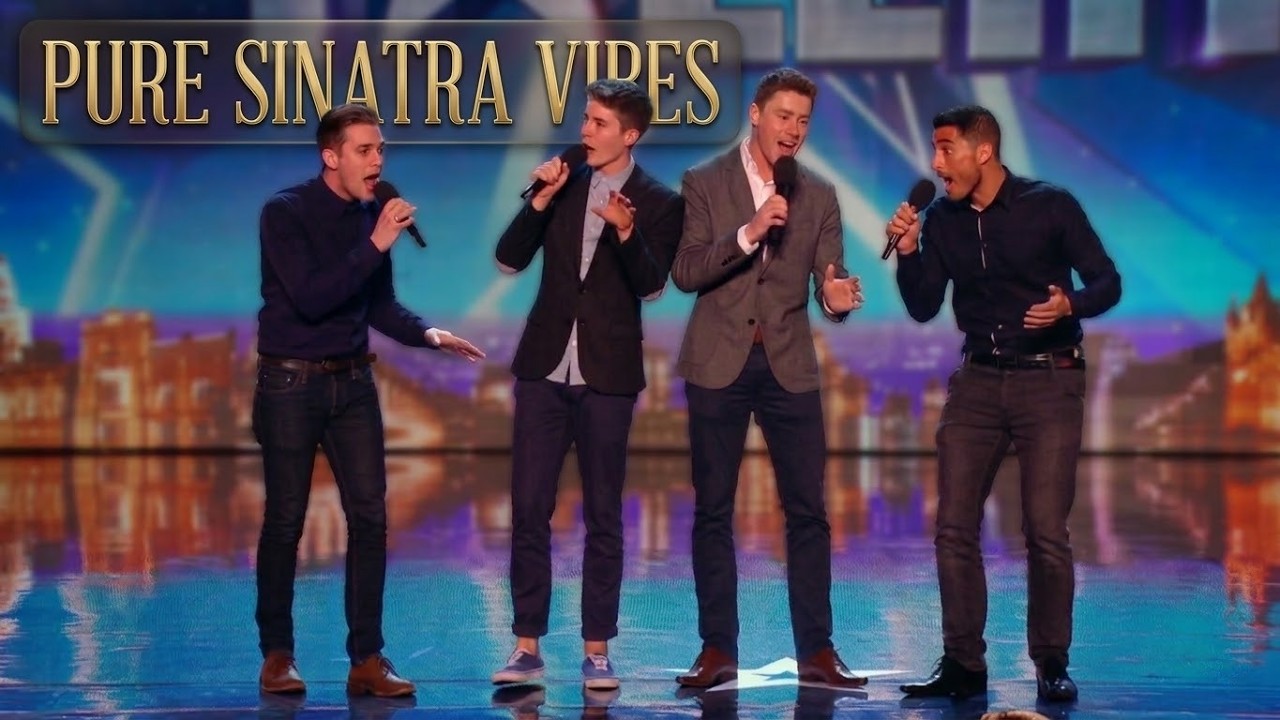
Jack Pack didn’t crash onto the Britain’s Got Talent stage with pyrotechnics or a choreographed dance break. When Adam, Alfie, Andrew, and Sean stepped into the spotlight, they brought something else entirely: tailored suits, slicked-back hair, and a calm, old-school polish that seemed to belong to a bygone smoky lounge rather than a Saturday-night TV contest. There was an immediate sense of intent about them — not flashy, but confident, as though they had rehearsed not just the notes but the posture and timing that make a group look effortless. The audience felt it too; conversations quieted, heads tilted, and the humming anticipation in the Hammersmith Apollo settled into a focused hush.
They opened with Frank Sinatra’s “That’s Life,” a choice that carried both risk and reward. It’s a standard that invites comparison to an icon, yet Jack Pack approached it not as imitation but as interpretation. From the first bars, the room slipped into their world of swing and swagger. Their harmonies were warm and perfectly aligned, like four voices shaped to fit one classic, and their phrasing hinted at decades of lounge-room experience even as it pulsed with contemporary precision. It was nostalgia served with a fresh coat of paint — you could hear Sinatra’s ghost in the arrangement, but the group’s chemistry and modern sensibility made the performance feel immediate rather than retro.
What made the audition land so hard was that delicate balance: too faithful and they’d be seen as a tribute act; too modern and they’d lose the charm that makes swing timeless. Jack Pack walked that tightrope with ease. There were moments when a single voice would step forward — a textured solo note from Alfie here, a crisp baritone line from Adam there — and then they’d fold back into tight, sophisticated harmonies. The quartet moved onstage with the kind of relaxed synchronicity that suggested not only talent but friendship and rehearsal-room discipline. Little touches — a shared glance before a key change, a subtle step in unison — made the performance feel as polished visually as it was sonically.
Judges and audience reacted almost instantly. The crowd rose to their feet, a ripple of surprise turning quickly into sustained applause. Alesha Dixon’s response was emphatic; she called the performance “Perfection,” a word that captured both technical admiration and emotional approval. David Walliams, catching the era-defying swagger of the act, christened them a “swing boyband,” a phrase that neatly summed up their unusual position in the pop landscape. Amanda Holden, ever attuned to commercial potential, saw something rare — not just a novelty but a gap in the market. She argued that Britain already had pop boybands and operatic acts, but not a stylish swing group with mass appeal, even drawing a comparison to the kind of audience Michael Bublé attracts. Those endorsements didn’t just reward the audition; they built a narrative: here was a group that could bring classic songs to a new generation without losing their soul.
That audition at the Hammersmith Apollo was more than a TV moment; it was a launchpad. Jack Pack carried the momentum through the series, performing “My Way” in the semi-final and “Feeling Good” in the final — two more standards that played to their strengths of drama and vocal interplay. They finished fourth in Series 8, but the ranking hardly told the whole story. For many viewers, their performances were the highlight of the season, a rare example of television introducing not just fleeting excitement but the beginnings of an artistic identity.
And unlike some talent-show acts that flicker and fade, Jack Pack converted that visibility into real opportunity. Their profile after the show led to a record deal with Simon Cowell’s Syco in September 2014, an early sign that industry figures saw commercial viability behind the vintage charm. The group didn’t stop at television bookings; their post-show résumé includes performances at storied venues. Appearances at the London Palladium and a sold-out show at the Royal Albert Hall helped cement their place beyond novelty status, proving they could draw audiences in prestigious, demanding settings where the music itself matters most.
What’s striking about their trajectory is how the audition captured a broader appetite. People responded not merely to the throwback aesthetic but to the authenticity behind it — the way Jack Pack’s members genuinely seemed to love the repertoire and to care about delivering it well. Their approach suggested that vintage style could be reintroduced with respect and flair, that a classic song could be reframed for modern listeners without becoming a pastiche.
In the end, the real magic of that first audition was twofold: it gave viewers a thrilling live-music moment on television, and it announced the arrival of a group who wanted to make a career out of a sound many had written off as museum music. Jack Pack proved that swing needn’t be stuck in the past; given the right voices, the right attitude, and a commitment to craft, it could feel thrillingly alive again.