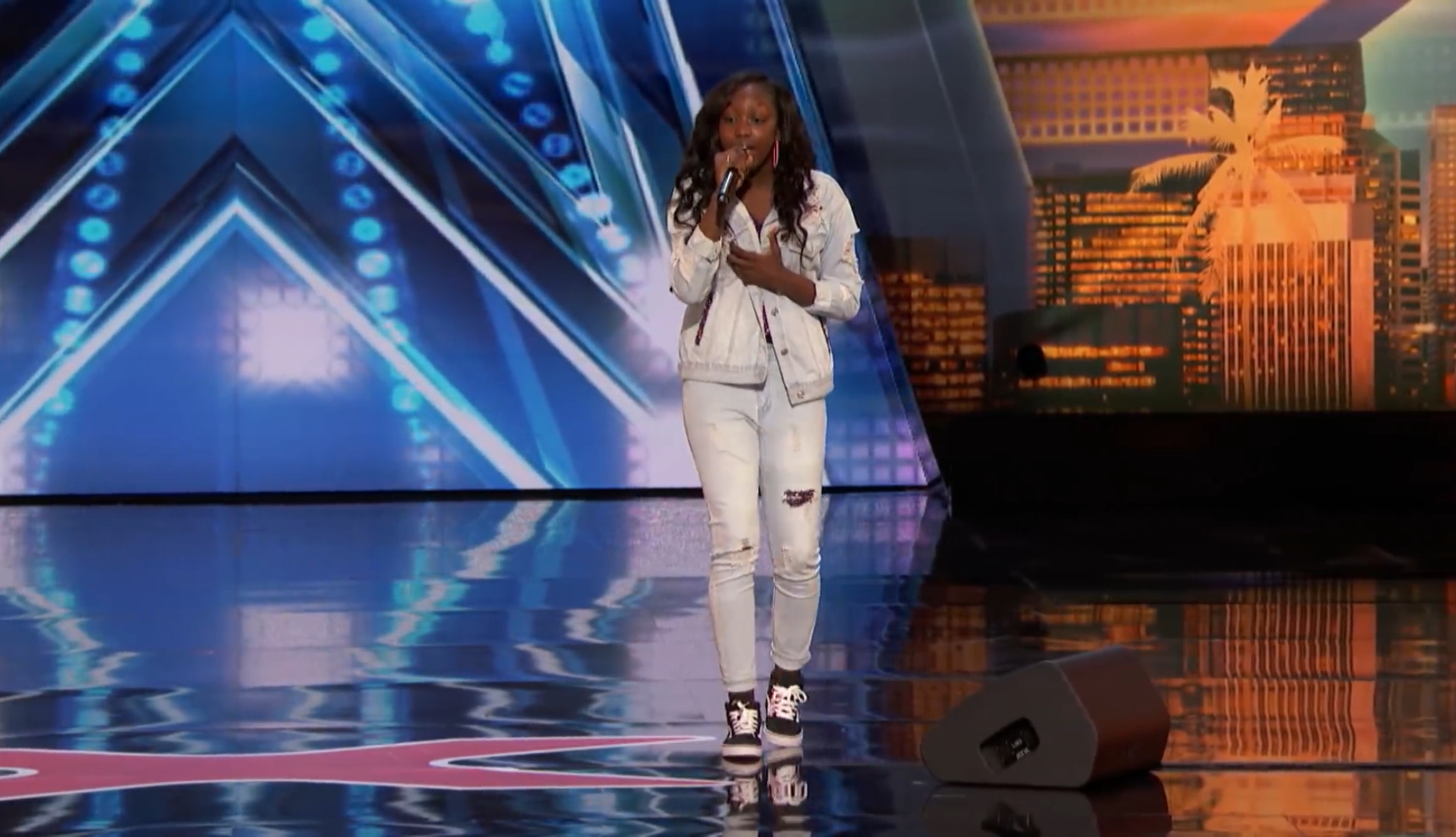
At just fourteen years old, Flau’jae walked onto the America’s Got Talent stage carrying more than a backpack and a mic — she carried a legacy. Growing up in Savannah, Georgia, she knew the outlines of a story most kids don’t: a father who loved rap and lyricism, a man who dreamed but never got to see his child perform because he was killed before she was born. That absence shaped her life in quiet, insistent ways. Birthdays arrived with a missing chair at the table; family stories were punctuated by what-ifs rather than punchlines. Yet instead of allowing that loss to make her small, Flau’jae had chosen to make it a reason to grow. She came not simply to compete, but to complete a story her father could never finish — to use the music he loved as a platform for something bigger than fame.
When she introduced her original song, you could feel the temperature in the room change. Original material is always a gamble on a competition stage: it exposes the artist’s rawest self and leaves no safety net of familiarity. For Flau’jae, the gamble was deeply personal. She didn’t hide behind metaphors or dazzle with meaningless bravado; she named the wound plainly. “If you would have put that gun down, then he would have been here right now,” she repeated, each iteration landing not as a catchy hook but as an accusation and a claim of loss. It was a line that refused to be comfortable, that demanded listeners reckon with the human cost of violence.
From the first bar, she proved she wasn’t merely mimicking trends from social media. Her flow was tight and deliberate, punctuated by confident switches in cadence and emphasis that made clear she understood rhythm as storytelling. She moved across the stage with the kind of presence that belied her youth, locking eyes with the crowd as if speaking directly to the people whose choices ripple outward. Small technical moments stood out: a rapid-fire cluster of internal rhymes that snapped cleanly into place, a sudden quiet on a vulnerable line so the words could hang heavy, and a controlled shout on the chorus that turned personal grief into collective protest. Each choice felt purposeful, as though she had considered not just how the line sounded but how it would land in someone’s chest.
Structurally, the song unfolded like a conversation. The verses painted intimate vignettes — imagined scenes of a father helping with homework, of first steps and shared jokes that never happened — while the chorus widened the lens, calling for accountability and change. By folding the personal into the civic, Flau’jae avoided sentimentality and created urgency. This was not melodrama: it was testimony. Listeners who had lost someone senselessly could see themselves in her lines; listeners weary of headlines about shootings could hear the human face behind statistics. That balance is rare, especially from a teenager, and it was what made the piece resonate beyond a single performance.
The reaction in the theater reflected this layered impact. Judges weren’t just responding to skill; they were responding to moral clarity delivered with command. Heidi Klum, clearly moved, praised the song’s honesty and directness, pointing out how rare it is to see someone so young speak with such blunt truth. Her gesture — a hand to her chest, eyes glistening — made it obvious this was more than another audition. Simon Cowell, who often frames feedback through marketability, surprised the room by calling Flau’jae’s act his favorite audition by a wide margin, acknowledging the raw talent and the potential for a serious career. When industry-savvy judges use language like that, it signals both artistic respect and real-world possibility.
The four unanimous “yes” votes she received felt like validation, but they were more than a pass to the next round. They were a public acknowledgment that stories like hers deserve amplification. In the days after the audition aired, clips of her performance circulated online not simply because she was skilled, but because she used the platform responsibly — turning inherited trauma into a call for awareness rather than spectacle. Educators, community organizers, and parents pointed to her performance as an example of how young people can channel grief into activism and art, and fans lauded her for addressing a painful truth without easy answers.
Backstage, the veneer of composure cracked just a little. In a small exhale and the briefest of smiles, Flau’jae looked like a kid who had been both seen and heard. For her, the yeses meant more than progress in a television competition; they meant that her father’s absence had been acknowledged in a way that felt meaningful. She wasn’t just advancing in a show — she was making a plea through her craft: to listen harder, to question the choices that lead to irreversible loss, and to imagine a different path forward.
At fourteen, Flau’jae reminded everyone watching that youth and pain can coexist with wisdom and resolve. Her rap was more than technically impressive; it was a plea wrapped in rhythm, a plea articulated by someone who converted inherited grief into a platform for change. In doing so, she signaled a powerful truth: the next generation doesn’t only want to be heard for its talent — it wants to be taken seriously for its message.