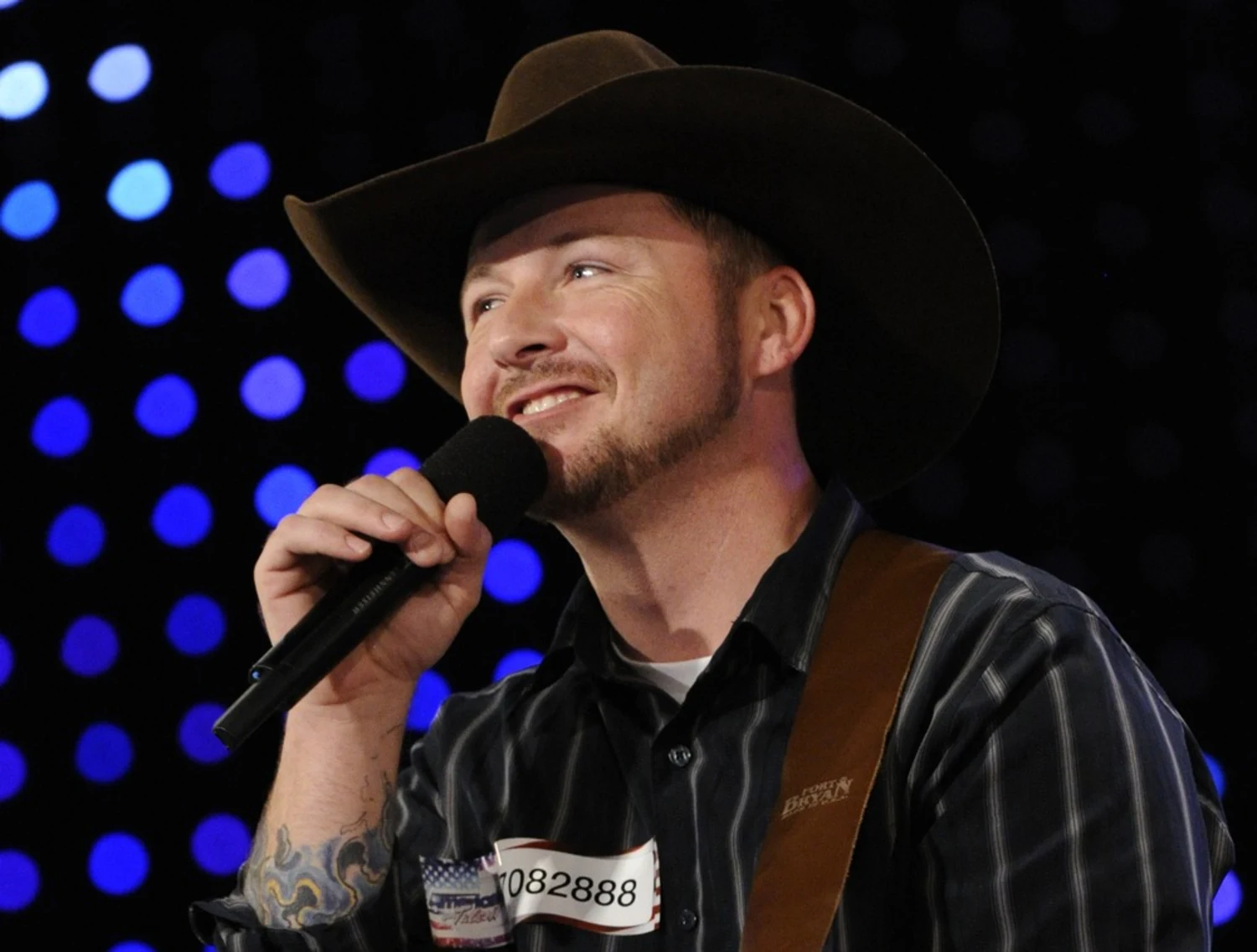
The audition by Tim Poe on America’s Got Talent is one of those rare moments that stays with you long after the screen goes dark. Tim, a U.S. military veteran, walked onto that stage carrying more than a microphone and a song—he carried a lifetime of service, a traumatic injury, and the quiet weight of a voice that hadn’t always been able to speak the way he wanted. After fourteen years in the military, his life was forever changed in 2009 in Afghanistan, when a grenade detonated while he was trying to shield his team. The blast broke his back and caused a severe brain injury that left him with a persistent stutter. Yet what unfolded over the next few minutes showed, in the most human way, how resilience and art can work together to heal.
From the moment he began speaking to the judges, you could see a certain tension: the hesitant starts, the careful pauses, the visible effort it took to get words out. Each sentence felt like it mattered—because it did. Tim shared his story plainly and without flourish: the years of service, that decisive day in combat, the long road of recovery that followed. He spoke about therapy, about relearning how to do things many of us take for granted. Small details made the narrative tangible—how his pathologist suggested singing as a therapeutic tool, how he first discovered that melody and rhythm bypassed the blockage that his speech sometimes hit. These quiet specifics made his story feel immediate and real, not like a tale told for sympathy but like a life told plainly.
Then he sang. He chose “If Tomorrow Never Comes,” a song whose lyrics about love, regret, and urgency felt especially fitting. What happened in the transition from talking to singing was almost cinematic: the stutter that had been so present during his speech faded, and his voice opened into a smooth, soulful quality. It wasn’t full of flashy runs or attention-seeking theatrics—Tim’s singing was direct and heartfelt. There was a grain to his tone that suggested both vulnerability and strength, a timbre shaped by experience rather than technique. When he hit certain phrases, you could tell he wasn’t merely reciting notes; he was telling a story, transforming those lines into something only he could bring to life.
The contrast between his speech and song created a kind of hush in the room. Judges and audience members leaned in, not because of any showmanship but because of the sheer honesty of the performance. Howard Stern and the other judges reacted not just to the vocal quality but to what that singing represented: a breakthrough, a reclamation of voice. Their unanimous “yes” felt less like a stamp of approval for a contestant and more like an affirmation of the man who had walked onto that stage—someone who had faced unimaginable adversity and found a new way to communicate and connect.
There’s something deeply moving about seeing therapy take such a triumphant form. Tim explained that it was his speech therapist who first encouraged him to try singing, giving him exercises and songs to practice that would work around the neural pathways affected by his injury. The idea that music could be a bridge for him—turning something that had been a source of frustration into a strength—adds another layer to the performance. It’s a concrete example of how creative therapies can change lives, not in some abstract way, but in everyday interactions: telling a joke to a friend, reading a bedtime story to a child, expressing love more clearly because a melody makes the words flow.
Watching the clip, it’s impossible not to feel inspired by the humility of his delivery. Tim didn’t seek to impress with vocal acrobatics; instead he relied on the truth in the lyrics and the sincerity of his tone. That restraint made the performance more powerful. You could imagine veterans watching and nodding at the familiar cadence of survival stories; family members wiping tears as they recognized the quiet pride of someone who’s fought to rebuild a life; strangers moved simply by a human being reaching through the noise to be heard.
The viral nature of the audition speaks to something broader than talent show spectacle. It’s viral because it captures a tiny, pivotal moment of transformation—the exact second a person rediscovers a part of themselves and shares it openly. It’s a reminder that healing isn’t always dramatic; sometimes it’s a single song that lets a person step into the light. For many viewers, Tim’s performance wasn’t just entertainment. It was proof that art can be a pathway to recovery and that courage can take many forms, from running toward danger to standing under a spotlight and trusting your own voice.
In the end, Tim Poe’s audition is memorable because it is deeply human. It celebrates resilience, honors sacrifice, and shows how something as simple as a melody can change the shape of how someone expresses love, pain, and hope. If anything, it reassures us that even after trauma, people can find new ways to connect—and that sometimes, the most powerful performances are the ones where honesty and heart lead the way.