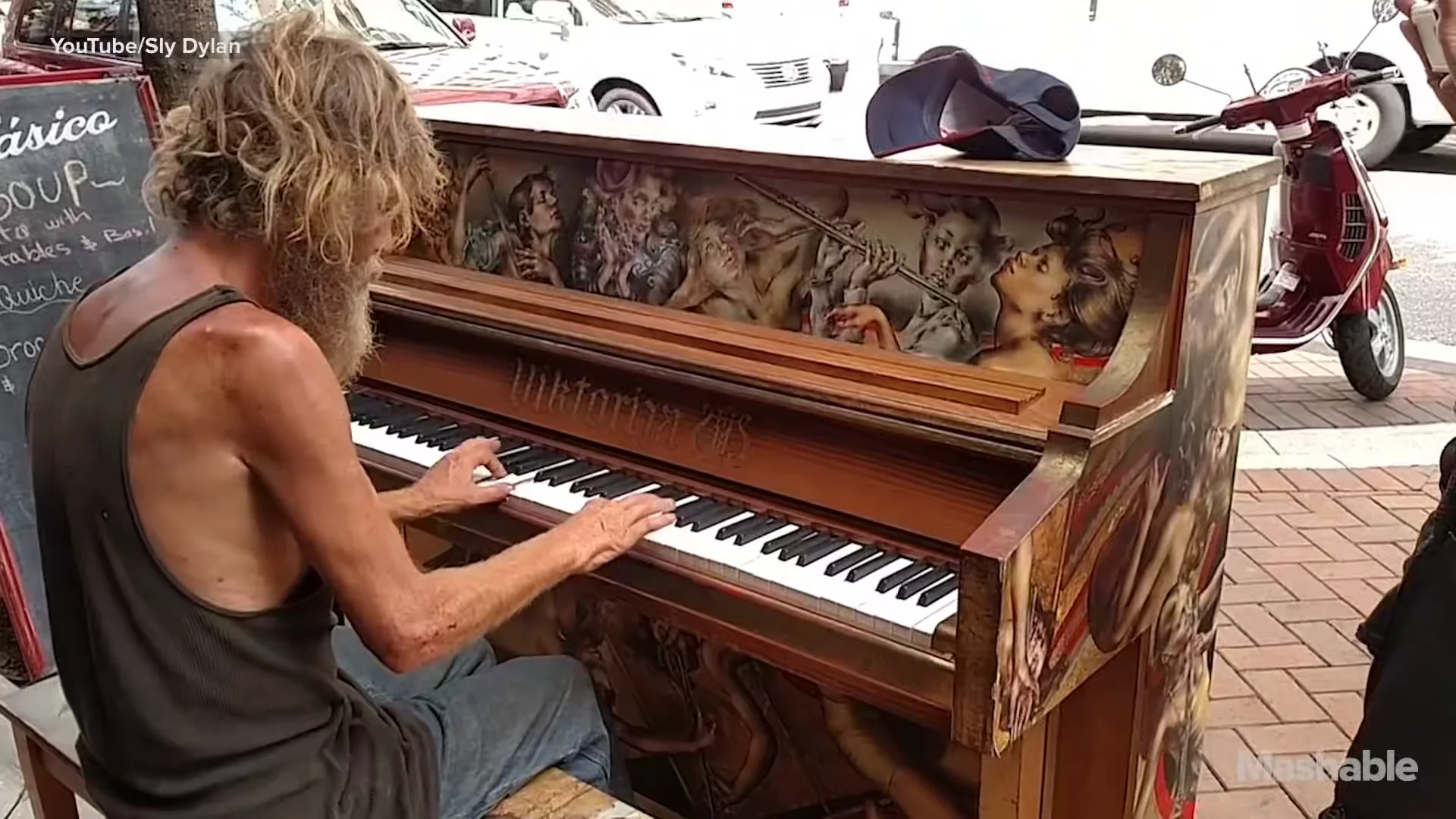
In the heart of Sarasota, Florida, a simple piano on the street has become the backdrop for an unexpectedly powerful story. Residents have been stopping in their tracks to listen to Donald Gould, a 51-year-old Marine veteran who, despite living on the streets, fills the air with music that sounds as if it belongs in a concert hall. The contrast between the worn benches and the graceful lines of a familiar melody makes the scene feel almost cinematic: a man who has known both discipline and hardship coaxing beauty from an instrument in the middle of everyday life.
Gould’s connection to the piano began long before he found himself without a home. He learned to play as a child, fingers taught to find patterns across the keys, and that early training followed him into adulthood. At one point he pursued formal studies in music education at Spring Arbor University in Michigan, immersing himself in theory and technique. Those years of study are evident when he sits down and begins to play — there’s a confidence in the way he phrases a line or eases into a chord progression that comes from rigorous practice, not just raw talent.
Life, however, took a difficult turn after the death of his wife in 1998. The loss was devastating, and in the years that followed Gould struggled with substance abuse as he tried to cope with grief. It’s a sadly familiar arc: an intense personal loss, some faltering attempts to manage the pain, and the kind of downward slide that can leave even the most capable people vulnerable. Over time those struggles contributed to him becoming homeless, and yet, even amid instability, the piano remained a refuge — a place where he could express what words could not.
When people first hear Gould play on the sidewalk, many are surprised by the depth and clarity of his sound. He doesn’t simply pick out tunes; he interprets them. Whether it’s a gentle ballad or a more upbeat standard, his touch on the keys carries nuance: small rubato moments that breathe life into a phrase, a warm tone on the lower registers that grounds the melody, careful dynamics that make crescendos feel inevitable rather than forced. For passersby, it’s easy to imagine a lifetime of lessons and late-night practices behind those gestures.
The scenes that have unfolded around Gould and the street piano are quietly moving. A morning commuter might pause, coffee in hand, watching as his fingers move across the keys; a group of teenagers on their way to class may slow down, pulled by curiosity, and find themselves standing still for an entire piece. Sometimes children wander close, entranced by the clinking of the notes, their faces open and unguarded. Others drop a few dollars into an open case or shout encouragement between songs. The reactions are small but sincere — smiles, a ripple of applause, the occasional request for a favorite tune.
Local residents and business owners have also taken notice. For some, hearing Gould play has become a highlight of the day, a reminder of the unexpected humanity you can encounter walking down a familiar street. A café owner might step out to offer a bottled water; an older neighbor might bring a blanket on a chilly morning so he can sit more comfortably between sets. These gestures don’t erase the larger problems he faces, but they do create small islands of care and recognition. In communities, music often functions as a bridge — an accessible language that connects people across economic and social lines — and Gould’s performances seem to do exactly that.
There are also more practical responses blooming from the attention Gould has received. People who hear him play and learn his backstory have in some cases tried to help more tangibly, connecting him with shelter resources or offering to help with medical appointments. Others have shared videos online, amplifying his story to wider audiences and prompting conversations about how communities support veterans and people struggling with addiction. The surge of interest is complicated — fame can be fleeting and attention can sometimes feel exploitative — but for many it has been a catalyst for goodwill and for conversations about longer-term assistance.
Most striking, perhaps, is the way music seems to center Gould. When he plays, there’s a quiet dignity in his posture and focus that suggests the piano is more than a way to earn spare change; it’s a reminder of identity, of a skilled and sensitive human being who once walked a very different path. His music creates a pause in people’s days, a small sanctuary where listeners can feel something profound without a lot of fanfare.
Donald Gould’s story is, in many ways, emblematic of larger societal challenges: the intersections of grief, mental health, substance abuse, and homelessness, particularly for veterans. Yet it’s also a story about resilience and the redemptive power of art. In Sarasota, the street piano has become a place where lives briefly align — the tired, the curious, the compassionate — and where someone who has been overlooked can, for a few minutes at a time, reclaim a sense of purpose through song.