
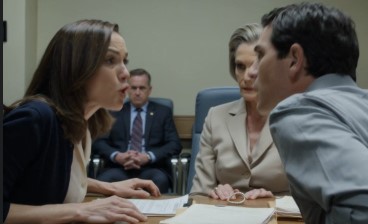
“You were never pregnant.”
My mother-in-law said it in front of the hospital ethics committee while my husband stared at the floor.
Then a nurse placed two newborn bracelets on the table.
Both carried my name.
My name is Claire Dawson. I’m thirty-nine, and I live in Knoxville, Tennessee.
For eleven years, my husband, Andrew, and I tried to have a child.
There were appointments.
Procedures.
Losses I could barely speak about.
Each time, Andrew held me and promised we would keep trying.
His mother, Margaret, was less kind.
She called me “fragile.”
She told relatives I was obsessed with motherhood.
Once, at Thanksgiving, she said Andrew deserved a wife who could give him a family.
I cried in the bathroom while he pretended not to hear.
Then, last year, I finally became pregnant.
The doctor called it a miracle.
I carried our daughter for thirty-four weeks before severe complications sent me to the hospital.
Everything happened fast.
Bright lights.
Rushing nurses.
Andrew’s hand slipping from mine as they pushed me into surgery.
When I woke, my stomach was empty.
Andrew sat beside my bed with red eyes.
He told me our baby had died.
He said she had lived only nine minutes.
I begged to see her.
He said it was too late.
Margaret arranged the cremation before I left the hospital.
There was no funeral.
Only a tiny white urn she refused to let me hold.
Afterward, I stopped sleeping.
I heard babies crying in grocery stores and had to leave.
I kept the blue hospital blanket beside my bed even though Andrew told me it was unhealthy.
Then, six months later, a hospital nurse called me.
She asked whether I had ever requested copies of my delivery records.
I said no.
Her voice became quiet.
“You need to come here.”
The meeting took place in a windowless hospital conference room.
A long table stood beneath harsh fluorescent lights.
Andrew sat on one side.
Margaret sat beside him.
The hospital lawyer and two ethics officers sat across from us.
A nurse named Elena entered carrying a sealed file.
Andrew would not look at me.
The lawyer began carefully.
“Mrs. Dawson, there are serious inconsistencies in your medical record.”
Margaret folded her arms.
“This is unnecessary.”
I turned to her.
“What did you do?”
She gave me a cold smile.
“You need to accept that there was never a viable child.”
My heart stopped.
“You told me she died.”
Andrew finally spoke.
“Claire, please stay calm.”
“Do not tell me to stay calm.”
The nurse opened the file.
Inside were two newborn identification bracelets.
One read BABY GIRL DAWSON.
The other read BABY GIRL MILLER.
Both had my medical record number.
The ethics officer looked at Andrew.
“Why did you authorize a transfer under another family’s name?”
My husband’s face collapsed.
Margaret answered for him.
“It was the only sensible choice.”
I stood.
“What choice?”
She looked directly at me.
“You were unstable. Andrew was exhausted. That child needed a proper home.”
The room seemed to tilt.
I gripped the table.
“You gave my daughter away?”
Andrew covered his face.
Margaret remained perfectly still.
“You would have ruined all three of your lives.”
The nurse placed a photograph beside the bracelets.
It showed a premature baby inside an incubator.
Alive.
A handwritten note on the back read:
TRANSFER APPROVED BY FATHER.
I looked at Andrew.
“Where is she?”
Before he could answer, the conference-room door opened.
A social worker stepped inside holding a court order and a recent photograph of a smiling little girl.
She placed it in front of me and said, “Your daughter has been living twelve miles from your home, and the woman raising her is—”
👇👇 Part 2 in the comments👇👇
=== PART 2 — goes in the comments ===
“—Margaret’s niece, Rachel.”
I stared at my mother-in-law.
Rachel had visited us twice after the birth.
She brought casseroles.
She hugged me while I cried.
And all that time, she had my daughter.
The social worker explained everything.
My baby had survived.
She needed weeks of neonatal care, but doctors expected a full recovery.
While I was unconscious, Andrew signed temporary guardianship papers.
Margaret then altered the transfer documents to make it appear that another family’s baby had entered the neonatal unit.
Rachel took my daughter home after discharge.
The hospital discovered the truth when Nurse Elena noticed that two bracelets shared the same record number.
Andrew began crying.
“My mother said you would never recover.”
“You let me mourn a living child.”
“I was afraid.”
“You watched me hold an empty urn.”
Margaret stood.
“That baby was better off.”
The social worker placed the court order between us.
“No. She was taken through fraud.”
The urn had contained no ashes.
The cremation papers were fake.
Rachel had recently learned that I believed my daughter was dead.
She immediately contacted the hospital and agreed to cooperate.
She had been told I surrendered the baby after a breakdown.
The court granted me emergency visitation that afternoon.
Andrew and Margaret were removed from the room by investigators.
Both were later charged with fraud, falsifying medical records, and custodial interference.
Andrew pleaded guilty.
Margaret did not.
The evidence was overwhelming.
She lost her nursing license and received a prison sentence.
Andrew and I divorced.
He was denied custody and allowed only supervised contact after counseling.
Rachel returned my daughter voluntarily and helped make the transition gentle.
Her name was Lily.
She was seven months old when I held her for the first time.
She touched my face and stared at me as if she already knew me.
I cried into her hair until the social worker brought me tissues.
Months later, the court gave me full legal and physical custody.
Lily now sleeps in the room I prepared before she was born.
The white urn is gone.
So is every lie that kept us apart.
They told me my daughter had lived for nine minutes.
The truth is that she was waiting twelve miles away for me to find her.