When Kodi Lee walked onto the stage, he didn’t stride with the practiced swagger of a seasoned performer or pause for dramatic effect. He moved with the gentle certainty of someone who trusts the steady hand of the person beside him. His mother, Tina, guided him to the piano with a familiarity that spoke of years of small rituals: the way she steadied his arm, the soft exchange of a look as she helped him find the right seat, the quiet reassurance in her voice that said, We’re together in this. That intimacy — a mother helping her son into position on one of television’s largest stages — set a tone that felt private and sacred even amid bright lights and a roaring crowd.
Before he played a single note, Tina shared a few heartfelt words about Kodi’s early relationship with music. She spoke of the way his whole face would light up when a tune caught him as a child, how those spontaneous moments of song had reduced her to tears, and how she’d learned that his humming was more than a habit; it was his way of reaching out, communicating a feeling words couldn’t hold. Those few sentences were more than backstory — they were an invitation to listen not just with ears, but with empathy. The audience quieted, sensing that what they were about to witness might be different from a typical audition.
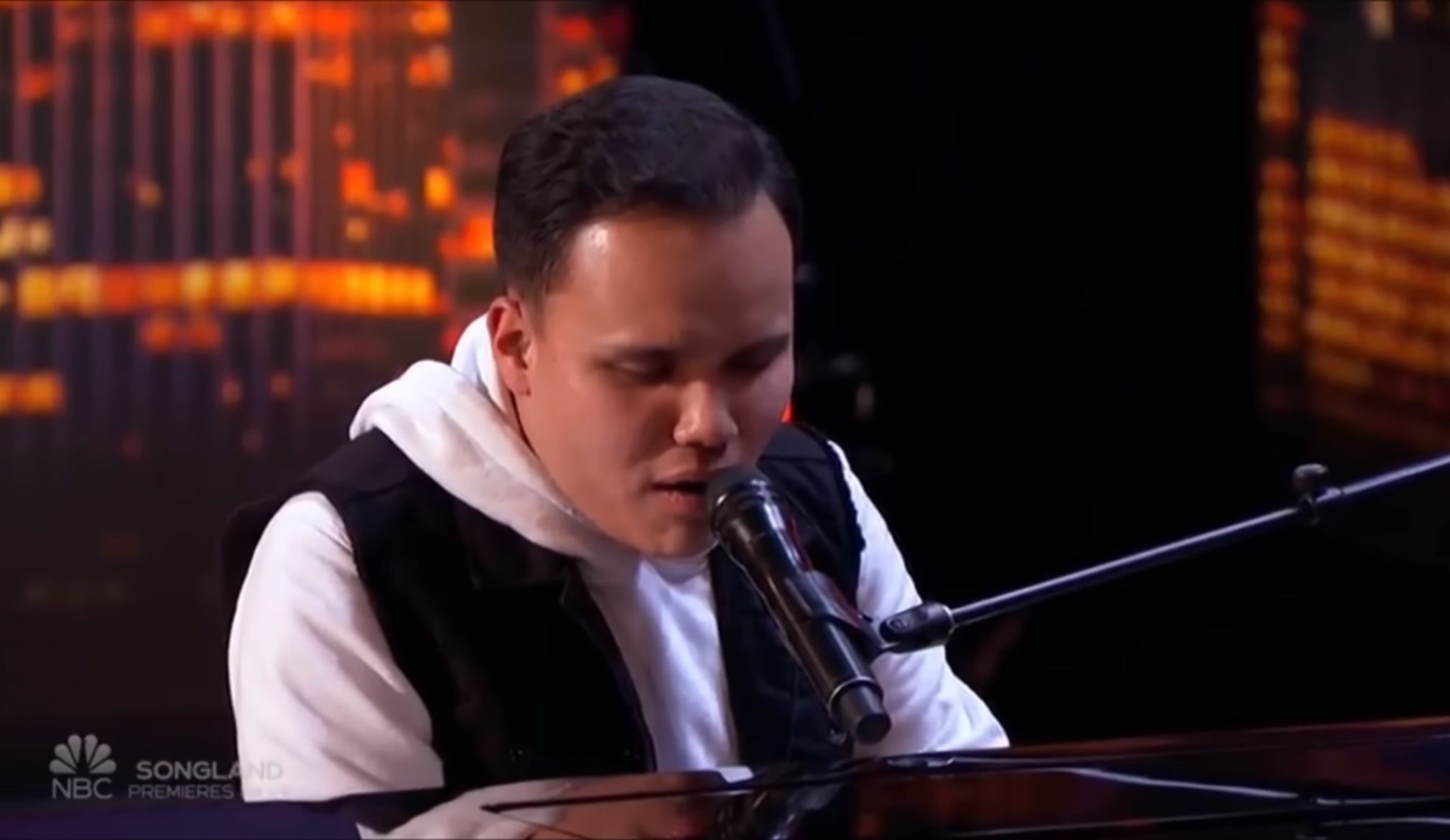
Kodi sat down, placed his hands on the keys, and began to play “A Song for You.” The choice felt instantly right: a tender, timeless composition that offers room for both technical skill and raw emotional expression. From the opening chord, the theatre slipped into a hush the way rooms do when people realize they’re on the verge of seeing something rare. Kodi’s touch on the piano was confident and expressive; he shaped phrases with an intuitive sense of timing, pushing and pulling the tempo in ways that gave each line a living, breathing contour. It was piano playing that suggested not only practice but feeling — an understanding of where to linger and where to let a chord fall away.
Then he sang, and the voice that emerged was at once powerful and wounded, seasoned beyond what you might expect for a young man. There was richness and control in the lower register, clarity and fragile vulnerability in the higher notes, and through it all, a sincerity that made each lyric land like a personal confession. Kodi didn’t lean on flashy runs or theatrical showmanship; he allowed the melody and the story to do the work. Small decisions — the way he held a sustained note just a fraction longer, the slight tremor that made a phrase crack with feeling — became the emotional punctuation of the performance. Listeners found themselves leaning in, not to catch every syllable, but because it felt like someone was translating a whole life into sound.
Judges and audience alike watched with a mix of disbelief, admiration, and a kind of tender protectiveness. Julianne Hough, still new to the panel, sat clearly moved, searching for words as Kodi unfurled the song’s quiet power. Gabrielle Union, visibly emotional, later explained that as a new mother she felt an immediate protective instinct — a response that underscored how Kodi’s music tapped into universal feelings of love and care. Even Simon Cowell, whose reactions are often clipped and calculating, was unable to hide how deeply the performance affected him. What began as polite attention shifted into full, palpable adoration as Kodi navigated the song’s crescendos and intimate low points.
When the final chord faded, the room seemed to hold its breath for a single, suspended moment before erupting into a thunderous standing ovation. People rose to their feet, clapping and cheering with an enthusiasm that felt almost parental. Tears were common in the crowd — some people openly wept, others sniffed and smiled through damp cheeks — and many reached for their phones, knowing they had just seen something they wanted to remember. Backstage, the energy was equally intense: crew members exchanged looks of astonished pride, and friends and family embraced with a mixture of relief and exhilaration.
Gabrielle Union’s response crystallized that rush of feeling. Without hesitation, she stepped forward and pressed the Golden Buzzer, an act that read like an instinctive, urgent offering rather than a trained flourish. Confetti exploded, and Kodi — steadied by Tina’s presence — experienced a public, overwhelming affirmation that shot him straight through to the live shows. That single press felt like a punctuation mark: not just approval of a great audition but a recognition of a human being whose talent had moved people to their core.
Beyond the award and the viral clips, Kodi’s audition mattered because it reminded viewers of music’s unique ability to cross boundaries. Here was an artist who was blind and autistic, yet able to reach across difference and connect with strangers through something older and more primal than words. His performance challenged assumptions about disability and artistry and about who gets to stand in the center of a stage and claim it as their own. In the end, Kodi Lee’s moment at the piano was more than an audition; it was a testament to the grace of vulnerability, the force of unconditional support, and the way a single song can alter the course of a life and the hearts of everyone listening.