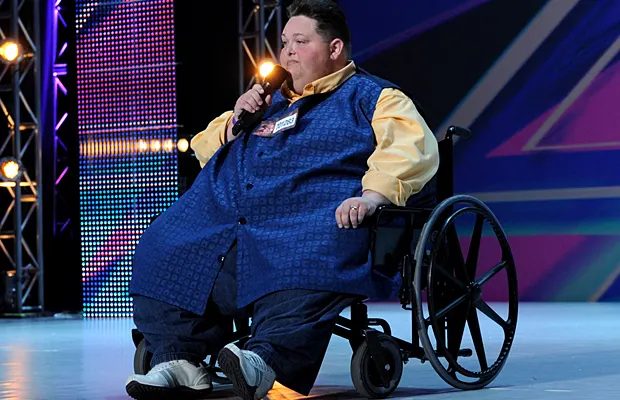
Freddie Combs walked onto the X Factor USA stage as if the lights themselves were a kind of benediction. At 40 years old, the minister from Greensboro, North Carolina, carried with him a story that reached far beyond the notes he would sing. He hadn’t simply rehearsed a song — he was offering a testimony. Not long ago he had been confined to a bed, his world narrowed to a few square feet, routine care, and the slow tick of days marked by pain and frustration. Once tipping the scales at 920 pounds, Freddie’s life had been limited to the narrow boundaries of his home and the routines that kept him alive each day. The decision to reclaim his health wasn’t a single heroic leap; it was a series of small, stubborn steps taken over months and years. Those incremental changes — choosing water over soda, learning to stand with support, keeping appointments with doctors and therapists — added up to a 400-pound loss and the physical strength to appear onstage in a wheelchair, ready to share his voice.
There was an intimacy to how Freddie took his place at the microphone. He settled in with the kind of calm a preacher has after years of leading a congregation, his hands resting lightly as if feeling the space around him. Before he sang, he dedicated his performance to his wife, Kay, the woman he called his rock. He explained, simply and plainly, that she had stayed by his side through the darkest chapters: during nights when he couldn’t leave the bed, through the grueling appointments and painful adjustments, and through the tedious work of rebuilding daily life. That dedication reframed the song from an individual triumph into a testimony of partnership and collective endurance.
Freddie chose Bette Midler’s “Wind Beneath My Wings,” a song often given to solemn tribute but rarely infused with the lived texture of survival. From the opening lines, his tenor was smooth and warm, a voice honed by sermons and church choirs as much as by practice. He honored the phrasing, letting each emotional crest and valley breathe, and his delivery bore the kind of authenticity that comes from having something real at stake. When he sang, “Did you ever know that you’re my hero?” it wasn’t a line meant to charm; it was a plain, aching truth, aimed straight at the woman who had carried him through. Small details amplified this authenticity: a slight catch before a high note that suggested memory and gratitude, the way he softened a phrase to let the words hang in the air, and the controlled swell of volume that turned a personal thank-you into a shared moment.
The audience responded as stories like Freddie’s tend to elicit — not with sensationalism, but with a steady, growing empathy. People who had come expecting spectacle found themselves wiping their eyes. You could watch the judges, often trained to mask emotion, shift in their seats as the performance unfolded. Simon Cowell, known for his trenchant assessments, leaned forward and called Freddie’s voice “heavenly,” a word that captured both musical praise and a spiritual recognition. L.A. Reid complimented the act as “refreshing,” emphasizing that what he heard was not simply vocal talent but the kind of authenticity that makes music matter. Their comments landed like confirmation that Freddie’s story and his sound were equally compelling.
Freddie’s transformation was not a tidy montage of gym sessions and quick fixes. It involved logistical hurdles — arranging transportation to appointments, coordinating care, learning new ways to move — and emotional ones: confronting the shame and isolation that had built up over years, answering hard questions from doctors and loved ones, and relearning how to trust his body. Kay’s role was multifaceted: she was emotional ballast, logistical coordinator, and co-conspirator in small daily victories. Friends from his church and community pitched in, driving him to therapy, preparing meals that fit his new dietary needs, and offering encouragement on the days when progress felt painfully slow. That web of practical help and steady faith turned abstract goals into achievable steps.
What made Freddie’s audition resonate so widely was how it linked the personal to the universal. Many people recognize, even if only dimly, the person who has carried them through hard times — a partner, a parent, a friend. Freddie’s tribute to Kay tapped into that shared human ledger of gratitude, and his performance became a mirror in which others could see their own quiet debts reflected. The applause that followed the final note felt less like a verdict and more like a collective embrace, an acknowledgement of the work it takes to heal and the courage needed to stand exposed before the world.
When the judges returned their verdicts, the four enthusiastic “Yes” votes seemed inevitable. Freddie would move forward in the competition, but he had already won something deeper: the respect and admiration of people who had witnessed his story unfold in minutes. He left the stage having changed the room’s atmosphere, having offered hope to those who might feel stuck in their own struggles, and having honored the quiet, steady love that had helped him rise. For viewers at home, his audition was a reminder that resilience often looks ordinary in the moment-to-moment — a sequence of small choices and the loyalty of others — and that sometimes the most powerful voices are those forged by hardship and held steady by love.